Category

rock and roll

Remembering the New York Dolls: Rock’n’Roll Goes to Camp

By Sandra Canosa

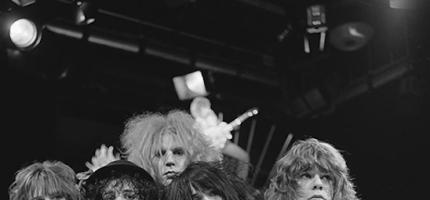
But the Dolls were also tougher, sloppier, and more aggressive than any of those ‘60s rock bands had dared to be, a rambunctious brawl of electric sound that strongly foreshadowed the punk revolution of the later 1970s. Songs like “Looking for a Kiss” and “Trash” dealt with subjects like heroin and drug addiction with an almost perverse nonchalance; watching them perform live, as Nick Kent described it, was “almost as if Donny Osmond ditched his brothers, started taking downers and grew fangs, picked up with a bunch of heavy-duty characters down off 42nd Street and started writing songs on topics like premature ejaculation.”

The Wild, the Innocent, and the E Street Paradox: Bruce Springsteen and Sincerity

By Sandra Canosa

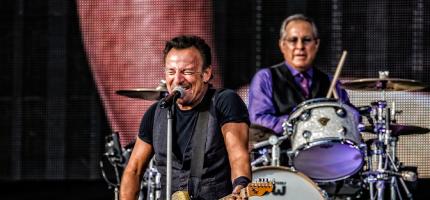
But Springsteen is of course no schoolchild, and no stranger to the tradition of the protest song. He openly idolizes Guthrie, and in the early days of his career was often billed as “The New Bob Dylan.” His rendition of “This Land Is Your Land” contains all the original verses, and it’s slow, grisly, and obviously pained. He knows it’s no patriotic celebration song. So what kind of promises are we talking about here? Surely it’s not the promise of a long and well-populated line for the government dole.

Can Music Survive Without the Teenybopper Fangirl?

By Sandra Canosa

To an outsider, the gathering of Beliebers in such large proportions can be dizzying, if not downright menacing: strange words to ascribe mostly prepubescent girls in the awkward middle stages of growth spurts, hormonal changes, and corrective braces and eyewear. But the apparent strength of their allegiance to Justin – whose music and lyrics are mostly innocuous, if not downright dumb, to most grown adults or “serious” music fans – is what is most disorienting. The communal desires, the vast groupthink, and the worship of a (false?) idol smells of blind consumerism at best and fascism at worst. 

Simple As This: Is Jake Bugg the New Bob Dylan?

By Melinda Parks

To see him play live, you would hardly know that Jake Bugg is just a kid. Feet planted before the microphone, head bobbing up and down to the rhythm of his guitar strumming, he exudes the subdued confidence of a more seasoned performer. His voice – distinctively nasal, irresistibly British – carries strongly over the crowd, sounding impressively similar to his studio recordings. He strolls along the edge of the stage at intervals and glances casually about the room, as if to demonstrate just how easily this comes to him. 

Krautrock and the West German Identity

By Sandra Canosa

Tago Mago rages schizophrenically from song to song, from the two-bricks-shy of a pop song “Mushroom” to the sprawling “Halleluhwah” and everything in between. This confusion, this constant search for how best to communicate, is part of the album’s appeal. West Germany and its people had to find new ways to be heard in the world—a nation dismembered, no longer quite German, not yet fully Westernized, and always idling in the Cold War shadows of the Iron Curtain.

Godspeed You! Emperor and the Art of Survival

By John McGovern

When T.S. Eliot wrote, “Mankind cannot bear much reality,” he inadvertently (“post-rock” hadn’t reached Oxford yet) described Montreal-based Godspeed You! Black Emperor’s bombastic sound. The band’s music is classically structured and is often lumped into a genre called “post-rock,” though the band dismisses this as a pretentious term. “Post-rock” is used to describe instrumental groups that include the traditional rock n’ roll instrumentation -- guitar, drums, bass -- but breaks from pop song structures. Instead, post-rock draws from a diverse array of influences, most evidently jazz and classical music. The detached, introspective sound of many “post-rock” bands is nonexistent in Godspeed’s music. 

The High Achievers of Royalty Storm the Music Scene

By Sam Chapin

The Royalty is a hard band to pin down. At times they sound like Vampire Weekend, or else like Marilyn Monroe. They can go from channeling Beach House to the Crystals without taking a breath. They sound like a band straight out of the ‘60s or ‘70s that built a time machine and started listening to St. Vincent and Weezer (two of the band’s major influences). Royalty’s front-lady, Nicole Boudreau, recently spoke with Highbrow Magazine.