Category

civil rights

On Its 50th Anniversary, the Voting Rights Act is Under Attack

By Peniel E. Joseph

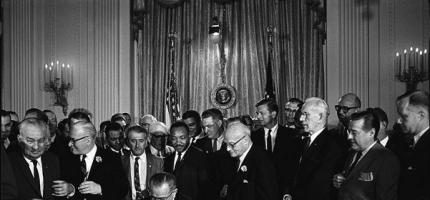
For African Americans, the passage of the Voting Rights Act on Aug. 6, 1965, represented the culmination of a centuries-long struggle for citizenship. President Lyndon Johnson’s signing of the legislation, designed to end a century of voter disfranchisement in the South and other parts of the nation, was inspired by grassroots protests and organizing that gripped the nation. Martin Luther King Jr.’s efforts in Selma, Ala., linked a local campaign for voting rights to a national movement to redefine American democracy.
My Civil Rights Year

By Paul Kleyman

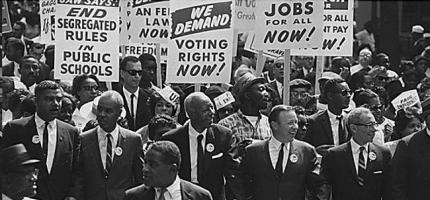
My Selma experience was deeply sensory, staying up all night in the basement of the Brown AME Chapel making coffee for people, moving to the rhythmic speeches and songs in the church sanctuary, crowding into the back of a pickup truck to go to the march after a chilly, pre-dawn rain—and walking 19 miles in tennis shoes (decades before “cross trainers”), only to peal them off in Montgomery and plunge my feet into the happy coolness of red mud.

2014: The Year of the Protester

By Kirsten West Savali

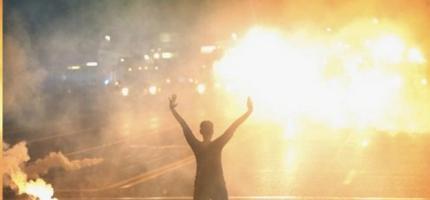
There have been those who have described this as the latest iteration of the civil rights movement, but as Malcolm X taught us, there can be no civil rights until we first have human rights. These protesters understand that the expectation of subdued civility in the face of the continued dehumanization of black life is evidence of the racism that this country was founded upon. 

Attorney Gen. Holder’s Compelling Case in the Brown Killing

By Earl Ofari Hutchinson

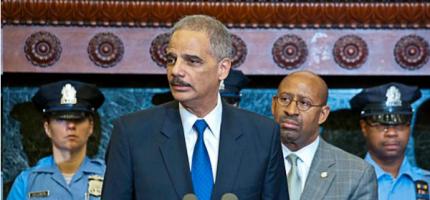
Attorney General Eric Holder has a compelling federal case in the Michael Brown killing if he decides to bring civil rights charges against Ferguson, Missouri cop Darren Wilson. He's certainly taken almost unprecedented lightning fast first steps in that direction. He's got a phalanx of FBI agents assigned to the case. He's authorized an autopsy by a crack medical examiner from the military. 

The Echoes of a Struggle: From South Africa to Brazil

By Cheryl Sterling

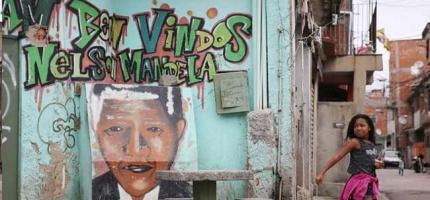
When the Movimento Negro Unificado (United Black Movement) formed in Brazil in 1979, they turned to the anti-apartheid struggle and to Mandela, in particular, for a vision for change and a symbol of empowerment. They looked at the apartheid structure; its separation of the races; the mandatory passes that blacks carried that showed all aspects of their lives; the separation of place and space in social, economic and political spheres, and they concluded that Brazil was an apartheid state.

Farewell Nelson Mandela

By Stephen A. Crockett Jr

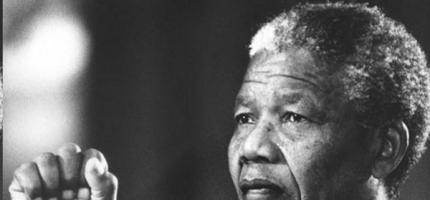
On Thursday Nelson Mandela at approximately 8:50 p.m. left this world in much better shape than he found it. Even the sky is in mourning in Johannesburg as CNN reports, gray rain clouds covering and the area this morning. Children used rocks to spell out "We love you Mandela" in front of his home. Some left stuffed animals, others lit candles and wept. In Soweto township residents gathered around the house where Mandela lived before he was arrested in 1962 and sang freedom songs. Across the nation from D.C. to Los Angeles, flowers and candles were left in front of murals bearing his likeness, CNN reports.

JFK’s Civil Rights Legacy: 50 Years of Myth and Fact

By Earl Ofari Hutchinson

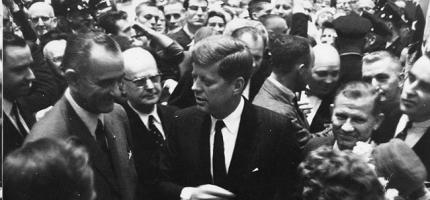
In the decade before he won the White House, Kennedy said almost nothing about civil rights. In 1957, as a senator he voted against the 1957 civil rights bill. His opposition has been spun two ways; one cynical, one charitable. The cynical spin is he opposed it to appease Southern Democrats because he had an eye on a presidential run in 1960. The charitable spin is that he thought the bill was too weak and ineffectual. Three years later though he ignored the angry shouts from Southern Democrats and lobbied for a forceful civil rights plank in the Democratic Party's 1960 platform.

What We Want to Hear From Michelle Obama

By Keli Goff

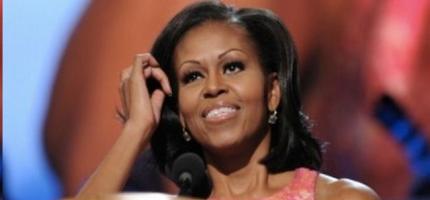
In less than three months, President Barack Obama will celebrate the anniversary of being sworn in for his second term as president. Although many conservatives are looking ahead with anticipation to the end of his final term in office, many liberals are looking ahead with the hope that in his final years as commander in chief, the president might begin pushing a more aggressively progressive agenda. Then there are those of us who are hoping that in the president’s final term, we might get to see the Michelle Obama we haven’t seen since the early days of the 2008 presidential campaign.