


For Australian animator and director Adam Elliot, the art form of stop-frame animation is a battle of inches. Every movement must be meticulous, and every frame must exist independently from one another, yet in the end must come together to create something wholly unique. No frame is disposable. In the art’s stillness and precision, it serves as a mirror for reflection -- as is the case of Elliot’s latest film Memoir of a Snail.
Described as a tragicomedy, Memoir of a Snail tells the story of Grace Pudel, for whom life is a series of mishaps and misfortunes. To survive, one must retreat inward to avoid pain; this instinctual response to hardship shapes her entire journey. When she discovers snails, she instantly relates to their lethargic characteristics and mimics their behavior. To survive, Grace builds a metaphorical shell to protect herself from the harshness of reality. Yet, in her search for safety and comfort, she becomes a prisoner in the life she has constructed for herself.
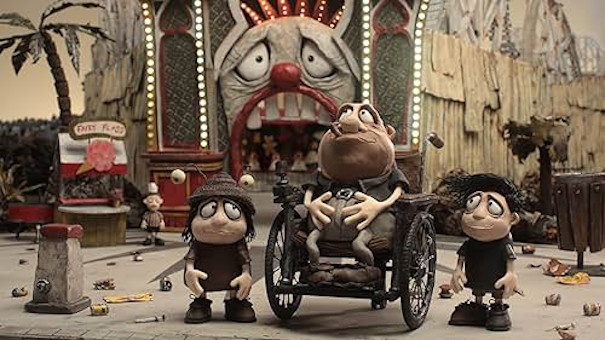
Born in 1970s Melbourne, Grace’s mother died at childbirth, leaving her and her twin brother, Gilbert, under the care of their loving father, Percy, a paraplegic who struggles with alcohol abuse. For Grace, existence is marked by cruelty, and the only comfort she finds is from her family and her fascination with snails, with whom she feels a deep kinship. However, as life takes a few more turns for the worse, Grace retreats further, unwittingly isolating herself from both the world and her true self.
Hollywood has taught American audiences that the art of animated movies is designed for young children. For Elliot, nothing can be further from the truth. Memoir of a Snail explores heavy matters such as depression and identity, all while possessing a raunchy sense of humor, as noted for the excessive amount of clay female breasts. The film’s willingness to explore human sexuality through the precision of stop motion allows Elliot’s vision to feel not only personable, but tangible.

Sarah Snook gives a masterful performance as Grace, navigating the audience through the eyes of a child with low self-esteem. Snook’s deadpan delivery is wonderfully offputting while still maintaining an endearing quality. Her unique, eccentric comic sensibilities allow the character to maintain the innocence of childhood while delivering heart-wrenching dialogue. As Grace grows older, Snook smartly injects a sense of cynicism into Grace that showcases the turmoil and pain the character has endured throughout her life.
Elliot’s portrayal of life's tragedies makes Memoir of a Snail resonate authentically as we witness Grace coming of age. In sorrow, there is beauty, but only for those willing to seek it. At times, this journey can be excruciating, with the screenplay presenting another harrowing moment every few minutes for this young girl. The experience can feel emotionally exhausting, as the film occasionally appears heavy-handed in its emotional reveals. Yet, like life itself, those intense moments eventually fade. By the film's conclusion, Grace fittingly learns to embody her name, offering herself grace and accepting that life is difficult, realizing there’s no need to make it harder on herself.

Author Bio:
Ben Friedman is a contributing writer and film critic at Highbrow Magazine.
For Highbrow Magazine