

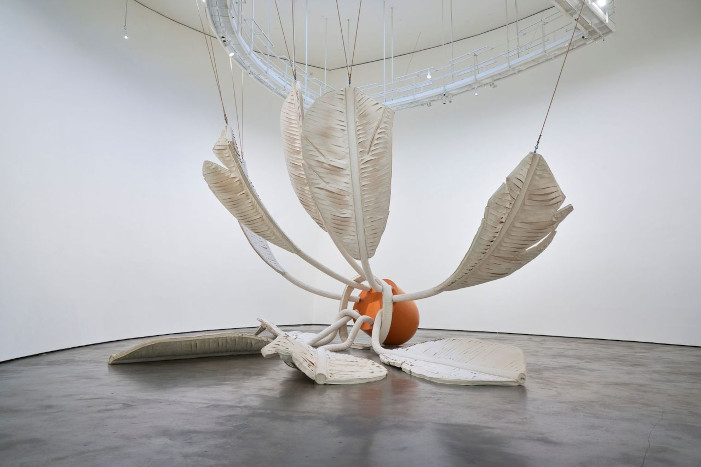
Soft Shuttlecock. Claes Oldenburg and Coosje van Bruggen. Solomon R. Guggenheim Museum, New York Partial gift, Claes Oldenburg and Coosje van Bruggen, New York, 1995
Let’s face it. Pop Art has become as much a part of consumer culture as Coca Cola, iPhones, and the New York Knicks. Even if you’re too young to remember Andy Warhol’s Campbell soup cans or his silkscreens of Marilyn Monroe and Elvis Presley debuting in major museums, you know it’s the kind of art discovered in everyday performance happenings, in found objects transformed into sculptures, in collages filled with newspaper clippings and candy wrappers. It’s about you.
I must confess that I was curious about the role that a venerable institution like the Guggenheim Museum played in Pop Art’s evolution. It was their former curator, Lawrence Alloway, who introduced Pop Art to American audiences through the 1963 exhibition Six Painters and the Object, laying claim to the name. That was the first institutional presentation of the Pop Art phenomenon in New York.
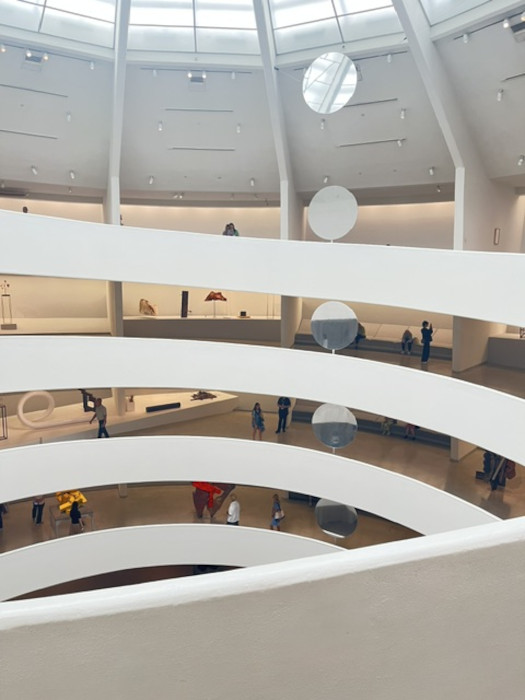
The Guggenheim (photo by Sandra Bertrand)
The current Guggenheim Pop:1960 to Now explores the movement’s enduring influence on artists today, presenting iconic works from the collection. In a lofty introduction to the exhibition, it “elevates the commercial to the sacred, and transforms the banal into the spectacular.” That’s a high order indeed! I can only say what I experienced was a continuing fondness for the commonplace made new.
The first eyepopping surprise was Soft Shuttlecock (1995) by Claes Oldenburg and Coosje van Bruggen. Not seen for 25 years, this gigantic ‘birdie” gives a new perspective on a familiar object. Another Oldenburg offering that displays his early interest in toys is Freighter and Sailboat (1962). This pair of delightful muslin-filled foam rubber objects are to be found suspended on the exhibit room’s wall on the topmost tier of the museum. (The majority of the Pop Art works I encountered were in this upper room, almost as an afterthought to the expansive solo exhibition of Carol Bove’s sculptural assemblages, currently on view.)
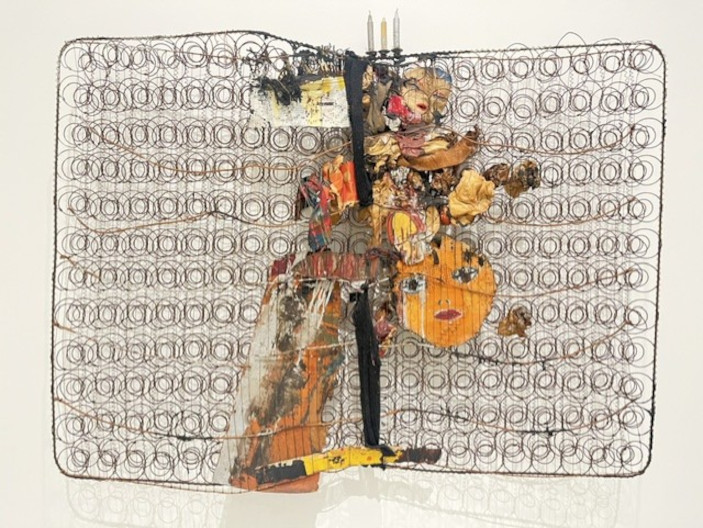
Bedspring. Jim Dine. Solomon R. Guggenheim Museum, New York Purchased with funds contributed by the Louis and Bessie Adler Foundation, Inc., Seymour M. Klein, President, 1985 (photo by Sandra Bertrand)
Jim Dine’s Bedspring (1960) is a perfect example of urban detritus transformed into the perfect three-dimensional Pop Art collage. The artist found his bedspring near Washington Square Park and transformed it into a messy but whimsical compilation of newsprints, burlap, lightbulbs, and so much more.
Dolores James (1962) doesn’t appear to be a moniker for a female acquaintance in John Chamberlain’s welded steel sculpture, but it is a riveting junkyard reassemblage of automobile parts and scrap metal. Running over these parts with his car and even sledgehammering them into submission, he has managed to produce a colorfully abstract piece, a kind of explosive eye candy for the car culture and the rest of us. In May 2012, I had my introduction to his works when the Guggenheim presented a first major retrospective of the artist. It was a dazzling display of scrap metal made beautiful in its afterlife.
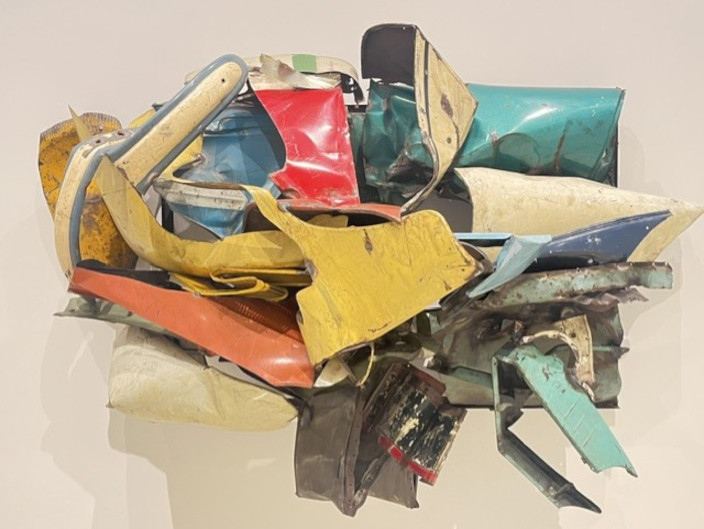
John Chamberlain Dolores James, 1962 Welded and painted steel 72 1/2 x 101 1/2 x 46 1/4 inches (184.2 x 257.8 x 117.5 cm) Solomon R. Guggenheim Museum, New York 70.1925 (photo by Sandra Bertrand)
As Bove’s eclectic sculptures were ever present, I couldn’t help wondering if Chamberlain’s constructions weren’t inspiration to her own minimalist artworks. As visitors wind their way up or down the Guggenheim’s spiral path, Rich Mom (2018) is unmissable. The wall notes suggest its bold stainless-steel construction with red-orange urethane paint, seemingly cuddling a black disk, is reminiscent of the Madonna and Child iconography. If that’s a leap of faith for you, I recommend a light-hearted perspective throughout the journey.
The inclusion of Yayoi Kusama’s works in any exhibit here or abroad is always revelatory. A 1960 example from her patterned monochrome painting series, Infinity Nets, places oil and rice florets in a dense rhythm. She describes these as an attempt to “predict and measure the infinity of the unbounded universe from my own position in it.” It’s a quietly elegant stand-alone piece. Nearby, her Infinity Mirror Room allows viewers a shared three-dimensional immersive experience.
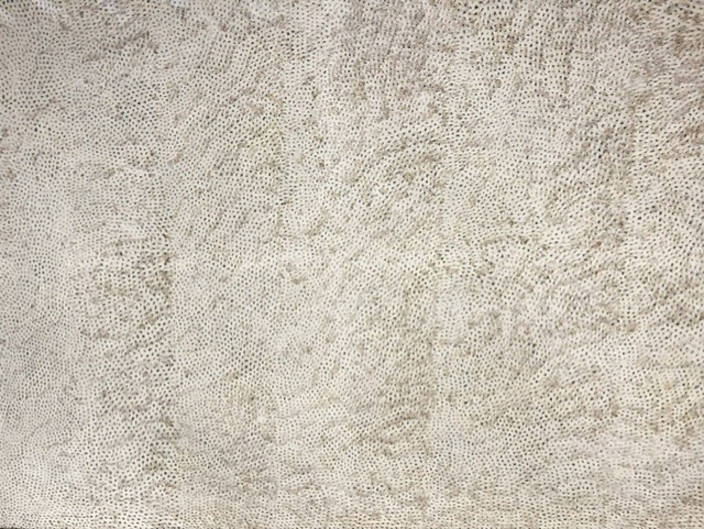
Yayoi Kusama No. 2. J.B., 1960 Oil and rice florets on canvas. Solomon R. Guggenheim Museum, New York Gift, Paula Cooper, 2013 (photo by Sandra Bertrand)
Argentinian-born Marta Minujin exemplifies so many aspects of Pop Art, I was relieved to find her represented in a couple of sketches here -- promotional drawings as part of her proposal to the McDonalds Corporation. A pair of letters, one from the artist and another rejection from the Consumer Affairs Administrator for a formidable if outrageous proposal is worth the read.
Minujin’s edible art would have consisted in the construction of an iron replica of the Statue of Liberty on her side, to be placed in New York’s Battery Park. On the 10th day, McDonald’s employees would ascend firetruck ladders to cover her with hamburger patties, staging a public meal cooked with flamethrowers. Never fearful of repressive governments, one of her earlier exhibits, the Parthenon of Books, was staged in Buenos Aires, comprising more than 20,000 books banned by the military and redistributed to the public at the exhibit’s close.
Another artist on display, featured in this year’s Whitney Biennial, is Martine Guttierrez. Her “Demon of Lust” (2018) shows the artist transforming herself into a mythical figure from indigenous cultures. One of a series, this transformative approach to depicting the self in portraiture was earlier perfected by photographer Cindy Sherman, particularly in her movie still series from 1977-1980.
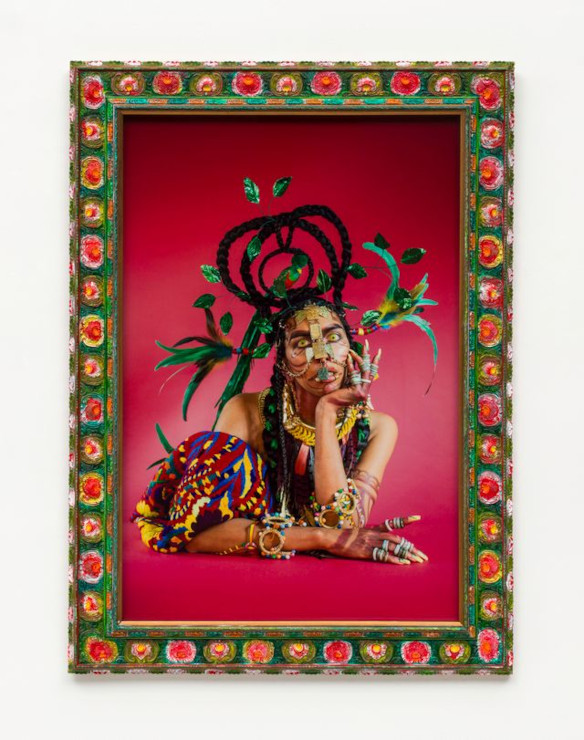
Martine Gutierrez Demons, Chin ‘Demon of Lust’, p93 from Indigenous Woman, 2018. Solomon R. Guggenheim Museum, New York Purchased with funds contributed by the Photography Council, 2021
Visitors will also encounter a piece from Roy Lichtenstein’s “Mirrors and Entablatures” series from the early ‘70s, rarely seen. This was his controversial take on New York architectural details. These silvery discs are starkly visible during your stroll.
If you’re wondering where Warhol is concealed in this mélange, his “Orange Disaster #5” (1963), a grid of silk-screened electric chair photographs, will keep you guessing.
Guggenheim’s version of Pop Art offers a complex array of artists and their diverse and sometimes disturbing sensibilities about the creation of art. It’s worth a concentrated look but the Guggenheim itself is a “happening” in its architectural innovation. It also offers a permanent collection of artworks since its founding that the first-time visitor will not want to miss. Franz Marc’s Yellow Cow from 1911 still puts a lingering smile on my face.
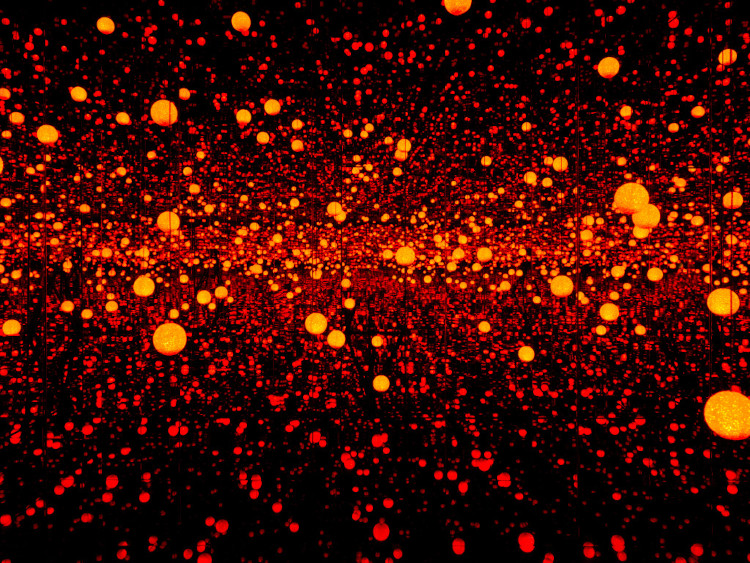
Yayoi Kusama. INFINITY MIRRORED ROOM - DANCING LIGHTS THAT FLEW UP TO THE UNIVERSE, 2019
Guggenheim Pop: 1960 to Now runs through January 10, 2027.
Author Bio:
Sandra Bertrand is Highbrow Magazine’s chief art critic.
For Highbrow Magazine