


Move over, Michael Myers. Stand aside, Freddy Krueger. There is a new horror villain in Hollywood, and he is making Michael and Freddy look friendly by comparison. To call Art the Clown sadistic would be putting it kindly. For Art, killing is an art form and for mainstream horror, he is a provocateur redefining and challenging the boundaries of terror. Whether he is pouring bleach onto his victim’s open wounds or sodomizing one of his victims with a chainsaw – the silent clown has a flair for the juvenile and extreme. Yet, maybe most surprisingly, Art the Clown has become a mainstream sensation amongst horror fans.
Terrifier 3, a film so non-mainstream that it forwent submitting a rating to the Motion Picture Association of America, grossed $18.9 million in its opening weekend – outperforming the other clown in Joker: Folie à Deux in its second weekend of release. The first film was made on a $35,000 budget, and the second installment on a $250,000 budget, whereas this latest installment boasts a $2 million budget and outgrossed both its predecessors in one weekend, proving that there is a longing for the depraved among horror fans. Yet, $18.9 million implies a far greater reach than just horror junkies, suggesting that this movie of a child-killing demon clown has mainstream appeal.
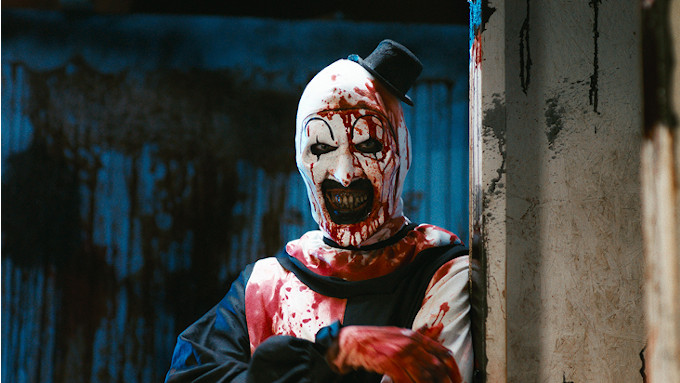
The widening audience for the Terrifier franchise highlights two fascinating trends within media consumption: growing societal desensitization brought on by the absurdity of the political climate, mixed with the consumption of social media, which promotes the sensational. Director Damien Leone continues in the lineage of 1980s low-budget gorefests defined by over-the-top effects, scantily clad women, and plenty of blood. Yet, while Art the Clown seems like a continuation of a bygone era in slasher films, his success is rooted in the age of TikTok consumption, which rewards content that elicits instantaneous gratification.
The rise of TikTok exemplifies changing viewing habits among younger audiences. Sequential narratives are a thing of the past. Why watch eight seasons of House when you could simply watch a two-minute clip of Dr. Gregory House explaining how a family can harvest the lungs of their ill son to save their dying daughter? That's how I consumed television last night—scrolling on TikTok at 11 PM and stumbling upon clips from a show I have never seen, leading to about 10 minutes of random episode compilation with no rhyme or reason placed for continuity. To wash myself clean of the cynicism of Dr. House, I then watched a few clips from the ABC sitcom George Lopez, a show I own on iTunes, yet still preferred to consume in disjointed two-minute snippets.
In defense of the younger generation, while these viewing habits may sound alien, is it all that different than channel surfing cable? Unlike cable, TikTok’s airwave is dictated by an algorithm that tailors viewing habits to the user. Of course, that means the provocative has an easier time of being discovered, which works to the benefit of Leone’s filmmaking approach. While the storytelling of good versus evil may be lost on new audiences, the kill scenes can be viewed as vignettes of shock designed to elicit physical reactions from audiences. In doing so, it allows different avenues for the franchise to be discovered directly and indirectly.
Directly, people will watch the clips from the film, but indirectly, some will watch the clips via watching a reactor react to the clips. In many cases, people will never watch a second of the film but will recognize Art the Clown via memes that go viral on social media. On TikTok, a popular meme that has 4.8 million views shows Art, pasted into an office breakroom acting surprised with a caption that reads, “When management asks who put ‘burn this place down’ in the suggestion box.” David Howard Thorton’s silent but darkly comedic performance as Art the Clown, along with Leone’s visceral direction offers the perfect storm allowing Art the Clown to enter the zeitgeist of pop culture, despite the film’s not so mainstream sensibilities, suggesting that audiences were primed for a movie like Terrifier 3 to come along. In a climate saturated with shock value, both in politics and entertainment, the ascent of Art the Clown becomes emblematic of broader societal trends.

Every few months, a new piece of entertainment will emerge that inevitably begins the discourse of ever-growing violence in the media that threatens the psychological well-being of everyday Americans, especially the youth. Meanwhile, the leaders of America are screaming on television, lying about how Haitian citizens in Springfield, Ohio, are eating the pets. Terrifier 3 is a film that has absolutely no connection to Donald Trump in substance or style. Neither does the movie make any political statement in any form. Rather, its mainstream appeal can in part be a sign of a society desensitized to listening to the weirdest, often vile remarks made daily for many years straight. What is extreme and shocking when everyday life is extreme and shocking? The same algorithm that rewards Trump rewards Art the Clown.
In a recent survey conducted by the Pew Research Center, 48% of TikTok users aged 18 to 29 reported that keeping up with politics or political issues was either a major or minor reason for using the platform. For instance, after watching a clip of Trump abruptly ending a town hall to transform it into a 40-minute dance party, users might then scroll to a clip of a man being bludgeoned to death by Art. They could swipe again to find updates on the Israel-Hamas conflict, watch a brief trailer for Terrifier 3, and then move on to a clip featuring vice presidential nominee J.D. Vance dodging questions about whether Trump lost the 2020 election.

For American users, this rapid-fire scrolling way of consumption lasts approximately 58 minutes and 24 seconds daily. This immersion in the chaotic landscape of politics and entertainment colliding highlights how Terrifier 3 became a mainstream success – its absurdity and cruelty mirror everyday life – thus allowing the once controversial to feel for lack of a better phrase – par for the course.
Watching Terrifier 3, I was left unphased, simply consuming the brutality with my audience. While its imagery is cringe-worthy, its sensibilities sadistic, and its moral compass completely devoid, at no time did I stop and think, “What am I watching?” Rather, I nonchalantly scarfed down my non-buttered popcorn and cherry ICEE. Walking out of the theater after, I saw a TikTok my girlfriend sent to me in which at a rally in Detroit, Trump warned that the country would end up “like Detroit” if he lost. I was left completely unphased.

Author Bio:
Ben Friedman is a contributing writer and film critic at Highbrow Magazine.
For Highbrow Magazine