


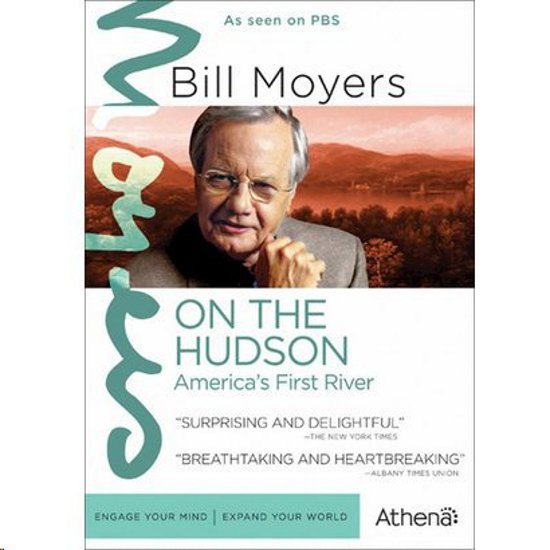
Now on DVD: Bill Moyers: On the Hudson - America's First River
These days, the Hudson River Valley is once again a destination for restless urbanites in search of bucolic getaways. Its storied history is chronicled in the recent DVD release of "On the Hudson - America’s First River," an introspective documentary by veteran journalist Bill Moyers. Over the course of two episodes, Moyers enlivens the iconic river’s four-century transformation with tales of military heroes, literary characters, nature seekers, industrialists, corporate polluters and environmentalists. Images of staggering beauty, captured through a variety of media, enrich this vibrant narrative.
Starting in the early 17th century when Henry Hudson first ventured up the river in search of a northwest passage, Moyers explores the history and culture of the Hudson as it experienced waves of European tourists, American artists and wealthy summer residents seeking peace and nature. Along the way, Moyers artfully weaves a mosaic of poetic narration, insightful primary source readings, scholarly interviews and amusing anecdotes. He also takes on the murkier aspects of the river, as it became a core artery of industrialization and corporate development.
Part One, “Stories from the Hudson,” journeys (albeit at times tediously) through the importance of the waterway during the American and Industrial Revolutions, the changing terrain of the landscape and the majestic architecture along its banks. Moyers also captures our imaginations by paying homage to writers and artists like Washington Irving, James Fenimore Cooper, Thomas Cole and Frederick Church, whose pastoral depictions of the river and its environs created a sense of place for early Americans.
Notably, historians and local residents reflect on the emergence of an American culture and the quintessential paradox between reverence for the landscape and desire for progress. Nostalgic stories about a childhood in Troy, a once prominent and now partly shuttered factory town, told with endearing fervor by local resident and writer Richard Selzer, are also memorable for their eloquence and comedy.
Part Two, “The Fight to Save the River,” covers the rise and fall of the fishing industry, the dumping of contaminants into the river and the birth of the American environmental movement. Firsthand accounts told by environmental activists, local business owners and scientists conjure an almost incomprehensible time when people and institutions treated the Hudson as a landfill.
A series of interviews with local angler Robert Boyle, who has published extensively on the toxic state of the Hudson, and John Cronin, the Hudson Riverkeeper who spent over a decade patrolling the waters for environmental violations, provide a wealth of information on the local ecosystem and the environmental movement. And the vignettes regarding successful lawsuits against toxic dumper Anaconda Wire and Cable Company and Con Edison, which sought but failed to build a power plant on Storm King Mountain, are particularly informative.
Yet, the most dramatic moments come from an interview with former GE Chairman Jack Welch. In a series of animated clips with Bill Moyers, the charismatic corporate titan vigorously defends GE’s fight against dredging as an appropriate clean-up method for polychlorinated biphenyl (PCB), an industrial toxin known to cause cancer in animals. Over the course of nearly three decades, two GE plants dumped more than a million pounds of PCB into the Hudson, which led to the destruction of the multi-generational fishing industry and disrupted local ecosystems. GE ultimately lost the anti-dredging campaign and is already conducting a second phase of dredging with oversight from the Environmental Protection Agency. The documentary, released on DVD a decade after its initial airing on PBS, regrettably omits this development.
Though the river remains polluted today, Moyers points out that it continues to improve through efforts of environmental groups like Riverkeeper, famous activists such as legendary folk singer Pete Seeger, and state and federal legislation. The new flock of inhabitants to the Hudson River Valley, urbanites in search of all things local and rustic, also can leave a positive, sustainable footprint on this land. The rich and complex history that comes to life in "On the Hudson – America’s First River" certainly provides a compelling case for why the new residents should care about the future of the river.
Author Bio:
Annie Castellani is a contributing writer at Highbrow Magazine.
Photos: Dan Nguyen (Flickr); Julian Colton (Flickr).