


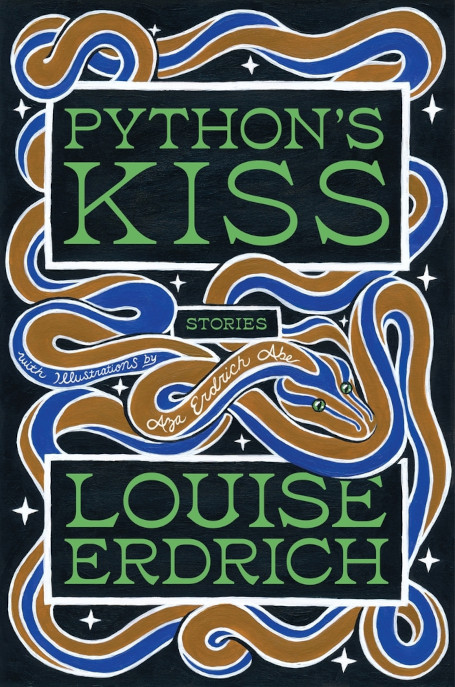
Python’s Kiss: Stories
By Louise Erdrich
Harper
222 pages
A lot happens in Python’s Kiss, a new collection of stories by Louise Erdrich, only her second since The Red Convertible (2009). There’s love and death, romance and murder, and many other incidents and occurrences in between. It makes for an alluring baker’s dozen of this Pulitzer Prize-wining author’s short fiction.

The title story, for example, includes a bare-knuckled fight between a suitor and his prospective father-in-law, as well as the escapades of a dog smart and nimble enough to scale a seven-foot fence. The story’s narrator—a woman reflecting on a turbulent period when she was 8 years old—depicts events leading to her first intimations of self-awareness and the looming mortality of everyone (and everything) around her.
Erdrich adeptly crafts language that propels the reader through a story. In the first paragraph of “Python’s Kiss,” the narrator recalls life with her grandfather, who runs a grocery store and owns a fearsome watchdog named Nero:

“At night, [Nero] was turned loose to guard the cash register in the front of the shop, where he paced the waxed linoleum, a ghostly white. Other unbanked valuables were kept in a safe, but that was in my grandfather’s bedroom. He slept behind a locked door with my grandmother on one side and a loaded gun on the other. This was not a place where a child got up at night to ask for a glass of water.”
With an opening paragraph like this, it’s hard to imagine a reader shrugging her shoulders indifferently and moving on to the next story. Erdrich grasps what’s needed to snatch and hold a reader’s attention. And she’s equally skilled at mingling lyrical and plainspoken prose. Later in “Python’s Kiss,” the narrator recalls her encounter with a neighbor’s Burmese python:
“I looked straight into its impartial, primordial face. Its tongue flickered, sensing the currents of pandemonium, and then the forked tip touched me just above my upper lip, on the right cheek.”
Other stories plunge readers into events without any unwieldy preambles. In “Love of My Days” (a Western of sorts), a farmer and a sheriff clash with a cruel, murderous fugitive from justice. The story quickly kicks into gear and the pace never slackens—an essential element in any short fiction and certainly a winning attribute here.
Most of these stories take place in a particular region of the American Midwest, an area already deeply explored in Erdrich’s many novels. The narrator of “December 26” describes her surroundings in the plainspoken language we often associate with that part of the country:

“Ours is an isolated little community in Wisconsin or Michigan or Minnesota, it doesn’t matter. We’re near water and near Canada.”
Some stories in Python’s Kiss veer into something akin to magical realism. In “Domain,” a woman brushes up against the afterlife, while “Asphodel” flirts with time-travel in Groundhog Day mode.
While these “experimental” stories may not appeal to every reader, Python’s Kiss nonetheless contains much of the imaginative scenarios and lovely prose so evident in the work of Louise Erdrich.
Author Bio:
Highbrow Magazine chief book critic Lee Polevoi is the author of The Confessions of Gabriel Ash, a novel.
For Highbrow Magazine