

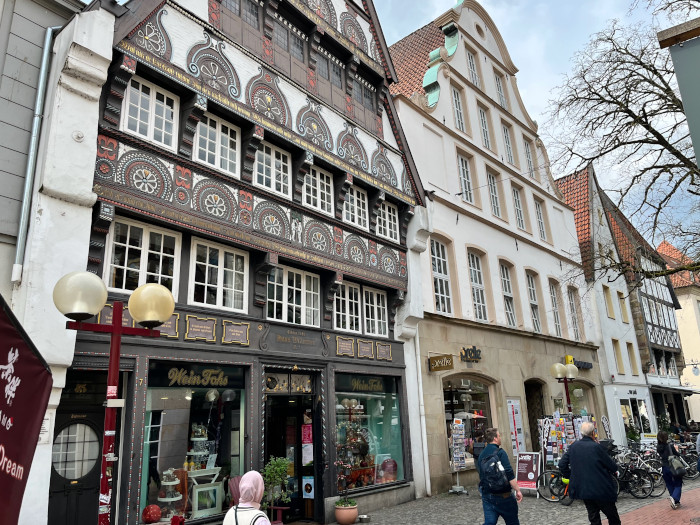
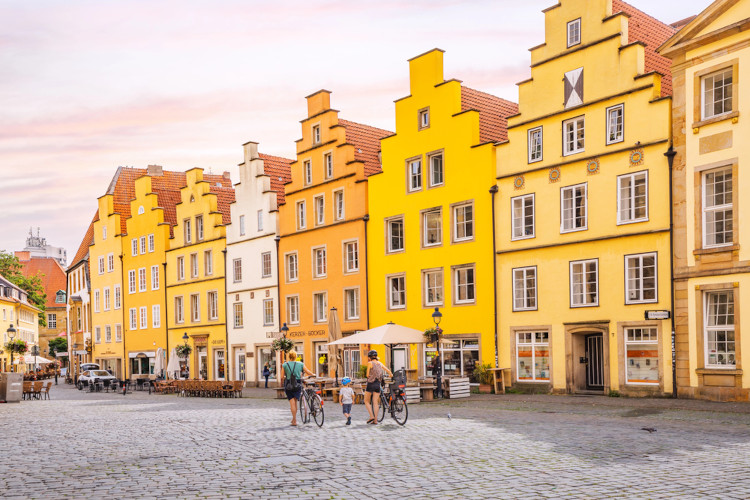
Ornate shops line Krahnstrasse, Osnabrück's main pedestrian path in the Old Town.
I can think of three reasons why you ended up in Osnabrück, Germany: 1) Your car broke down on highway B68. 2) You confused it with Osterberg. (Sorry, mate, that’s in Bavaria, 350 miles south.) 3) You read up on the place and realized it’s one of the more intriguing (and overlooked) cities in Germany.
History Buff Alert: The Treaty of Westphalia was signed here in 1648. Hey, I see you yawning! Stop it! For those who cut history class that day, the Treaty of Westphalia was the first-ever peace accord signed by multiple European countries (and duchies, principalities, kingdoms, empires, city-states, etc.), thus bringing an end to the chaotic, confusing, cacophonous Thirty Years’ War among Sweden, France, Spain, Germany, the Holy Roman Empire, possibly my next-door neighbor Chris, and Lord knows who else.
In Germany, the treaty is a BFD. Kind of like the U.S. equivalent of Appomattox Courthouse and the end of the American Civil War, but with better wine.
“You had lots of little wars going on, and then you had the big war,” said Allen Ware, a professional clarinetist and part-time guide who has lived in Osnabrück for more years than he cares to remember. Ware, a native of North Carolina, came to Germany to study music as a young man and never left.
“Sometimes, armies switched sides,” he said. “You had France fighting Spain, and this prince fighting that prince, and it was pretty confusing. Sort of like the never-ending wars in the Middle East in our more peaceful and highly civilized current era.”
In Osnabrück Town Hall’s Hall of Peace, where the treaty was certified, you’ll find portraits of the signers lining the walls. An artist, Anselm van Hulle, was hired to make quick sketches of the men, then create full oil portraits later, since it was impractical for the attendees to sit for a portrait at the time. Well, of course not! They had work to do! The conclave was so monumental, so crucial to the future of Europe, that civic leaders around the continent who weren’t even invited came here to witness the event.
If you weren’t at the signing of the Treaty of Westphalia, you were a nobody. Think of it as the equivalent of the annual White House Correspondents’ dinner, but without the drama.
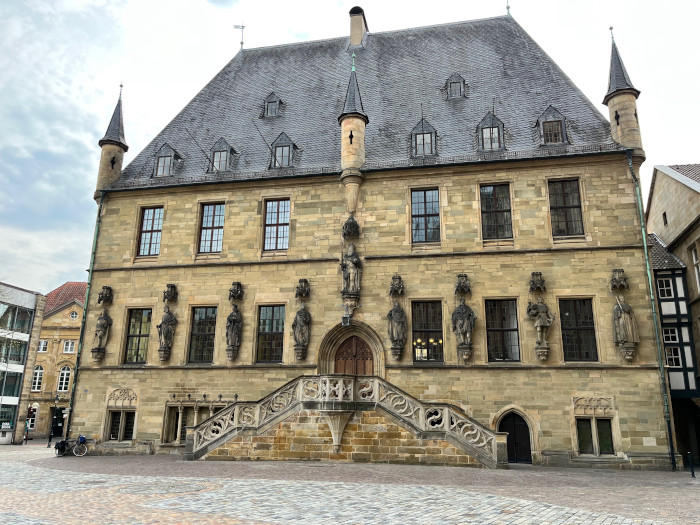
The Treaty of Westphalia was haggled over on the second floor of Osnabrück's Town Hall.
A City of Peace
So proud are the citizens of their city’s role in the treaty, even today, four centuries later, that they often refer to Osnabrück as Friedensstadt, City of Peace. Make no mistake: The Treaty of Westphalia is still a thing in Osnabrück.
At the time of the treaty, Osnabrück was affiliated with the Hanseatic League—not as a coastal powerhouse in that august European trading association, but as an inland storage city. Goods traveling from one Hanseatic city to another often had to be warehoused for a time, and Osnabrück built steinwerk (stone work) storage centers for that purpose.
The city had to compensate a trader for losses in a warehouse fire. The steinwerk minimized that risk. Stonework houses were virtually fireproof. They had no central staircases that might allow flames to rush from the ground floor to the roof. They had thick stone walls. The stonework houses even survived the fire bombs of World War II. Many of those storehouses, still standing today, date back to the 1200s and 1300s, and several can be seen along Grosse Gildewart Street.
Grosse Gildewart is just one of many postcard-perfect cobbled lanes in the city’s Aldstadt, or Old Town. The winding thoroughfares weren’t always so picturesque, though. In the Middle Ages, they were often covered in four or five inches of mud, human waste, and even animal carcasses. Refuse of the most revolting sort was simply tossed into the streets in the naïve hope that, ultimately, the rain might wash it away. Think of that when you stroll along the now charming passageways.
“Want to have a drink in this darling little café? I think this is where they used to toss their poop and dead pigs. Oh, come on, it’ll be fun!”
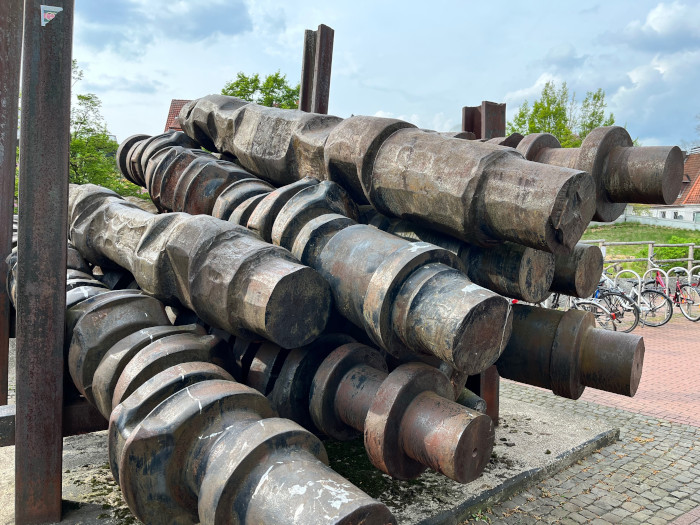
What at first looks like a modern-art sculpture is actually made up of camshafts to power ship engines.
The Lay of the Land
Osnabrück was bombed mercilessly in World War II. As a major industrial center, it’s easy to see why.
On a stroll with Ware, I noticed what at first looked like a modern-art sculpture. On second view, I realized it was a pile of huge camshafts, as if taken from some gargantuan engines.
“They’re camshafts for ships,” said Ware, “made here in Osnabrück during the war. That’s why Osnabrück was bombed early in the war, because that’s the sort of thing they made here. Toward the end of the war, even after the factories were destroyed, it was just revenge-bombing.”
If you want to know what the layout of Osnabrück looked like in its earlier days, head to the old Town Hall’s second floor, where a scale model of the city circa 1633 puts you in the picture. The Town Hall was bombed in 1944, but the perceptive city fathers, realizing that a firestorm was a distinct possibility, removed the portraits, the elaborately carved benches where the emissaries once sat, and the room’s massive chandelier and stored them in a bunker before the inevitable bombing happened, so they were saved for posterity. And for you.
Osnabrück (population 168,000 and a three-and-a-half-hour train ride from Frankfurt Main Airport) made most of its money through taxes. Thanks to its enviable role in the Hanseatic League, goods were taxed when they entered the city and when they left. The city’s tax office still stands next to the Town Hall, a useful reminder to always pay your taxes lest they cut off your head in the market square. The city also had a royal grant to weave wool and linen. So cheap and durable was Osnabrück linen that much of it was exported to the American South, where slave-holders used it for their workers’ clothing.
Close by the Town Hall on Market Square is the Marienkirche, the Lutheran church of St. Mary’s, a Gothic house of worship built in 1430 and one of the most visible buildings in the city. A viewing platform, some 15 stories high (165 feet), is reached by a circular stone staircase with 193 steps. I know, because I counted. From the balustrade at the top, you can see all across the city—the Town Hall and the market square, the leaning apartment building (more on that later), the train station in the far distance, and other landmarks.
As a half-dozen of us stood on the wooden catwalk that wrapped around the building, I began to wonder how sturdy it was. The ground was a long way off. I decided to move to another part of the balcony, where there wasn’t so much weight concentrated in one spot. As I did, the tower bells tolled five, and I believe I nearly went deaf. I could hear the ringing in my ears for the next hour.
From the tower heights, I could make out parts of the city walls, but almost none of them survived the centuries. The original city walls weren’t destroyed by war or neglect; the culprit was housing. The city had long required citizens to live within the walls; from a safety factor alone, that made sense. But once the region grew more civilized, especially in the period following the Peace of Westphalia, the city allowed citizens to live outside the walls. The home builders, though, needed construction material, and turned their eager eyes toward the stones from the walls. There was no longer a need for such protection from the outside world, so the city sold off the walls in large sections. The defensive towers remained, however, and seven of them still stand. Most are now used for student housing, cafés, and guest lodging.
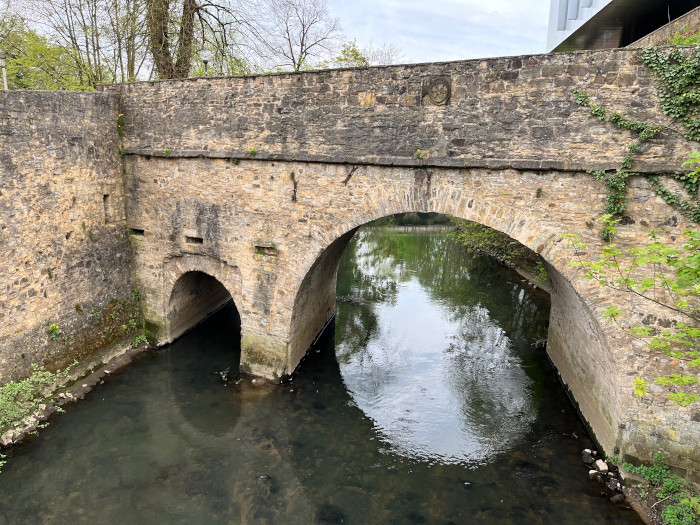
The River Hase (not the River Osna) flows below a centuries-old bridge at the outer edge of the city's Old Town.
There Is No Osna River in Osnabrück
With my guide, I was able to climb to one of the towers, the Bucksturm, once used as a prison. On the second floor, a small cabin-like structure built of thick oak was used as solitary confinement for prisoners as early as the 14th century. Inmates weren’t given food or blankets; they had to rely on donations from friends and family to stay alive. Most of the detainees didn’t survive their jail time.
The wooden cell is known as the Johanniskasten (“John’s Box”), named for Johann von Hoya, a medieval version of a robber baron. Hoya was incarcerated in the box for seven years before being released. Apparently, he had so many generous friends that not only did he survive, he came out weighing more than when he went in, according to local lore.
As we left the tower, we crossed a small, fast-flowing river. I asked Ware if that was the Osna River, assuming that Osnabrück meant “bridge over the Osna.”
“There’s no Osna River,” he said, “That’s the Hase.” He explained: “The letter O often begins a word meaning water, even in Old English, so Osnabrück means ‘bridge over water’—as opposed to, say, ‘bridge over dry land where we didn’t really need to build a bridge in the first place.’ At taxpayer expense.”
At this point, Ware walked down a flight of steps toward the river and entered a long-abandoned medieval tunnel that passed below the river.
“The people of Osnabrück used to say it was a secret tunnel for the Catholic clergy,” he said, “who were often mistreated when this part of Germany became mainly Protestant. They eventually called it the Nun Passage, but there’s no evidence for that. There are a lot of Osnabrück stories that aren’t true.”
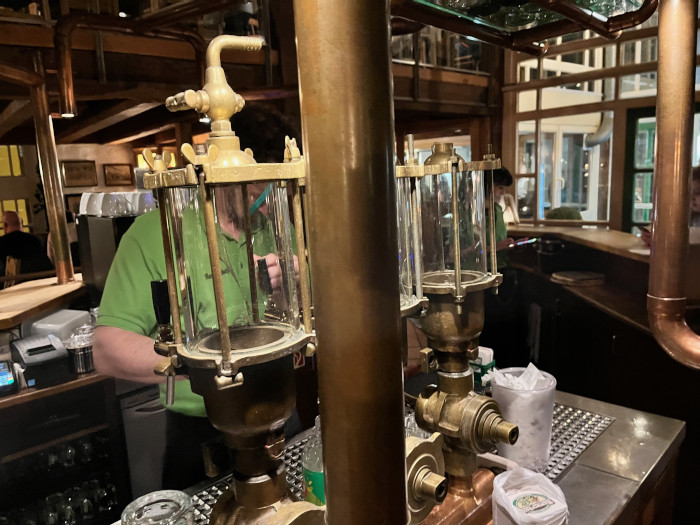
The bar at Rampendahl, Osnabrück's sole brewery.
Dining and Drinking in the Old Town
On my first full day, I stopped for coffee and a snack at Sophie’s, a coffee house-bakery and the oldest (1903) continuously operating restaurant in Osnabrück. The interior won’t win any awards for charm, yet the locals line up down the street for a taste of “Aunt” Sophie’s macarons, baguettes, tarts, and petits fours. The exterior of the 16th-century half-timbered building on Krahnstrasse, Old Town’s main pedestrian street, is, like Sophie’s macarons, a knockout.
Dinner that night was at Marktschänke in the Old Town. The setting was straight out of a German children’s tale, thanks to the half-timbered, brick-lined interior walls. Marktschänke looked like the sort of place where Gaston and his little buddy LeFou might have played ring toss on the antlers of mounted deer heads. The menu, in keeping with the décor, offered herring (matjes, a local staple), a variety of schnitzel dishes, steaks, roast beef with fried potatoes, and pork medallions—Germany on a platter.
Earlier in the day, Ware had told me that because of the city’s high water table, the water in Osnabrück wasn’t potable in medieval times, so everyone drank beer, even kids. Coincidentally, at dinner, our evening host, Carsten Niemeyer, told us about a popular bar in Osnabrück that brews its own beer on premises. As we finished our meal, Niemeyer said, “Now, if anyone is interested in having some beer and taking a tour of the brewery, we can....”
Unfortunately, the rest of his words are lost to history or, at least, lost to my soggy notepad, because I was already out the door and heading to the brewery—the only problem being that I didn’t know where it was, so I had to wait for Niemeyer.
The Rampendahl Brewery is in an old burger’s house, parts of which date from the 12th century. Guests enter through an ornately carved sandstone portal. The interior defines gemütlichkeit, with its rustic wood-paneled walls, brass fittings and copper tubing behind the bar, massive ceiling beams, stained-glass windows, and red-tiled floor. Rampendahl makes three kinds of beer: a dark dunkel lager, a light Helles lager, and a wheat beer. For some reason, according to Niemeyer, “Men prefer the light beer, women the dark.”
The Rampendahl also serves hearty traditional dishes, including potato soup, schnitzel, and pork knuckle, as well as burgers and vegetarian soups and salads.
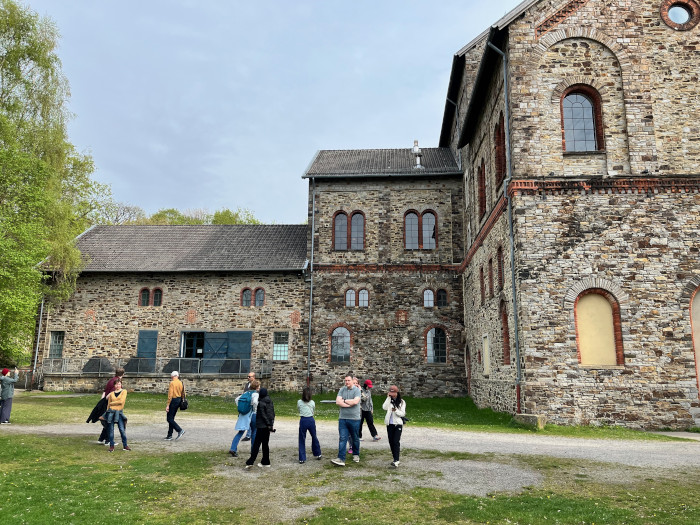
The Museum of Industrial Culture resembles a church more than a coal factory.
What the Heck Is a Geopark, Anyway?
In 2015, UNESCO created a category of protected areas called Global Geoparks—landscapes and geological sites that are worth saving and visiting. One of the main attractions in Osnabrück is the Geopark called TERRA.vita, a former coal mine, coal-processing plant, and working carbon quartzite quarry. Carolina Bessler, my guide, planned to take me through the former processing plant, now a museum. But first, this being Germany, a hike!
To the top of the Piesberg, the mountain at the center of the quarry, one must climb 269 steps because, well, Germany. We climbed to the base of a wind turbine, the bane of the Teutons (they’re everywhere), and surveyed the horizon. In the near distance was Osnabrück. Down below was the quarry. On the horizon, what looked like hills were actually slag heaps planted in grass. Trees were growing. There was even a comical Choo-Choo-Charlie train, still operating, that used to take the workers out to the quarries and ferry the stone back to factories, and that now carts tourists around the mountain.
We returned to our starting point for a walk through the Museum of Industrial Culture. If that name is a turnoff, and I have no doubt that it is, try to go beyond the bureaucratic nomenclature, because the place is a hoot.
The coal factory was built in 1872 from local stone as the shaft building for a coal mine. It looks more like a church, but there was nothing godly about it. In fact, it carried the miners to what must have been hell on earth.
The building was constructed to house the steam engines for the elevator down to the mines and for the water pump to keep the tunnels dry. After the mine closed more than a century ago, the hulking ruin remained abandoned through the 1990s, when it was renovated into a museum. It displays the history of industrialization and local cultural history from the 19th century through modern times.
The still-working steam engines in the shaft house are a steampunk fantasy come to life—massive, 40 feet tall, and very loud. Water boils, resulting in steam that is forced down a cylinder holding a piston. The piston is put into a back-and-forth action that moves a pulley, which in turn spins a giant wheel. (Armed with such information, you are now a Master of the Universe.)
I watched one steam engine operate, which was designed to raise and lower an elevator. Incredibly, all the 19th-century machines are still working, including lathes, sewing machines, drills, presses, and other dangerous instruments designed to give you the nickname “Lefty.”
“Shall we go down into the mine?” asked Frau Bessler.
Of course, you say yes, only to regret such a decision as the elevator descends 300 feet below the earth’s surface. I imagined a fearsome hole, with unbearable heat and, perhaps, stricken miners pleading for help from under a tunnel collapse. Instead, electric lights outlined the tunnel, and the temperature was around 60 degrees F. Not exactly a wedding venue, but nothing spooky, as I’d feared. Still, don’t forget that the mine closed in 1898 after the Great Disaster, in which nine miners died after being cut off by a flood. This is unlikely to be your happy place.
Apparently, miners from around the world, no matter their language, never go down a shaft without first saying Glück auf, which means “good luck” in German.
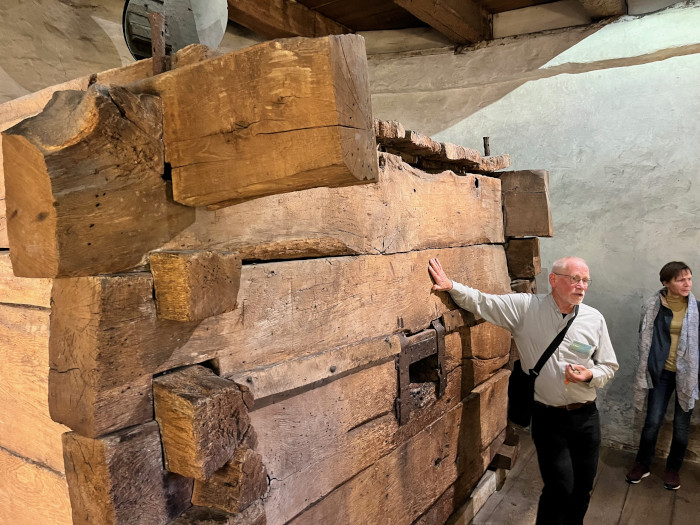
Allen Ware explains the history of the dreaded Johanniskasten, a medieval form of solitary confinement.
Three More Things to Know About Osnabrück
The tallest non-church building in the city is an apartment complex. It is absolutely hideous. Egregiously unwarranted. Everyone in town despises it. Because of the city’s high water table, the building’s foundation has begun to sink on one side, so now the building tilts. They call it the Leaning Tower of Osnabrück.
In Osnabrück, in olden times, a convicted thief would receive a pierced earring, which would then be ripped out of his earlobe, leaving a scar that forever marked them as criminals. This scar was called the Schlitzohr. Even today, mothers will call their rascally children, “You little Schlitzohr.” My German friend Franziska was familiar with the phrase and said mothers still use it today when a child misbehaves, but even she didn’t know of the word’s origin.
The “submarine” at the Museum of Industrial Culture in Osnabrück’s Geopark looks as if Captain Nemo might crawl out of it at any moment. In fact, it’s a water tank from a massive steam engine. But I’m still going with it being a steampunk Nautilus.
(Photo Credit: Depositphotos.com)
Author Bio:
Mark Orwoll, a Highbrow Magazine contributor, writes about travel, food, and drink for numerous outlets. He is the author of four books and the former International Editor of Travel + Leisure magazine.
Photo Credits: Mark Orwoll
For Highbrow Magazine