

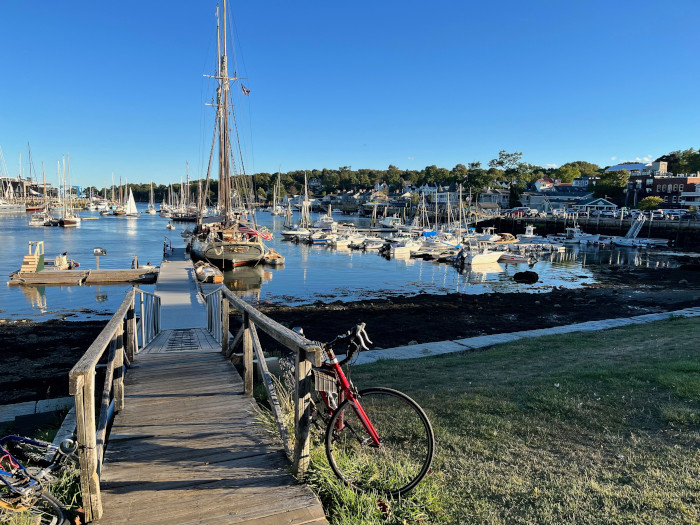
The Mary Day at the end of the dock in Camden Harbor
I ambled up to the Mary Day like an old salt, as if I had shipped out on schooners like her from Valencia to Valparaiso. Actually, I didn’t amble. I positively swaggered down the long dock. The only giveaways to my actual landlubber status were the rollaboard suitcase (instead of a sailor’s duffel) and the iPhone in my hand as I asked myself: Am I in the right place?
The Mary Day is a landmark in Camden Harbor, Maine. Not just a beautiful boat, it’s the oldest schooner to be purpose-built for passenger sailings. (Schooners traditionally were used for fishing and hauling coastal freight, and only occasionally for passenger service.) Launched in 1962, the ship has just enough scars to show its age, but not too many to give a nervous passenger pause.
Nonetheless, right away, as I stood at the hull of the ship, I was apprehensive. I’m at an age where my doctor told me to stay off ladders. I get the same advice from my wife, my friends, and the lady who cuts my hair. So naturally, to board the beautiful schooner, I was faced with, you guessed it, a ladder. I heaved my suitcase up to a welcoming deckhand and mounted the half-dozen rungs, threw my legs over the gunwales, and stood on the deck like I’d been sailing my whole life.
Call me Ishmael.
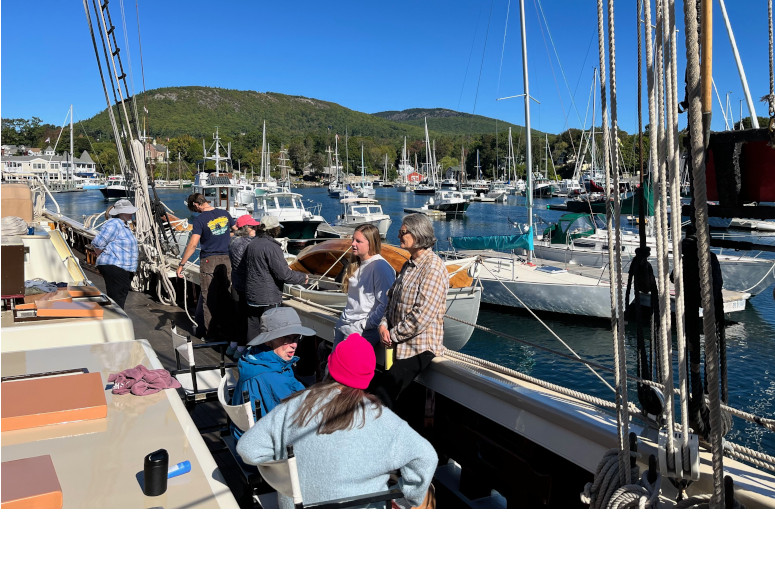
New arrivals on the Mary Day get to know one another.
Welcome Aboard, Me Hearties
John, the crewman who greeted me, smiled and shook my hand, then ticked my name off a passenger list. “Let me give you a tour,” he said. First things first: John told me in no uncertain terms to take caution on the stairways (called companionways) leading belowdecks; the steps are only slightly less steep than the rungs of an average folding ladder.
“Be sure you go down them facing backwards,” he said, “the same direction you go up them. You don’t want to fall. Trust me, I’ve fallen down every one of these stairs!”
He pointed out the Mary Day’s two bathrooms, or heads, on the main deck. The two heads were meant for a crew and passenger complement of 35 max. I didn’t like the sound of that, though I felt better when John told me they were cleaned five times a day. Still, I’d have to climb the nearly vertical stairs from my cabin if I needed to use the facilities overnight. And the flushing mechanism was…unique. You had to lift up a pedal on the floor with your foot, which filled the commode with water, then step on the pedal to flush.
“Make sure you practice how to flush it,” advised Miguel, a gastroenterologist and fellow passenger, “so you don’t have to learn how at 3 a.m.”
I had a concern, though, having nothing to do with the boat per se: the outdoor temperature on the water. It was late summer, and I assumed I’d be warm enough with long-sleeve shirts and a fleece vest. But only 30 minutes after boarding, while the Mary Day was still tied to the pier, I realized I’d need something warmer, especially for the evenings. I had forgotten one small detail: I was in Maine, where the locals worry about heat stroke when the thermometer hits 55 degrees.
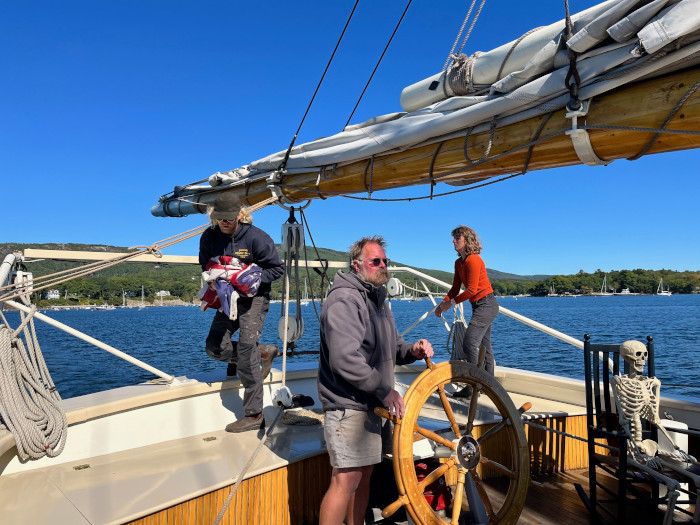
"Cap" Barry King, skipper of the Mary Day.
A Formal Welcome from ‘Cap’
Back in town (our ship would remain docked that first evening, so I was in no rush), I found a sporting goods shop, where I bought a hoodie. Across the front was emblazoned, “CAMDEN.” It might as well have said, “TOURIST.”
I put it on and walked back to the dock, where my fellow passengers were merciless. “Forget to bring a jacket, did you?” smirked one. “Hey, what town did you buy that in?” asked another, facetiously. Pro tip: Dress slightly warmer than you think you’ll need. Even in warm seasons, sailing can be chilly.
Before sunset, the passengers were called on deck for a greeting from Captain Barry King, a licensed Coast Guard master. The crew simply called him “Cap.”
“Welcome aboard!” he said. “Glad to have you all here for three days of pleasure and possibly a few moments of terror. We’ll see.”
Our group of 21 amateur sailors laughed politely, and a few of them looked uncertainly around the ropes and rigging of the Mary Day.
“So put your cellphones on airplane mode,” Cap continued. “Let’s live in the moment. Unplug! Unplug for just a little bit. We don’t often get a chance to do that these days. So let’s pretend that it’s 1995!”
Someone asked what our itinerary would be. Penobscot Bay, which lay before us just beyond the harbor, is dotted with scores of islands, and we had no clue which of them we’d be visiting.
“Itinerary?!” exploded Cap in mock horror. “No, there’s no itinerary! I make this up by the seat of my pants.”
One thing we knew for sure: We were promised an onshore lobster bake the next evening—somewhere, on one of those green bits of land in the distance. We just had to figure out which one.
Our mate (second-in-command), J.P., asked everyone to remain for a safety briefing. Like the boat’s three deckhands, J.P. worked the summer on the Mary Day and the winter at some other outdoor job—sailing a yacht down to Florida, being a mountain guide, or, in J.P.’s case, earning his ski-instructor license in Utah.
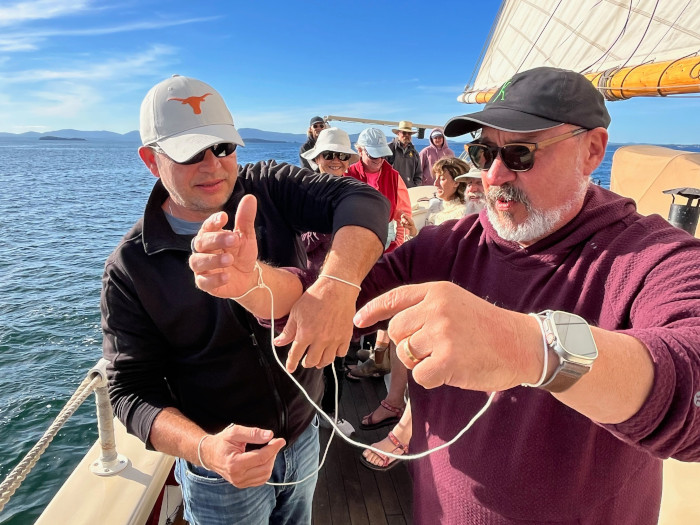
Playing games while learning knots
The Vibe on a Schooner
I’m not averse to a glass of wine with dinner, or before or after dinner, or a beer in the afternoon, so I was curious about the words on alcohol on the schooner’s website: Guests are welcome to bring their own grog (none is served on board) if they remember to drink in moderation. A large ice chest is provided for BYOB booze.
I’d brought some beers and wine with me, but wondered if I’d find myself in the seagoing equivalent of a revival meeting, where a Sam Adams was sneered at and the mere sight of a cup of Cabernet was criticized. But when I opened the container, where other guests had already stashed their bottles and cans, I discovered the ice chest of a college sophomore’s wildest dreams: IPAs, Strongbows, hard lemonade, bottle after bottle of Sauvignon Blanc and Chardonnay, and assorted other adult beverages. But make no mistake: This was no booze cruise. My fellow passengers adulted responsibly, even with a Smuttynose Brown Ale in hand.
The reason no one stashed their drinks in the refrigerators of their cabins was that there were no fridges in the cabins. There were no closets. There were no toilets. No writing desk, TV, coffeemaker, or other common appurtenances of cruise-ship cabins. Instead, there were bunk beds, a wall-mounted escape ladder to the main deck, and a sink the size of a small mixing bowl for brushing teeth and washing hands. Passengers wanting a shower could either put on a bathing suit and hose off on deck or use the shower hose in one of the two heads, where everything got sprayed.
“We just ask that you put the plastic cover on the toilet paper roll to keep it dry,” John told me during my initial ship tour.
There’s no getting around it: Sailing on a schooner is a bare-bones cruise. But to an extent, that’s precisely why guests sign on. Forget the art auctions, the boarding photographer, and the sad comic relief of the cruise director found on large cruise ships. Guests on a Maine schooner, if they wish, lend a hand to raise and lower the sails, learn how to tie knots, sing folk songs in the dining room adjacent to the galley, and simply grab a deck chair as the boat catches a fair breeze and heels to starboard, bound for the next island ahead.
I knew almost none of this when I boarded the Mary Day on a mid-September afternoon. But I learned quickly the next morning when we pulled away from Camden and made for the farther reaches of Penobscot Bay.

Sunset over Penobscot Bay
First Morning Under Sail
“Haul away, peak!” shouted J.P. Ten passengers pulled with all their might on the ropes as deckhand Liam yanked down on the mainmast line. When the mainmast was tight, Liam yelled, “Hold!”
“Haul away, throat!” J.P. called to 10 other passengers on the opposite side of the schooner. We were beginning to feel like seafarers already, and we were barely out of Camden Harbor.
The commands kept coming. “Haul away!” “Hold the line!” “Two steps for’ard!” “Drop the line.” By noon, we were jolly tars, infinitely pleased with our nautical knowledge and seagoing savvy.
What I know about sailing I learned from the Beach Boys in “Sloop John B.” I wouldn’t know a boom from a forestay, a jib from a gaff. Thankfully, the amount of sailing knowledge necessary for a cruise on a windjammer like the Mary Day is zero. You can even man the helm with nary a scrap of seagoing skill. Cap will probably point out a spit of land in the distance and say, “Make for that island.” Next thing you know, an entire schooner is under your control.
“Dolphins!” someone shouted as soon as we’d set down our lines. A pair of the sleek water creatures skimmed along the surface to starboard, as if checking that we were doing everything correctly. J.P. shouted, humorously, “Hold for dolphins!”
Unexpectedly, just then, a juvenile bald eagle circled high on a wind drift off our port bow, between the Mary Day and a nearby islet stippled with mature balsam firs and birches. White-sailed sloops and ketches in the distance looked like confetti spilled on the indigo waters of the bay. I’d been to Maine before, but now I felt like I was truly in Maine.
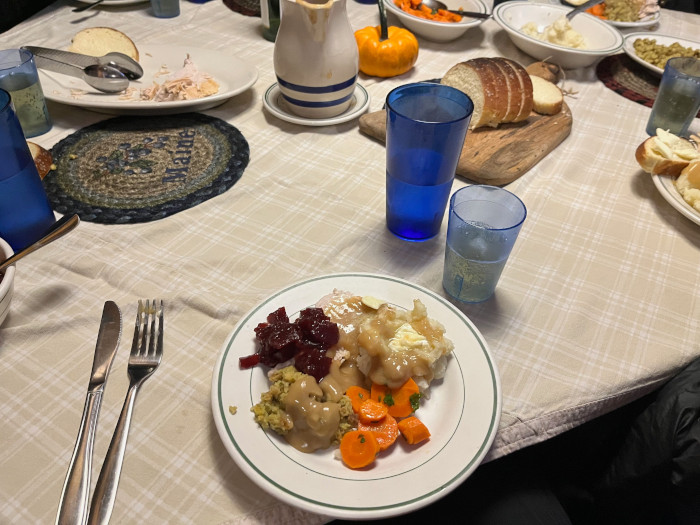
At dinnertime in the galley, expect hearty meals.
Chow Time
Anyone who has sailed on a ship that holds fewer than, say, 30 passengers, knows that mealtimes can best be described as homey affairs. Entrees are laid out in aluminum trays. Plastic cutlery is wrapped in a napkin or paper towel. For breakfast on our first morning, we served ourselves scrambled eggs, sausages, muffins, orange juice, and tea or coffee. There was plenty of food, but if you want an omelet station, waffles with blueberry syrup and Reddi-wip, and an array of meats and cheeses, buy a ticket on a Carnival cruise.
For lunch that day, we marched into the belowdecks galley and got corn chowder, PB&J sandwiches, slices of mozzarella, and a green salad. And so it went over our long weekend aboard: baked chicken and gravy with mashed potatoes, spaghetti and meatballs, pumpkin soup, pie or cake or fresh fruit for dessert. The meals were what I would call, in the best possible way, solid roadside-diner food, comfort food. Gourmet cooking and midnight chocolate fountains happen somewhere else.
For breakfast and lunch, the passengers would step down a steep stairway directly into the galley (complete with a wood-burning stove that troubled me more than the possibility of falling overboard). We’d pass into a small seating area where the buffet-style meals were laid out, and then either find a seat on deck or grab a tiny bit of table space and eat inside. Dinner was more formal. We took seats at three large tables next to the kitchen and were served our meals there.
The exception to all of that, and a highlight of most Maine windjammer cruises, was the beachside lobster bake on our first evening under sail. We made for a beach that Cap and the crew hadn’t been to before. The crew headed in on rowboats to set everything up. When the passengers arrived two hours later, a pyramid of large lobsters roasted over a fire, corn on the cob warmed on a grill, hotdogs sweated over the heat of a barbecue, and salads were laid out on a table. The beach sand was still warm, despite the dropping early evening temperature.
I’d never eaten a lobster with my bare hands before.
“Just crack it open,” said Miguel, the doctor. “But be sure to crack it open away from yourself!”
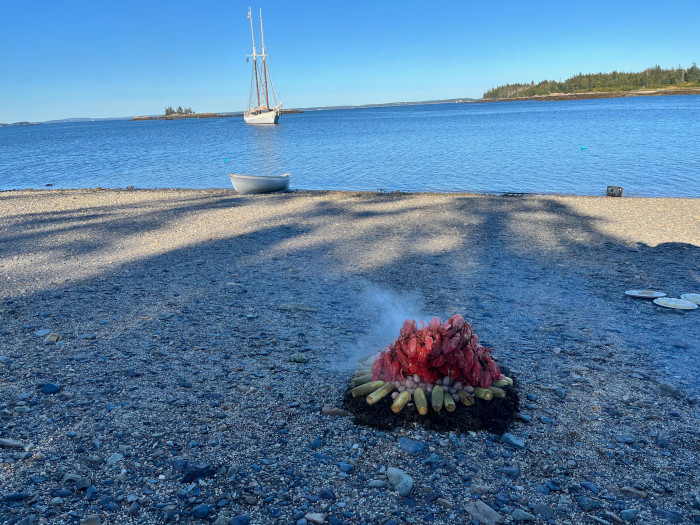
Fresh lobster and ears of corn begin to smoke over the fire at the lobster bake, a highlight of a schooner sailing trip.
How Guests Spend Their Time on a Windjammer Cruise
Honestly, I chose a three-night cruise rather than a longer one for fear of being bored. That turned out to be a meritless concern, thanks largely to the other guests.
I’ve been on more than 40 cruise ships, from behemoths to cozy luxury vessels. As a rule, the smaller the ship, the more interesting the passengers. Probably the enforced shipboard intimacy helps. On the Mary Day were a doctor, a fashion-industry exec, small-business owners, a married couple who were both engineers, and others from age 35 to 80, successful and fascinating people who liked to talk and listen.
One day, we anchored off tiny Burnt Island, with a hiking path that encircled it. I set off with five of my companions for what should have been a 30-minute hike. An hour later, we had no idea where we were or how to get back to the boat dock. How six college-educated people can get lost on a small island with a circular hiking path is still a mystery. But by the time we returned to the Mary Day, we were the best of friends.
Raising and lowering the sails was always a group effort; meals at 9, noon, and 6 regulated our days; leisurely conversations on deck over glasses of wine filled much of the time; and taking the helm under Cap’s watchful eye was always an option.
After dinner on our last night, down in the galley, deckhand Liam produced a guitar and began to sing folk tunes. I had brought my mandolin for just such an occasion, and we were soon joined on guitar by Joel, the fashion exec. The other passengers crammed into the compact dining room with us and sang along.
That night, I couldn’t sleep. At around 4 a.m., I put on my pants, undershirt, two top shirts, and my “Camden” hoodie—basically every piece of clothing I had packed—and climbed the companionway up to the deck.
The night sky was as dark as I had ever seen it. The bay waters lapped at the Mary Day’s wooden hull. Overhead was every star in the heavens. I live in the New York metro area; light pollution makes star-gazing impractical. But here, with Camden behind us and Land’s End, England, just 2,600 miles ahead, I stood mesmerized by the Big Dipper, the Belt of Orion, and, I’m pretty sure, Mars and Venus.
Then dawn spread across Penobscot Bay.
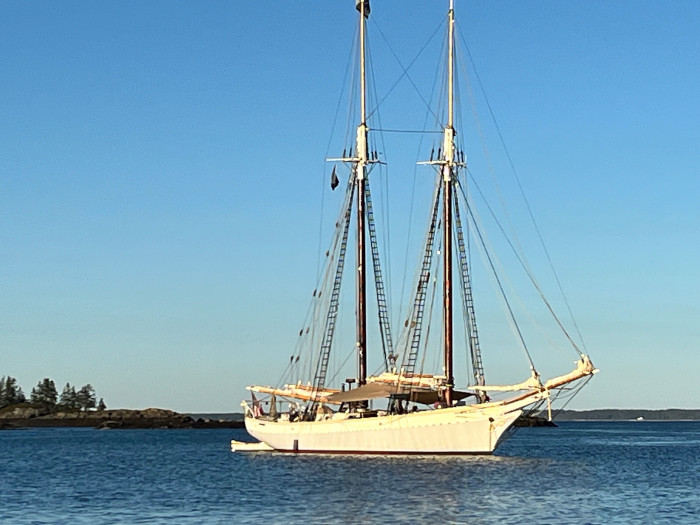
The Mary Day at anchor
The Mary Day sails on three-, four-, and six-day excursions from Camden, on the mid-Maine coast, June-September. Some other ships in the Maine Windjammer Association begin sailing as early as May and well into October.
Author Bio:
Mark Orwoll writes about travel and film for Highbrow Magazine.
Photo credits: Mark Orwoll
For Highbrow Magazine