

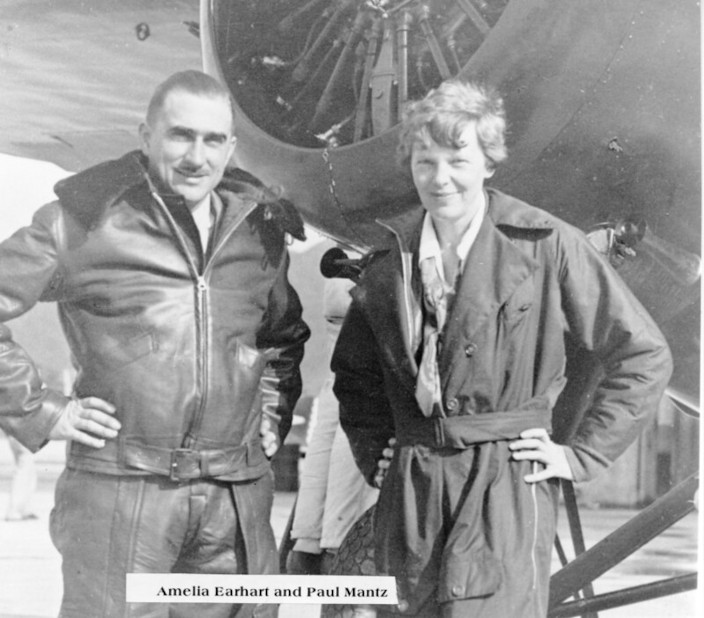
(SDASM Archives – Flickr)
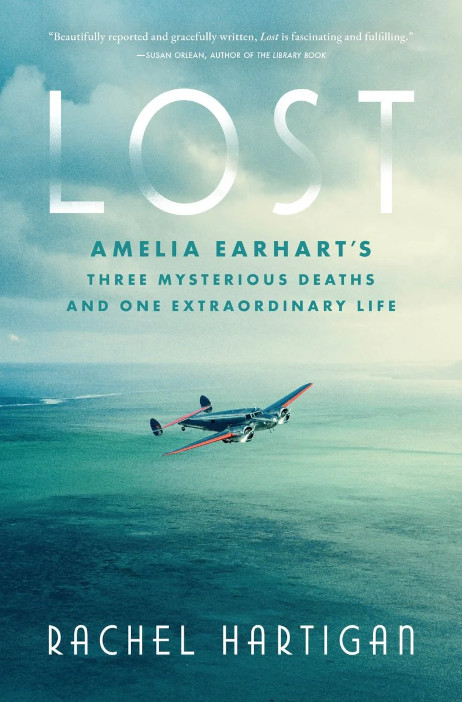
Lost: Amelia Earhart’s Three Mysterious Deaths and One Extraordinary Life
By Rachel Hartigan
National Geographic
300 pages
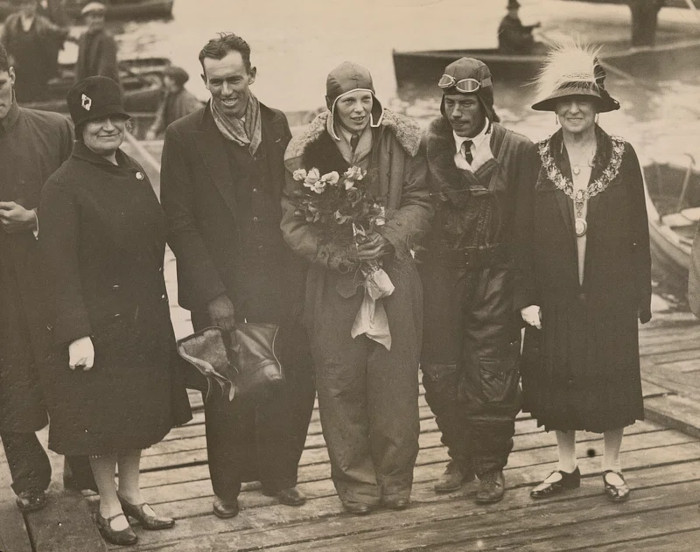
The chronicles of Amelia Earhart are catnip for a solid percentage of the reading public—those who enjoy aviation, adventure, mystery, feminism, geography, prewar American history, World War II history, and conspiracy theories, perhaps among other subjects. There seems to be something for everyone tucked into her overall life story. Cloaked in a past when photography was still nascent and news video was barely extant, the life of a trailblazing woman flier in tailored jackets and khakis with a distinctive light-brown bob has been irresistible over the nine decades since her disappearance, along with hard-drinking aviator Fred Noonan, somewhere over the vast Pacific Ocean.
Author Rachel Hartigan, of course, has not found Earhart’s remains. What she has unearthed is the world of “Earhart hunters,” who have spent decades trying to solve the mystery. That world is described in detail: the divers, archaeologists, and hobbyists chasing clues; the competing camps built around each theory; and the psychology of people, many of them charlatans of many stripes, who believed—and continue to believe—they can solve Amelia Earhart once and for all.
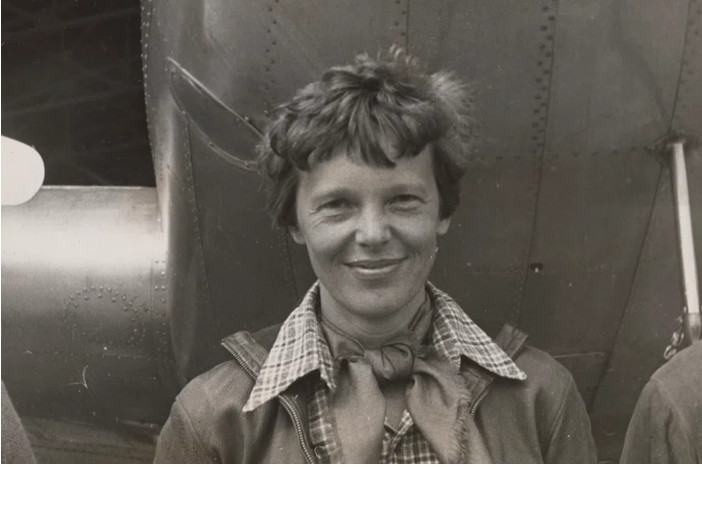
(RawPixel—Creative Commons)
But Hartigan’s Lost: Amelia Earhart’s Three Mysterious Deaths and One Extraordinary Life arrives with a structural confidence that mirrors its subject: unconventional, and quietly subversive. Rather than offering a cradle-to-grave biography, Hartigan braids two narratives—one tracing Earhart’s interesting life, the other unpacking the competing theories around her 1937 disappearance. The result is a book that reads as both biography and cultural detective story, and it is precisely this alternating structure that gives Lost its energy and purpose.
Hartigan toggles between Earhart’s upbringing, career, and rise to global fame, and the obsessive, often eccentric world of those hunting for clues (and proclaiming they have found them). The back-and-forth sharpens the reader’s understanding of both halves. Earhart’s life becomes richer when placed against the long shadow of her disappearance, and the disappearance itself becomes less abstract when grounded in the humanity of the woman at its center. The narrative feels both intimate and expansive.
What emerges most forcefully, though, is a sense that Earhart herself is slipping from the center of American consciousness. For a figure who once commanded front pages and radio waves, she now occupies a hazier cultural space—half-remembered, if at all, often reduced to a trivia answer. Hartigan’s book implicitly argues against this fading away. In an era saturated with video, documentation, and endless digital archives, it is increasingly difficult to grasp the magnitude of a pre–World War II celebrity whose image was mediated through newspapers, newsreels, and carefully staged publicity. Earhart was not just famous; she was mythic. And yet, without the visual permanence we now expect and take for granted, even myth can erode.
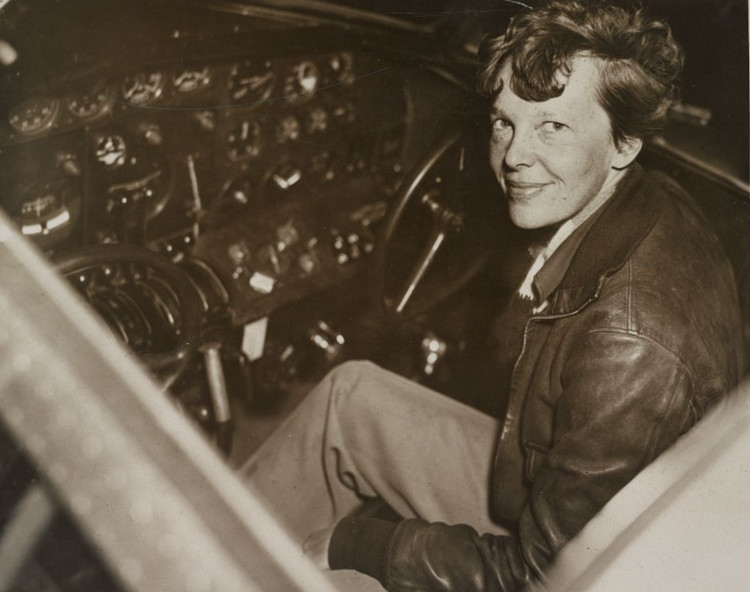

The book is especially compelling when it examines the circus that erupted around Earhart’s disappearance. Within days of her vanishing and growing into decades after, theories proliferated—some grounded in seeming evidence, others wildly speculative. Hartigan’s “three mysterious deaths” are what she calls the main theories about how (and even when) Earhart crashed and died: She and Noonan crashed at sea and were never found; they managed to land on an uninhabited coral atoll called Nikumaroro, survive for a period and ultimately die from exposure or injury; they were captured by the Japanese and died by execution or illness.
The frenzy has never really stopped. Hartigan catalogs these major possibilities and the personalities who forcefully champion each. Clearly, the mystery has always been as much about the people chasing it as the woman at its center. Even today, amateur sleuths and professional researchers alike devote years and resources to proving their version of events, often driven by the promise of fame (can someone be a historical influencer?) as much as truth.
In that sense, at least, the Earhart saga feels uncannily modern. The competing narratives, the thinly sourced claims, the cultish followings around particular theories—it all presages our current era of chatter-driven, nonfactual celebrity culture. Many decades before social media turned speculation into a participatory sport, Earhart’s disappearance invited the public to fill in the gaps with whatever story they found most satisfying. The difference is that, throughout the 20th century, the machinery of mythmaking was slower, mostly analog. Today, it would be instantaneous, though whether it would be more tethered to reality or less so is an interesting thought.
In agreeable fashion, Hartigan is careful not to let the mystery eclipse the life. The most rewarding sections of Lost are those that reconstruct Earhart before she became a headline. Born into a turbulent and peripatetic family, navigating financial instability, and forging a career in a male-dominated field, she embodied the quintessentially American ethos of self-invention and ambition. Her ascent was not inevitable; it was constructed—partly through her own determination, partly through the savvy publicity efforts of her manager-husband, George Putnam.
Earhart’s feminism, too, was understated. She did not posture as a radical, but her very existence in the cockpit was a challenge to the norms of her time. She cultivated a personal style—practical, semi-androgynous, unmistakably her own—and even launched a clothing line designed for active women. (Her bearing, countenance, and fashion recalls the late, great actress Diane Keaton, who portrayed the flier in a 1994 made-for-TV film.) In this light, Earhart reads as a kind of proto-feminist -- not explicitly ideological, but deeply influential in expanding the realm of the possible in a matter-of-fact manner.
It makes you wonder why it took until 2018 for Mattel to come out with an Earhart Barbie. Hartigan does not mention it, but for a figure who helped redefine what women could do—and how they could look while doing it—her delayed entry into this pantheon of mass-market feminist icons feels telling. It suggests that her legacy, while profound, has not always been fully integrated into the commercial narratives of empowerment that dominate today.
(RawPixel—Creative Commons)
Earhart navigated a real world that resisted her at every turn. Her victories were not scripted, nor were they self-chronicled, like today’s high-profile celebrities. With charm and good looks, she had a sort of winking wholesomeness and the good sense to keep herself a bit mysterious. But her particular type of celebrity seems almost extinct. (Are you familiar with Junko Tabei, or Jessica Watson? Tabei, from Japan, was the first woman to reach the summit of Mount Everest in 1975, and ascend the Seven Summits—the highest peaks on every continent—and wrote seven books. Watson, an Australian, was the youngest person to sail solo, nonstop, around the world at the age of 16, finishing her journey in May 2010.)
Lost ultimately succeeds because Hartigan understands that the absence of an answer is part of the story’s enduring power. What she offers is a reframing: The disappearance matters, but it should not define the life. By interlacing the two, she restores balance to a narrative that has long been skewed toward speculation.
In doing so, the book feels like a cultural corrective instead of merely a biography or some shopworn pseudo-investigation. It reminds us that before the theories, before the headlines, before the decades of obsessive searching, there was a woman whose life—restless, ambitious, distinctly American—was extraordinary enough on its own.

Author Bio:
Thomas J. Walsh, a Highbrow Magazine contributor, is a Cleveland-area writer, editor, and communications manager. A Navy veteran, he sits on the board of the VA’s Center for Healthcare Evaluation, Research & Promotion. He has been a staffer for The Philadelphia Inquirer, Philadelphia Business Journal, the Reno Gazette-Journal and various other publications.
For Highbrow Magazine