


If The Handmaid’s Tale left you longing for more, the solution is nigh. In fact, The Testaments, an adaptation of Handmaid author Margaret Atwood’s like-titled novel, is basically a continuation of the original series, and it is addictive.
Think Pride and Prejudice meets Children of Men, and you have an idea of where The Testaments is headed. As flip as the above comparison seems, it is apt. The Testaments – at least in early episodes – focuses on a handful of society girls doing their best to exist in the patriarchal state of Gilead.
Gilead is virtually unchanged from its last appearance in Handmaid’s Tale, which ended several years prior to the events depicted. It is still run by brutal men who subjugate women; punish women who refuse their hypocritical, theocratic directives; and pretend this is all for the greater good.
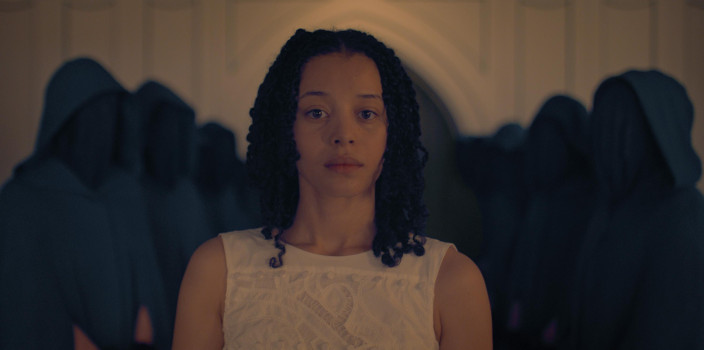
As The Handmaid’s Tale illustrated repeatedly, it is a terrible thing to live in one of Gilead’s lower social tiers. Women who fall outside the power structure are forced into servitude, either as housekeepers, teachers, laborers, or handmaids. The latter role is given only to fertile women who are essentially raped until becoming pregnant and forced to carry the children of an upper-class male. The Testaments demonstrates that life for society women is better, but only marginally.
The focus is on Agnes (Chase Infiniti), the daughter of a Gilead commander and his second wife, Paula (Amy Seimetz). Agnes attends a finishing school run by Aunt Lydia (Ann Dowd), who trained and disciplined handmaids in the original series. Agnes and her classmates are preparing for arranged marriages with Gilead commanders. Aware of their fragile positions in society, they face the same pressures as young women in every drama about society-arranged marriages, only magnified. Wed the wrong commander and you might be stationed in the dreaded Colonies or worse.
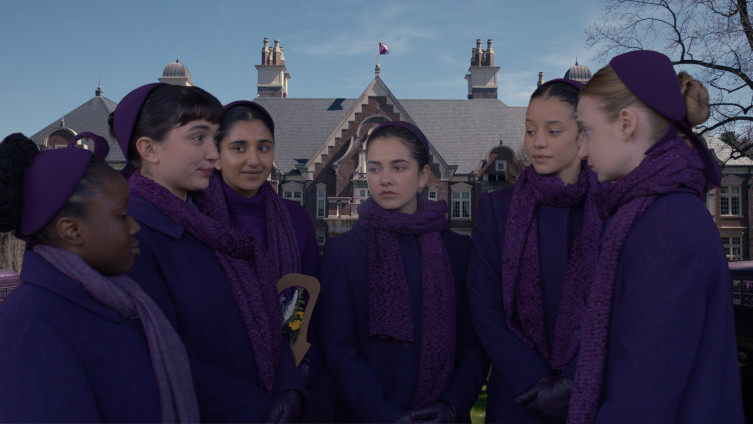
Adding to the suspense is the introduction of Daisy (Lucy Halliday), a young orphan who willingly moved from Canada to Lydia’s school. As a “true believer” – or a Pearl – she is distrusted by classmates who fear she is an informer for the teachers. Other key students include Agnes’s best friend, Becka (Mattea Conforti), and Shunammite (Rowan Blanchard), something of a mean girl.
As with any good series, there is a lot going on, and it is fertile ground to explore. Showrunner and executive producer Bruce Miller allows the series to examine the sometimes competitive relationships between young women, the lines humans will cross for survival, and the bravery that fighting oppression requires. The Testaments is much like The Handmaid’s Tale, but it is approached from a different perspective, allowing a broadening of viewpoint for longtime fans.
Whether one likes the show probably depends on their affinity for the original. If, like me, you think the examination of a repressive, religion-based society that subjugates women seems timely, there is much to enjoy in The Testaments. If you had your fill with The Handmaid’s Tale or simply can’t stomach another series that seems – at times – too close to reality, you might pass.
That said, there are arguably more touchstones in this series than in the original. The suspense and political intrigue are individual selling points, but we also get a solid examination of gender roles, a biting critique of classism, and an intriguing coming-of-age story.
There is no debating the quality of the production. Infiniti and Halliday are talented actresses, and they get apt support. Dowd, of course, was a favorite in the original series, and her reading of Aunt Lydia is as memorable as ever. In fact, viewers get a fuller picture of that character’s past. For some, that alone should be enough.
As ugly as it can be to immerse oneself in the nasty realities of Gilead, there are many rewards for doing so.
Author Bio:
Forrest Hartman is the chief film critic for Highbrow Magazine and a university professor.
For Highbrow Magazine