


(Photo Credit: Depositphotos.com)
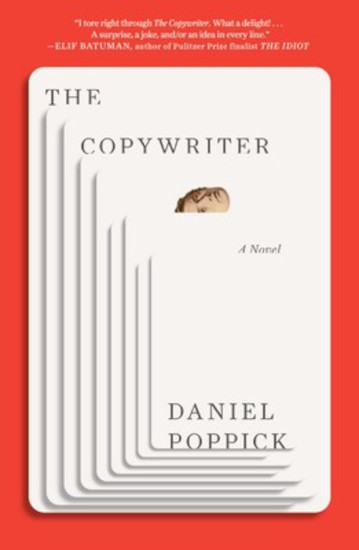
The Copywriter
By Daniel Poppick
Scribner
210 pages
Poets have never had an easy go of it, in day-to-day life or in letters. There’s not much that is expressively sublime about paying the rent, or helping a friend move furniture. Novelists and screenwriters—even some journalists—tend to hog what artistic glory exists in writing for a living. In the 21st century, Instagram and TikTok are not likely entry points for John Ashbery or Robert Creeley.
Poet Daniel Poppick is making a pretty good go of it, nonetheless. Describing his 2019 collection, Fear of Description, Publishers Weekly called him “a gifted defamiliarizer of quotidian experience” who “has begun to see everything through a lens of preapocalyptic dread.” He’s had two books of poetry published and his work has been featured in The New Yorker, The Paris Review, and The New Republic.
Now, he has penned a confection called The Copywriter, which brings to life his protagonist’s necessary day jobs as a copywriting pusher of ridiculous products and as a flak for a prominent New York City Jewish community center, all the while writing poetry and wondering how he will describe what he does for a living to the next person who asks.

(Photo Credit: Depositphotos.com)
Turns out, it’s a good question. Making a living as a poet and making a living while being a poet are not the same things, and Poppick explores this, at times deliciously. His form of poetic license tucks poems into and around the prose with titles such as “Questions to Which the Answer is ‘Night’” and “Parable of He.”
He loved the alphabet. But what he loved more was the alphabet’s shade. He arranged his calendar, his poems, and his notes like a vase of corrected flowers.
If that kind of word play is enjoyable, a reader will quickly consume this book, which is chockfull of similar observations and life annotations. In what is purported to be fiction, you’ll either be charmed or reliably put off by islands of text like, “A novel is unpaid labor, while poetry is labor’s ash.” Or, ironically, “Paradise has a limited vocabulary. Hell is more eloquent.” Agreed.
For such a scattered effort, it can be curiously dry of emotion. Given the loose theme of distaste for the arid daily corporate versus the freedom of artistic expression, you might yearn for more of the picaresque. Marketing material for the book suggests it could be a road-trip novel (among other things). If so, it’s not enough of one. Instead, the narrator irritably reads Proust while having his Subaru serviced over the course of a few days in Texas. It’s not exactly “We were somewhere around Barstow on the edge of the desert when the drugs began to take hold.”
(Photo Credit: Depositphotos.com)
So, a novel? A memoir? A chapbook? This is a book of poetry, with a plain tomato soup of a story within it. A can of Campbell’s can be just the thing on a cold day. But The Copywriter is not a novel—or at least not just that. What Poppick is striving for is a different kind of written art. As music producer Brian Eno and his coauthor Bette A. put it in their 2025 discourse, “What Art Does: An Unfinished Theory,” what an author chooses to write about “tells us that somebody takes something seriously, perhaps finds it beautiful or threatening, and invites us to rethink how we feel about it.”
To that end, Poppick succeeds. He might have done well to kill a couple handfuls of his more angsty darlings, though, despite the book’s overall brevity.
Poppick’s offering is less a proceeding narrative and more a collection of what he calls “parables” throughout. There are micro-essays and some solid straight-up poetry, and much of what you might think of as clever little handwritten notes stuffed here and there in the detritus of an existence.
Never mind what the publisher calls it—it is tough to know what the book wants to be at times. Or who. A guide prone to “psychedelic boredom” can frustrate a reader with where he is not taking you, especially when he doesn’t have a proper name. The millennial narrator is called D__, and the device is ... ironic, somehow? Using an initial in this way was a pretense fairly common in pre-20th century works, when writers of fiction wished to make it clear that a character was not based on a real person. Here, it comes off as precious.
There are clever asides in the story line when you realize that Poppick really must stride through life thinking poetically. For example, D__ is helping a friend move when his fellow opines on “the principle of office furniture … to make employees feel wealthy and degraded at the same time.”
The framework of the story (and the parables and poems and the dashed-off “dreams”) tends to run ragged. Chapters open with flung manhole covers like, “Admire the guillotine for its restraint,” before the loose narrative of the copywriter and his friends resumes.
Scribner has delivered an imaginative notebook, with verse that is both profound and nonsensical, fascinating and at times maddening. From it, you’ll get to thinking about the nature of poetry in our time, and how it lands in a world that’s falling apart politically and ecologically, which are two other faint themes in the storyline. At one point, D__ engages with a person attending his poetry reading in St. Louis.

(Photo Credit: Depositphotos.com)
“What do you think makes poetry different from the conversation that we’re having right now?” D__ asks. “Or any other experience? I kind of need to know. It’s been a weird time.”
The attendee answers, in part, with what Poppick might feel at times in his life as a poet and copywriter—that categorizing something like a novel, or how one makes a living, can be akin to artistic imprisonment.
“Personally?” the man says. “I think it’s a little carceral to draw a line, any line, between one thing and another, in any situation.”
Author Bio:
Thomas J. Walsh, a Highbrow Magazine contributor, is a Cleveland-area writer, editor and communications manager. A Navy veteran, he sits on the board of the VA’s Center for Healthcare Evaluation, Research & Promotion. He has been a staffer for The Philadelphia Inquirer, Philadelphia Business Journal, the Reno Gazette-Journal and various other publications.
For Highbrow Magazine