

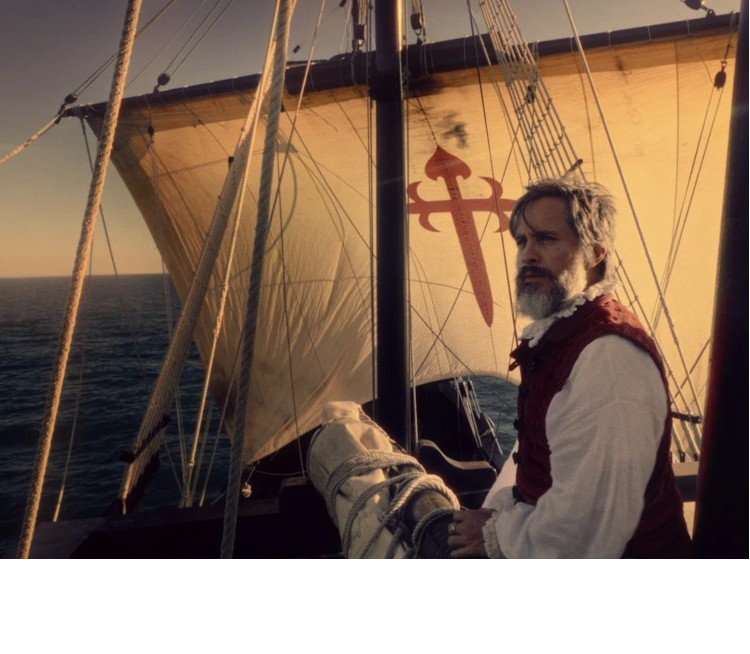
Magellan
2.5 stars (out of 4)
Starring Gael García Bernal, Amado Arjay Barbon, Ronnie Lazaro, and Ângela Azevedo
Language: Portuguese and Spanish, with English subtitles
Running time: 160 minutes
Available: Limited theatrical release, January 9, 2026
Imagine walking up to the most beautiful human you’ve ever seen. They are everything you ever wanted in a lover—the shining hair, the perfect body, the penetrating eyes. But then you engage them in conversation, and you run into an empty vessel, tabula rasa, a personality like a bucket of paint.
This, then, is Magellan, the new film from writer-director Lav Diaz, the Filipino practitioner of Slow Cinema. If you’re unfamiliar with that genre, it emphasizes long takes, little storytelling, and a minimalist approach to filmmaking. Diaz has succeeded on all counts, and will no doubt get a suitable-for-framing certificate from the Slow Cinema Society, if there is such a thing.
But we’ll get back to all that in a minute.
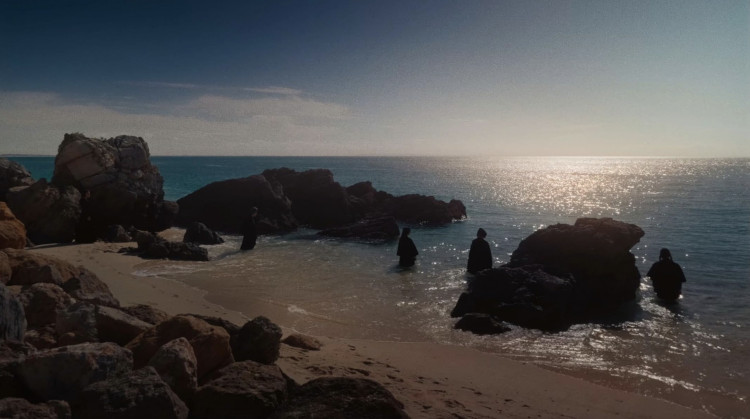
You remember Ferdinand Magellan from history class, right? The 16th-century Portuguese mariner who became the first seaman to circumnavigate the Earth. A hardy captain, face to the wind, unstoppable in his quest. The treacherous seas below South America were named the Strait of Magellan in his honor. He gave us the name of the Pacific Ocean (Mar Pacifico).
Adventurous, no doubt (also a slave owner, killer, and my-way-or-the-highway Christian evangelist). But, as it turned out, Magellan didn’t sail around the globe. He died in the Philippines, leaving the completion of the round-the-world cruise to his second-in-command.
Hey! Who just said spoiler alert?! Go back to Chapter Eight in your ninth-grade Western Civilization textbook. It’s all there.
The seafaring Magellan (played by a stone-faced, detached Gael García Bernal, whose ability to refrain from expressing emotion is a neat parlor trick) fails to get the support of Portugal’s King Manuel I for an expedition to Asia’s Spice Islands, despite a unique proposal: Magellan plans to sail west to the islands, across the Atlantic, then across the Pacific. Manuel finds this a ludicrous idea. No one has ever done it.
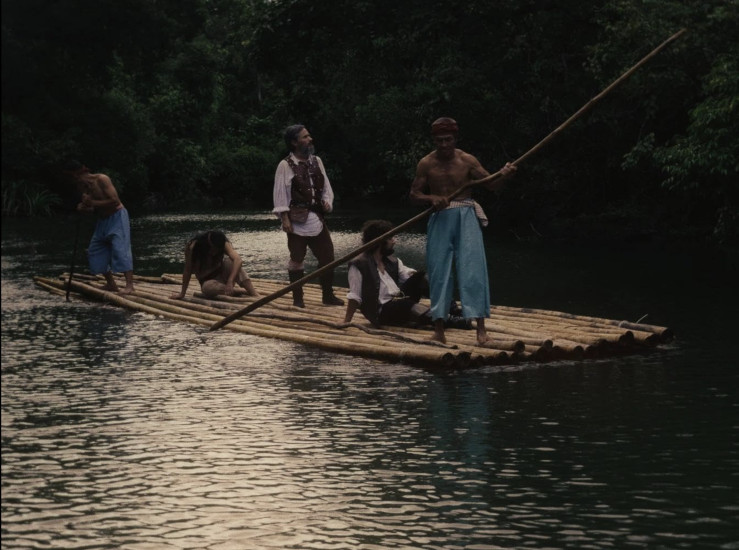
But King Charles I of Spain thinks otherwise, and provides Magellan with funding for a five-ship armada. Along the way, Magellan and his men weather storms, scurvy, and loneliness. The elements of high drama are baked into the tale of Magellan’s final voyage. So why is there no drama here?
Let’s take a moment to look at Magellan’s good points first. The cinematography is lush, impeccably styled, and painstakingly framed. Every scene, filmed mostly in a sort of twilight, looks as if it belongs in the Velázquez section of the Prado in Madrid.
Add to those inarguably arresting sequences is the unique camera work. In the entire film, the camera neither tilts nor pans. Every shot is static, as if the camera operators (Artur Tort and Lav Diaz) set up an establishing shot, then went out for coffee and a doughnut while the actors cantered about before the lens. While there are plenty of directors who have relied on this technique to some degree (Wes Anderson, Yasuhiro Ozu, Orson Welles, John Ford, et al), few, if any, rely on it exclusively.
Used well, the technique can be effective. But director Lav Diaz compounds the stationary filming by relying on unexpectedly long scenes. Magellan, sitting quietly in his cabin, hugs a statuette of Christ for a full three minutes—no movement, no dialogue, no musical soundtrack. The post-battle scene in which the dead are lined up on the beach, a scene in which there is almost no movement whatever, goes on for a stupefying five minutes. That’s asking a lot from the average (or even above-average) audience.
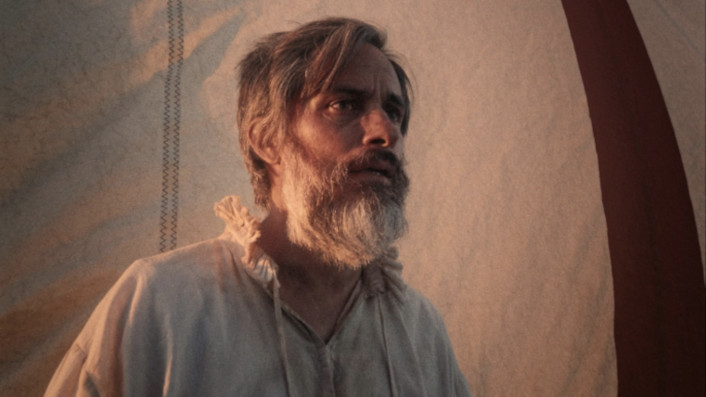
Watching Magellan (only 2 hours and 40 minutes long) isn’t as harrowing as attempting to sit through all eight hours of Andy Warhol’s Empire, but, as a director, is that a contest you even want to enter?
Filmgoers hoping for a Master and Commander-style saga of the high seas will be disappointed. A drawn-out sequence involving a storm never shows the surging of the ocean waters. In fact, the ship itself doesn’t even tilt. We see only desperate crewmen shouting to the heavens and sobbing in the rain, but there is no sense of peril, no impending doom.
Nudity pervades the film. Many of the early-day inhabitants of Cebu Island (now part of the Philippines) didn’t wear clothes. Neither do they here, in Magellan. There’s nothing erotic, though. The nakedness is much more like something you’d find in one of your grandfather’s old National Geographic magazines.
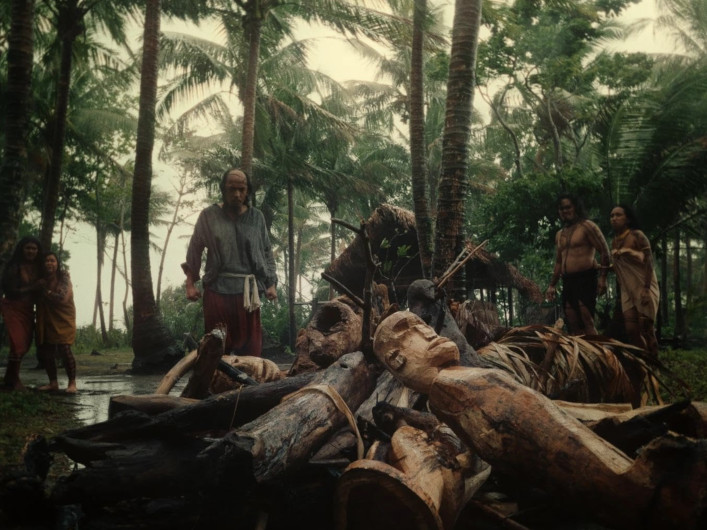
The Slow Cinema genre practiced by Diaz is also known as Contemplative Cinema, the thinking man’s film style. In the case of Magellan, I think I’ll let it go, and instead re-watch Master and Commander.
Author Bio:
Mark Orwoll writes about film and travel for Highbrow Magazine.
For Highbrow Magazine