

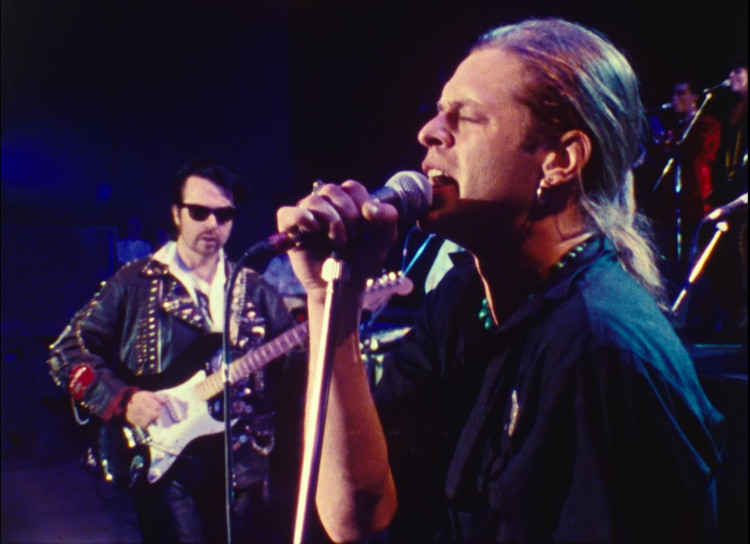
The Long Way Home: Remastered and Expanded
2 stars (out of 4)
Starring Boris Grebenschikov, Dave Stewart, and Aquarium, with appearances by Annie Lennox, Chrissie Hynde, Ray Cooper, David Crosby, Stephen Stills, and Graham Nash
Language: English, Russian (with English subtitles)
Running time: 98 minutes
Available: Private screenings (January 28, 2026, at New York’s Museum of Modern Art); awaiting distribution
Guitarist-singer Boris Grebenschikov walks the streets of New York in 1988, narrating his origin story offscreen. Raised in Leningrad (now St. Petersburg), Boris formed a rock band, Aquarium, and achieved success in the years leading up to the fall of Communism.
He’s a big deal in Russia, it turns out. Groupies write love letters on the stairwell walls of his cramped apartment building, which he shares with his wife and child. (“Boris, you’re a saint! Thanks for all you do,” says one wall scrawl. “You’re sent to us by heaven,” says another.) Girls stop him on the street and breathlessly ask for his autograph. He’s tall, talented, and, with his long blonde hair tied back in a loose ponytail, every inch the rock star. Is it any wonder that American record companies will soon come knocking at his door?
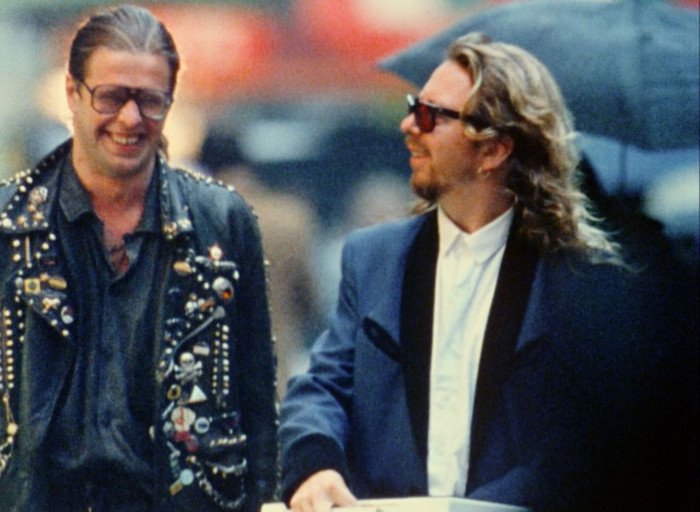
This is the premise of the recently reissued documentary The Long Way Home by the late director Michael Apted, originally released in 1989. There’s no drama, of course. No edge-of-your-seat wondering whether Boris will make it to the big time. After all, have you ever heard of Boris Grebenschikov? There’s your answer.
There is, however, the question: Whatever happened to Boris? A welcome epilogue that was recently added to the original provides an answer—one that satisfies our curiosity, if not Boris’s early dreams for his future.
The original film was produced at the height of music doc-, rock-, and mockumentaries. Between the late 1970s and early ’90s, long-haired filmmakers produced The Band’s The Last Waltz (1978), Neil Young’s Rust Never Sleeps, Rob Reiner’s This Is Spinal Tap, U2’s Rattle and Hum (1988), and The Decline of Western Civilization Part II: The Metal Years. Unlike those notable films, The Long Way Home apparently had no budget to speak of or professional equipment.
This raises another question: Why did Michael Apted do it like that? Apted (1941-2021) was among the most mainstream Hollywood directors imaginable. Among his many well-known films are such straightforward releases as Gorillas in the Mist, Coal Miner’s Daughter, The World Is Not Enough (James Bond), and TV’s Ray Donovan.
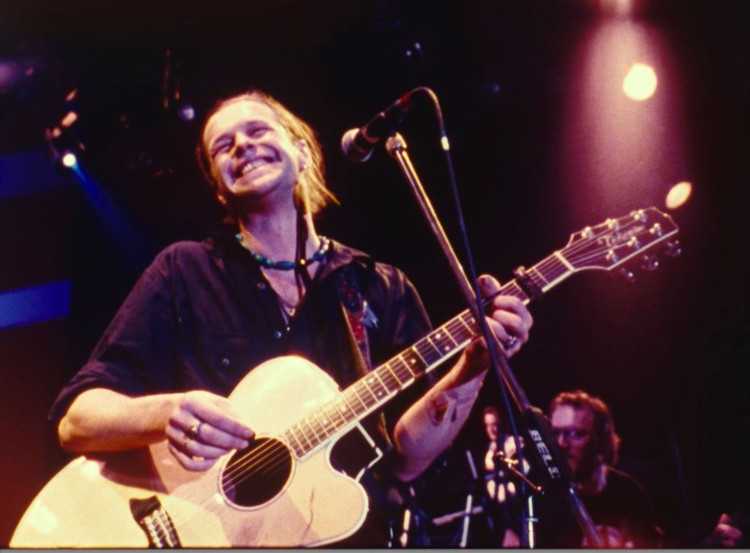
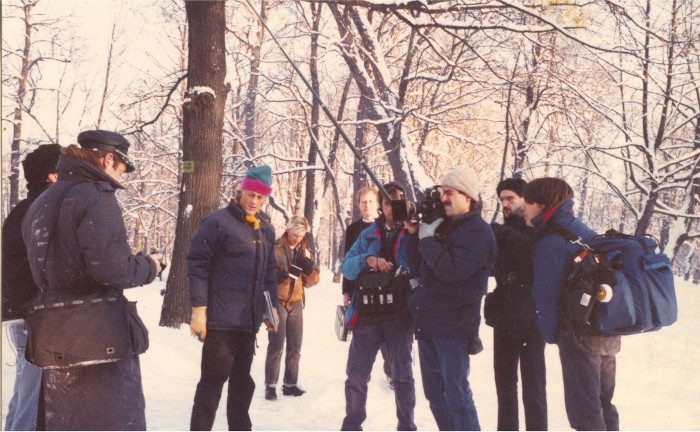
When first issued, the 16mm movie was a somewhat grainy, handheld-camera affair, with a sometimes sketchy soundtrack. This new release has been “remastered” with an epilogue, without which there would have been no need for a re-release 38 years after the fact. (Apparently, Apted wanted to add an epilogue, but died before he could.)
None of this is to say that the film doesn’t have its charms and curious attractions. Songwriter and musician Dave Stewart (Eurythmics) plays a key role as Grebenschikov’s U.S. music producer. Annie Lennox and Chrissie Hynde have cameos as backup singers. Even Crosby, Stills, and Nash show up as supporters, onstage and off. And comparisons with the faux documentary Spinal Tap loom large, including green rooms with no snacks or chairs, long and confusing walks in dark corridors to find the stage, slimy record A&R men, and other tropes of the rock world. They even perform at a concert with the slightly absurdist title, International Physicians for Prevention of War Concert for Peace.
Occasional moments of authenticity provide viewers with hope that everything will turn out well, especially when, out of the public eye, Boris’s band, Aquarium, plays traditional acoustic instruments and Boris sings old Russian folk tunes in his native tongue. But five minutes later, Boris and the boys are on stage, electrified, and singing American-style rock ballads, in English, that will never strike a chord with the audience.
The songs are derivative, lacking any sense of Boris’s Russian roots, and bland. Thousands of so-so bands have already sung the exact same sort of songs. Do we really need to import one from Russia to add to the overload?
We don’t need another John Mellencamp. We need the one-and-only Boris Grebenschikov.

The scenes filmed in late-’80s Manhattan may not have the gritty atmosphere many of us remember from those days, but they do offer up some revealing moments, as when the boys are overwhelmed at the abundance of musical instruments in a Sam Ash-like store and perplexed by the multifarious kinds of cheeses on display in a supermarket.
The Leningrad shots are more evocative of that place and time. Russia was going through tremendous upheaval in those years under Soviet leader Mikhail Gorbachev. Its citizens weren’t sure what to expect next as Communism began collapsing around them.
“The main thing you have to understand is that life here is very different,” says Aquarium bassist Sasha Titov, looking out over the Leningrad cityscape. “And people here are very different. And, well, the smell everywhere—it’s disgusting.”
And yet, we see street scenes filled with history and glorious Czarist architecture.
One of the more amusing Russian moments comes when Boris’s mother, in the midst of cooking a meal, attempts to instruct him in how to build an audience. She says the band needs to cut loose more often. “That’s what Elvis gave rock ’n’ roll,” she says. “His ‘Blue Suede Shoes’ really made the audience rock out like crazy.” I couldn’t help but recall a similar scene in the Irish musical-comedy The Commitments (1991), in which Jimmy Rabbite’s father (Colm Meaney) looks at his son sternly and intones, “Elvis is God!”
At one point, Boris confesses his great fear: that his Russian fan base will accuse him of selling out for fame in America. He’s right to be worried, because if he fails in the U.S., he’ll still be perceived as a sell-out back home. Dave Stewart doesn’t exactly inspire confidence when he says, in a rare moment of sublime self-understanding, “They’ll say that Dave Stewart completely ruined what could have been a good folk album.”
As a fan of rock-docs, I have a favorite: Anvil! The Story of Anvil. Having given up on their heavy-metal music career, the band gets back together with promises of a tour, only to find just 174 audience members in a 10,000-seat arena for the Monsters of Transylvania concert. In the end, they find unexpected success when they learn that they are “big in Japan.”
Unlike that riches-to-rags-to riches movie, The Long Way Home, in its original format, is largely unsatisfying. That’s balanced by the new release’s epilogue and remastering, done under the supervision of the original producer, Steven Lawrence, and editor, Susanne Rostock. The updated section provides the rationale for the re-release by bringing the story of Boris Grebenschikov full circle, and provides a measure of storytelling poetry to the tale.
When originally released, The Long Way Home received warm reviews, although I’m hard-pressed to explain why. Neither can I explain why Russian car-crash videos are so popular on YouTube. Historians of Russia’s Glasnost era, hardcore rockumentary junkies, fans of the film’s original release, and musical curiosity-seekers may want to stream this new edition once it finds a distributor. For anyone else, there are plenty of other “-umentaries” to choose from.
Author Bio:
Mark Orwoll writes about film and travel for Highbrow Magazine.
For Highbrow Magazine