


“Life's greatest gift is the freedom it leaves you to step out of it whenever you choose.” That quote by Andre Breton, the author of the Manifesto of Surrealism in 1924, turned a good number of believers in the rational world on their heads. He didn’t exactly mean suicide (though that was an option) but an escape from the conscious mind. In a topsy-turvy world -- does that sound familiar? – reality itself is up for grabs.
The Whitney Museum of American Art’s Sixties Surreal exhibit focuses on the decade that best exemplified the irreparable rupture in society. Over a hundred artworks from 1958 to 1972 from a diverse group of artists nationwide found resonance in the earlier movement. The universe had become a messy business – the ongoing civil rights movement, space exploration, nuclear war fears, drugs, the Vietnam War and queer and feminist sexual revolutions. The New York-centric art world no longer spoke the language of liberation these artists required.
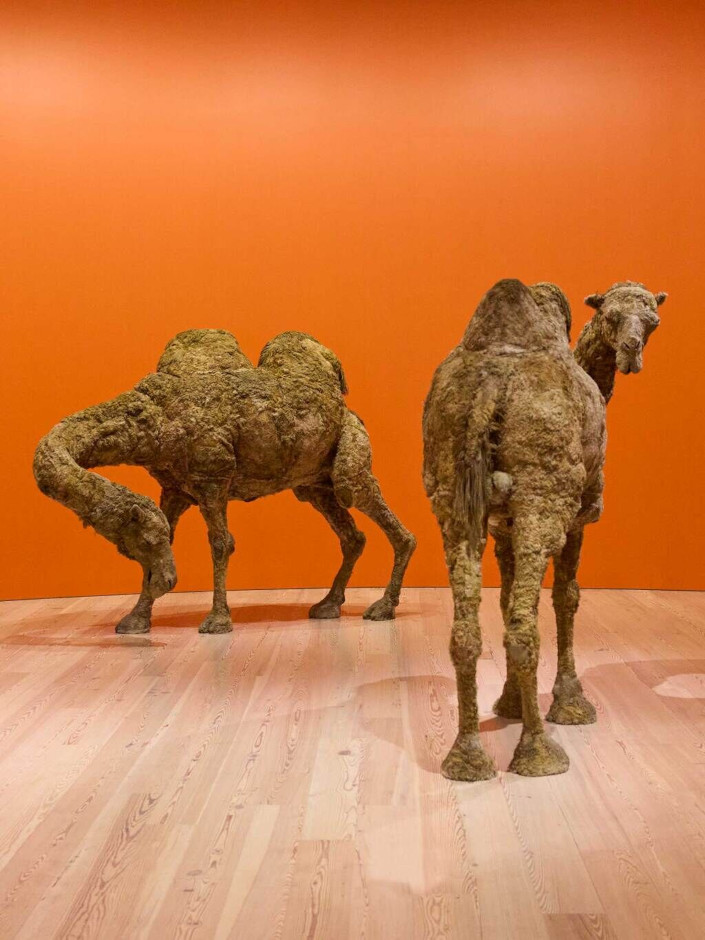
And what a language! Visitors confronting the opening arena of the exhibit can be excused for being confounded by a trio of camels. (This is not true taxidermy by artist Nancy Grossman, but a patchwork of natural and synthetic materials (Camel VI, VII and VIII, 1968-69). In the wall notes, she tells us these dromedary herds from North Africa shouldn’t exist with flesh on their hooves, four stomachs and dislocated jaws. “Yet with all of the illogical form, the camel still functions.” That’s an apt introduction for the rest of the exhibit.
The viewer initially is assailed by several video collages, primary among them Gunvor Nelson and Dorothy Wiley’s SCHMEERGUNTZ (1965), meaning “sandwich” in a nonsense language Nelson’s father invented. It’s a hypnotic pastiche on the eye, contrasting bathing beauty queens with elements of domestic servitude such as toilet cleaning.

A fixation on toilets did not go unnoticed by Claes Oldenberg, one of New York’s Pop Art celebrants, whose Soft Toilet (1966) takes center stage. In-your-face sexuality is everywhere in the exhibition, in such pieces as Robert Arneson’s Call Me Lover (1965) with male and female genitalia in the core parts of his glazed ceramic dial phone. Judy Chicago is represented by a sleek stoneware construction with sexual parts at the heart of the piece. The title is In My Mother’s House (1962-64), so you can make of that what you will.
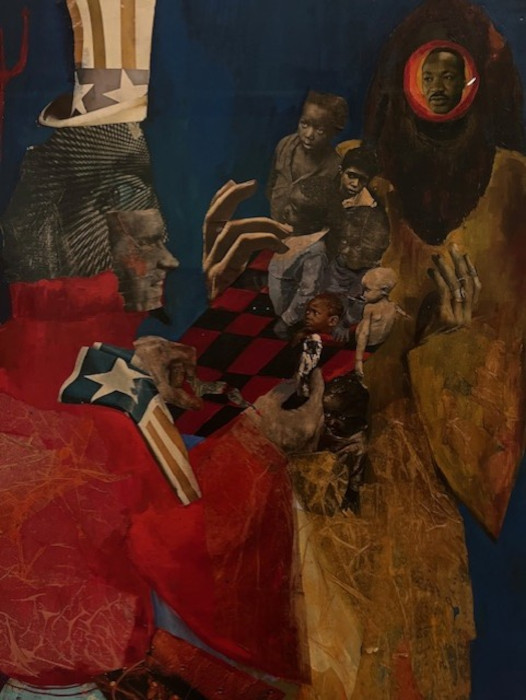
One riveting section of the exhibit, “Show of Force” exposes the emotional timbre of the times in bold, eviscerating ways. Kay Brown’s The Devil and His Game (1970) presents us with a disturbing collage of vulnerable children in the clutches of a laughing Nixon, while Martin Luther King looks on helplessly from space. A red mass in the lower frame of the canvas adds to the powerful execution. Red predominates in Luis Jimenez’s Man on Fire (1969-1970), a life-sized winged man of war who takes precedence over the room. Timothy Washington’s Viet Nam (1970) is a haunting portrait of a figure – a nightmarish cartoon of war’s waste. It also, along with Edward Kienholz’s blood-dripping John Doe (1959), challenges the very definition of surrealism. Such works transcend a mere label. They give us back humanity in its most tragic manifestations.
There are plenty of works that tickle the intellect through an elegance or cleverness of execution. Linda Lomahaftewa’s chose to honor her Hopi and Choctaw heritage with Woman’s Faces (1965-71) which gives us two faces that inform her geometrical landscape. A swirl of hair becomes a river; another’s chest is furrows of seeded soil.
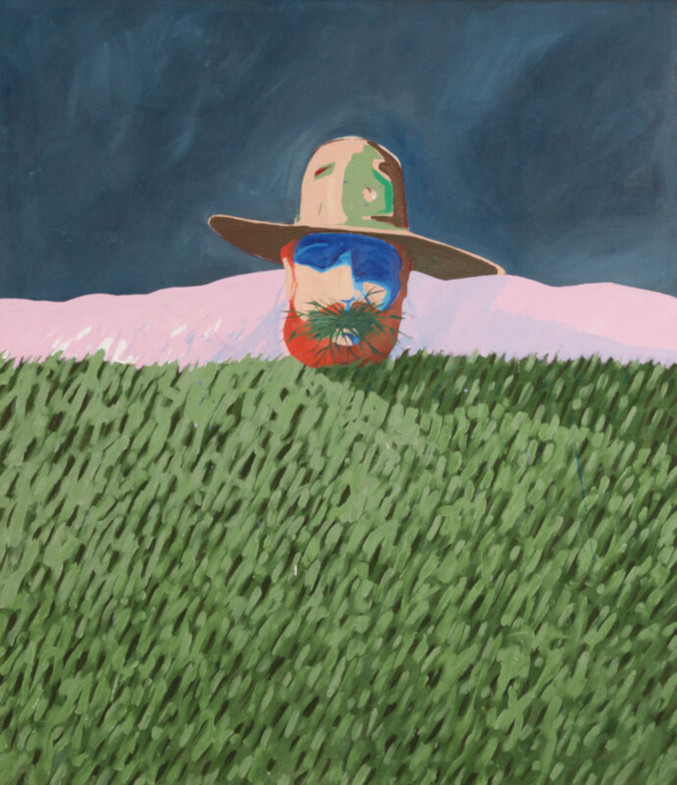
Andrew Myrick – “Let Em Eat Grass” (1970) is colorfully executed, with T.C. Cannon’s subject a head rising out of a sea of green blades, his mouth stuffed with grass. A villainous story is behind Cannon’s painting. Myrick’s quote in the title was directed at the Dakota Indians who faced certain starvation in 1865 when their crops failed. The man got his comeuppance when he was killed in retribution for the remark.
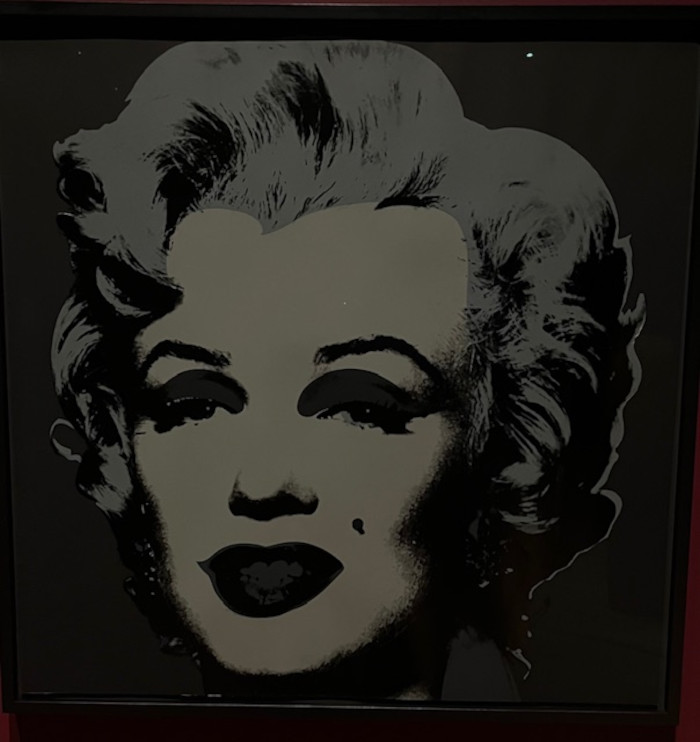
Another interpreter of his regional experiences is Mel Casas, whose Humanscape series (1965-89) depicts a drive-in movie screen with a parody of Latinx culture. The foreground is based on a San Antonio annual fiesta that celebrates the founding of Texas with the crowning of a white-only queen. These three outliers (from Arizona, Oklahoma, and Texas, respectively) bring a more profound resonance to the exhibition, holding their weight against other star representations on display -- such as Andy Warhol with his iconic Marilyn screenprint from 1967 and Marisol with her Women and Dog (1963-64) assemblage.
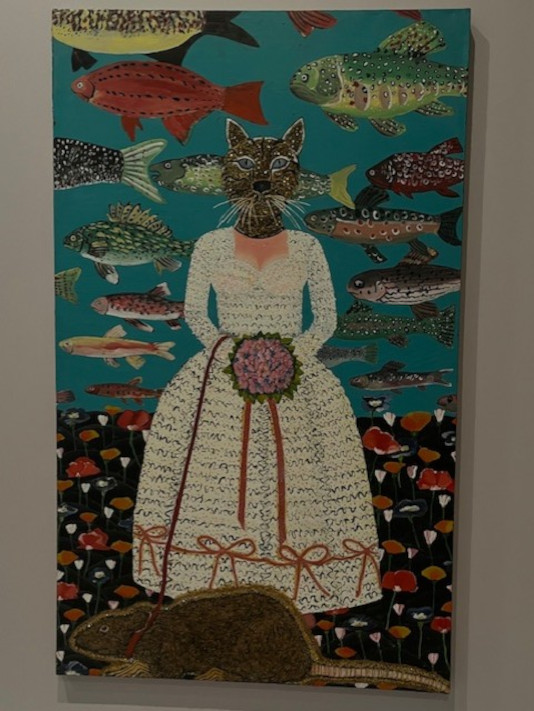
There are certain standalone pieces that seem to cry out for our attention, whether one chooses to look for a deeper meaning in their creation. One such example is Joan Brown’s painting, The Bride (1970). It’s a delicately executed image of a bride in her white pristine gown with a prominent cat’s head, schools of fish in the background, and an enlarged rodent at her feet. Barbara Chase-Riboud’s Confessions for Myself (1972) gives us a chillingly severe evocation of the artist as a religious icon in black. Hard and soft materials combined make this chimera almost real. She describes it as “visually surrealistic” and it speaks volumes to the imagination.
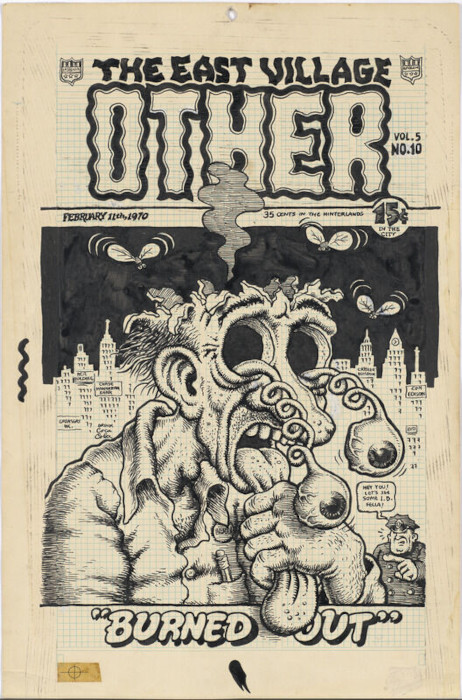
No close-up glimpse of the psychedelic chaos of the 1960s could be complete without Robert Crumb’s take with Burned Out (1970), an eyepopping grotesquerie for the cover of the counterculture newspaper, The East Village Other. For Crumb, the drawing exemplified “the end of the sixties.”
The Whitney’s focus on one of the most turbulent decades in our nation’s history is a wise choice. Even if the impetus for such an enterprise was the surrealist movement’s centenary since Breton’s founding, the unraveling of the social fabric through numerous upheavals has had an indelible effect on artistic expression. If anything, the result is too broad for one museum, however masterful the effort.
In honor of these one hundred years, the Pompidou Centre, the Philadelphia Museum of Art, and the Metropolitan Museum of Art among others have all answered the call. Right now, countless artists are returning to their studios, trying to make sense of what can seem to be an increasingly senseless planet.
The world is not done with surrealism.
Sixties Surreal is on view through January 19, 2026.
Author Bio:
Sandra Bertrand is the chief art critic at Highbrow Magazine.
For Highbrow Magazine
--All images courtesy of the Whitney and Sandra Bertrand. Published with permission.