


(Photo Credit: Depositphotos.com)
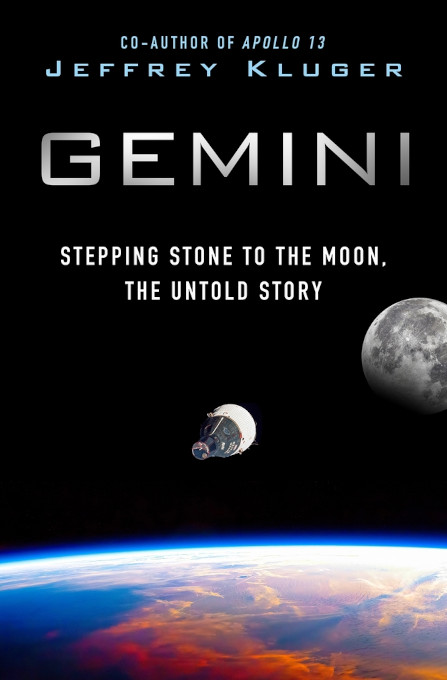
Gemini: Stepping Stone to the Moon, the Untold Story
By Jeffrey Kluger
St. Martin’s Press
271 pages
The Gemini space program of the mid-1960s might be compared with its same-age newborn cohorts of the era, Generation X. Gen Xers came after the Baby Boomers, the largest and most attention-seeking generation in American history, and preceded the Millennials, who supplanted the Boomers in those two categories.

(National Museum of the U.S. Navy—Wikimedia Commons)

The crucial and groundbreaking Gemini missions came after the swaggering heroics of the Mercury flights, immortalized in book and film by The Right Stuff and many other titles, and before the world-changing Apollo program, which of course landed the first men on the moon (and not insignificantly led to another legendary movie, Apollo 13).
The result is that the Gemini program, which had 10 manned missions—almost as many as Mercury and Apollo combined (11)—tends to get lost in the historical shuffle some 60 years on. That’s especially true because another big phase of manned-space flights—the shuttles, with their astonishing breakthroughs and unmitigated disasters—dominated NASA’s last two decades of the 20th century.
Jeffrey Kluger, who coauthored Lost Moon: The Perilous Voyage of Apollo 13 with astronaut Jim Lovell (the basis of the Tom Hanks movie), seeks to right this perceived historical wrong with his new volume, Gemini: Stepping Stone to the Moon, the Untold Story. Kluger has made a fine career chronicling the American space program in prose that manages to swing deftly from personal drama to technical details to internal NASA goings-on with solid storytelling and subtle contextualization.

(NASA – Wikimedia Commons)
What might be considered stale ground has been rendered fresh in the new book, suitable for those new to space history and those who thought they had all the knowledge they needed about those years. The narrative nicely sandwiches the subject matter between opening and closing accounts of Gemini’s better-known sibling programs.
Gemini’s duration was less than two years, spanning 1965 and 1966, and sent men into space at the rate of every eight weeks. “In that twenty months,” Kruger writes, “NASA and America had learned to walk in space, to fly long-duration missions in space, to navigate in space, to rendezvous and dock with another vehicle in space—in short, to do every little thing it would be necessary to do if the US were going to meet the pledge the martyred president John Kennedy had made more than five years before: to have American boots on the moon before the end of the decade.”
While the Mercury Seven astronauts rode in their capsules, the Gemini crews (some Mercury veterans included) piloted theirs. There were plenty of near-misses, harried and exhausting space walks, and near deaths. At one point, astronauts Wally Schirra and Tom Stafford came within seconds of ejecting from Gemini 6 as it sat atop its Titan rocket that was behaving oddly on the launch pad, a “safety” maneuver that could easily have killed them both due to the force of such a violent exit.
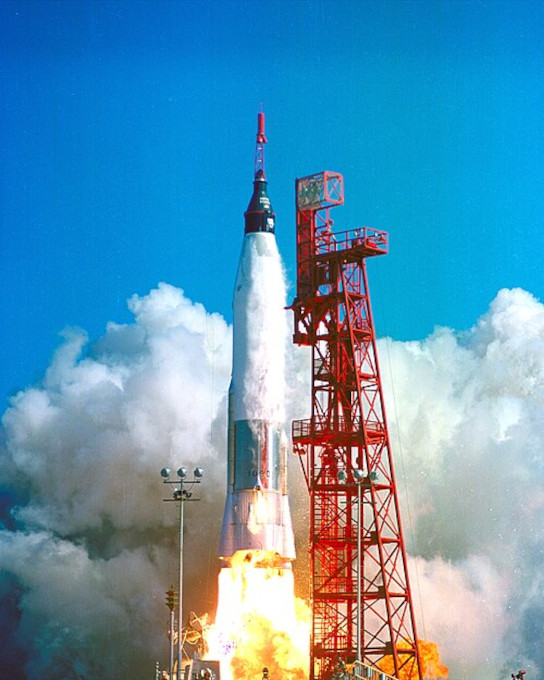
(NASA—Wikimedia Commons)

On the less pointy end of things, there is nice detail about why NASA officially pronounced the program as “GEM-in-ee,” instead of the traditional form. Named and logoed for the constellation because it featured two-man crews, Kluger reports that the engineers and military men of NASA worried about the “astrology nuts” who pronounced it “GEM-in-eye,” so “they made up their own technical pronunciation.” It is a three-paragraph aside, but the anecdote sheds much light on the precious male-dominated American space culture of the 1960s. NASA’s formidable public relations office, which comes up often in the book, even issued a press release on the pronunciation.
The Gemini program led immediately to the first Apollo effort in January 1967, which tragically claimed the lives of three astronauts—Gus Grissom, Ed White, and Roger Chaffee—as a result of a fire in their new capsule during a rehearsal. Kluger’s epilogue on this terrain is moving. Of the men who found their way to the moon, 12 were Gemini vets.
In the end, “the five-year, twelve-mission, $1.35 billion Gemini program was, by any historical, astronomical, and exploratory measure a very sweet one,” writes Kluger. “Sixteen men had gone into space across ten crewed missions—and sixteen had come home.”
In addition, it was during Gemini that the US pulled out in front of the Soviet Union in the space race, and stayed there. As with every other aspect of this exhilarating time in American history, Kluger weaves the Cold War rivalry seamlessly throughout his book. For hardcore space enthusiasts, there may not be much new here, but for general audiences looking for a compelling historical narrative that’s refreshingly short on nostalgia, the author delivers.

Author Bio:
Thomas J. Walsh, a Highbrow Magazine contributor, is a Cleveland-area writer, editor and communications manager. A Navy veteran, he sits on the board of the VA’s Center for Healthcare Evaluation, Research & Promotion. He has been a staffer for The Philadelphia Inquirer, Philadelphia Business Journal, the Reno Gazette-Journal and various other publications.
For Highbrow Magazine