

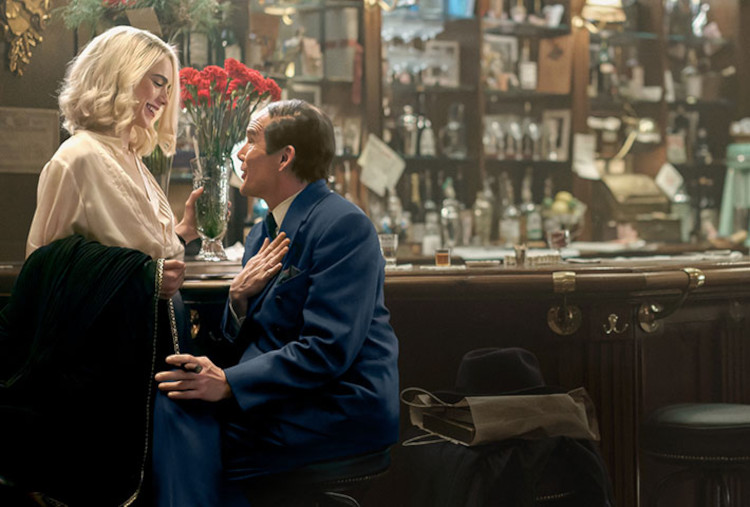
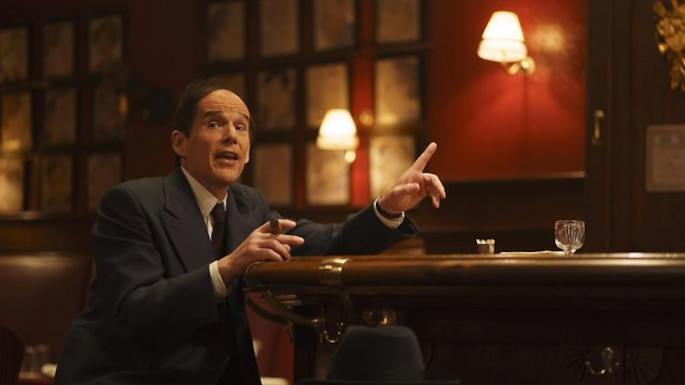
In Blue Moon, Ethan Hawke’s ninth collaboration with director-writer Richard Linklater, the actor transforms into musician Lorenz Hart, delivering what is arguably his most soulful, transformative, and deeply captivating performance yet. His portrayal of Hart showcases a side of Hawke’s talent that is raw, mesmerizing, and Oscar-worthy.
Linklater’s latest film captures a moment in Hart’s life, mere months before he dies. A figure of great renown in 20th-century American music, Hart is larger than life, filling any room he walks into. Loaded with a devilish charm; a gunslinger's fast, wry tongue; and a thirst for attention that masks his vulnerability and not-so-subtle drinking problem.

For those unfamiliar with Hart’s work, this is the underlying sadness that permeates Blue Moon. The film is a tragedy told through a comedic lens, capturing a man who is slowly coming to terms with the reality that he is about to be forgotten, as the industry passes by him.
The story unfolds on the opening night of his former colleague Richard Rodgers’s newest show, Oklahoma!, a moment that marks the beginning of Rodgers’s collaboration with Oscar Hammerstein -- the two men would go on to produce some of the most iconic musicals of the 20th century, including South Pacific, The King and I, and The Sound of Music. Realizing the success Rodgers is about to be awarded with, Hart is left as nothing more than a footnote in his friend’s success.

The film takes place at Sardi’s, the iconic New York landmark restaurant located in the heart of the theater district, mere hours after the premiere of Oklahoma! This singular location offers a unique perspective into the world of mid-20th-century New York artistry, gathering some of its most significant figures in one room, with the bartender (played by Bobby Cannavale) presiding over them. In this setting, we watch as Hart divulges his story to strangers, cracks jokes with friends who grow increasingly tired of his alcoholism, and most importantly, speaks of a young woman named Elizabeth, a Princeton student and poet, 20 years his junior, whom he plans to woo upon her arrival.
Hart speaks of love to the patrons who will listen, quoting the film Casablanca as he dissects the famous line, “Nobody ever loved me that much,” which is spoken by Ric Blaine, signaling his transformation within Bogart’s character as he relinquishes the bitterness and understands Ilsa’s sacrifice. Yet, for Hart, that line is an admission -- no one has ever loved him that much, as he is incapable of loving himself. The irony, of course, is that at Sardi’s, he is surrounded by friends and colleagues who worship his artistry and care deeply for his happiness.
Blue Moon makes no pretenses. The film opens with Lorenz Hart’s death, as the story frames itself around one crucial moment: the beginning of his perceived irrelevancy, and so seeking the validation of others to fill the chasm. In walks the drop-dead gorgeous Elizabeth (Margaret Qualley), a woman whose smile offers redemption. In her, Hart sees the chance to rewrite his narrative, to be the man he always longed to be: loved, desired, and admired.
As the final moments of Blue Moon unfold, the film leaves us with a bittersweet understanding of the complexities of fame, love, and loneliness. Lorenz Hart, a man whose contributions to music shaped the very soul of Broadway, is now a ghost in the world he once illuminated. But in the raw, aching vulnerability of Ethan Hawke’s performance, we see the heart of an artist unseen, unappreciated, yet endlessly striving. It’s a reminder that, sometimes, the most profound moments of a life are those we never fully grasp, and that perhaps the truest measure of a person is not how they are remembered, but how deeply they were willing to feel.
Author Bio:
Ben Friedman is a contributing writer at Highbrow Magazine.
For Highbrow Magazine