


My first drum lesson—my first music lesson ever—seemed to be going easy enough. It covered the basics, what to expect going forward, timing, and a few exercises. It ended with an assignment: Work on Queen’s “We Will Rock You.”
Piece of cake, I thought. Boom-boom-thwack; Boom-boom-thwack. Yes?
No, my instructor said. Do it while playing accompanying eighth notes on the closed hi-hat cymbal.
Um ... eighth notes?
I didn’t know how to read music of any kind at the time, but at least I knew what a hi-hat is—the double-stacked clomping cymbals opened and closed by a drummer’s left foot, played across the body with the right hand. The snare is struck with the left hand, the bass with the right foot. As I just started playing in March of this year, I’m reminding myself of this as much as telling you.
A closed hi-hat is that tippita-tista-tista sound, the pedal on the floor, often played with alternating quarter notes on the snare and bass for what’s called a basic rock “money beat.” But, back to Queen: “We Will Rock You” with eighth notes is tippita-tista-tista-boom-boom-thwack … tippita-tista-tista-boom-boom-thwack, your right hand tapping the cymbal constantly for two minutes.
It turns out that this is quite hard to do if the only drums you’ve ever played are a lifetime of the steering wheel congas. Normal life hardly ever requires simultaneous three- and four-limb independence. To get there, you must force open a new neural pathway, or a million, and keep plowing.
Happily, drumming strengthens a brain’s neuroplasticity, a fact that helps me muscle through a beginner’s frustration. It improves motor skills and working memory, according to studies. The concentration needed to keep varying rhythms and tempos, and hone movement with precision, trains one to focus more effectively. Hitting the skins consistently even promotes mindfulness. All good stuff as I barrel toward 60.
Drumming also makes you kind of high, turns out. It releases endorphins and other hormones, producing a seated runner’s bliss, reducing stress and generating feelings of well-being, even euphoria, like the first time I nailed a multi-drum fill on a Creedence Clearwater tune.
My old school
As for the rest of the drums, readers here probably know a ride cymbal from a crash, a floor tom from a kick drum. But humor me while I enthuse on a new hobby as it grows into a bona fide passion. I gaze at drum kits through gauzy, amber lenses these days, eyeing them as veritable steampunk sculptures with satin finishes set rightfully upon regal risers. Damn right, a drummer’s stool is called a throne.
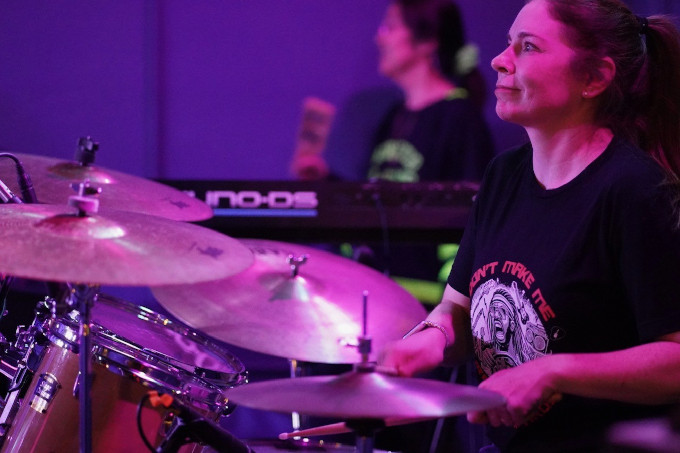
Such reverence for one’s instrument is highly encouraged at the School of Rock, the international music education program founded in my native Philadelphia and most famous for the 2003 comedy starring Jack Black. The SOR’s Highland Heights, Ohio, location is where I am a 58-year-old beginner student. I take lessons from a seasoned pro named Jeff West, a Cleveland-area native who happens to be my age. Back in our 20s, when I was in the Navy followed by college and a journalism career, West was already an established drummer and music entrepreneur in New York City. His first paid gig was in 1982, when we were 15.
Along with the lessons, in May, I signed up to be placed in a grad band -- “grad” being an SOR euphemism for “old people.” After an introductory get-together, we were given our first song to hammer out: “Waiting Room,” an ’80s post-hardcore punk banger by the group Fugazi with a wildly disjointed drums part. (The performance-based “School of Rock Method” employs a “song first” learning technique, which beats the hell out of traditional scales and dry theory. For parents, what would you prefer to hear your child practicing down the hall, “Frère Jacques” or “Come As You Are”?)
To say I found “Waiting Room” challenging is an understatement. After the first practice, I seriously considered leaving the group—falling immediately into the predictable role of flaky percussionist. But upon the next lesson with West, I was talked down with a few simplification measures. Notably, the urgent and consistent 16th notes that Fugazi drummer Brendan Canty employed like a semiautomatic handgun were cut in half for my benefit. Eighth notes had become my friend.
The band members all listed three songs as suggestions to play. One of the three for each member was selected, and mine was “Night Moves,” a favorite Bob Seger mid-tempo standard. It was not the hardest of our 11-song set to reproduce, but not the easiest either, with Seger’s sweet-husky voice soaring over odd time signatures and subtle instrumentation.
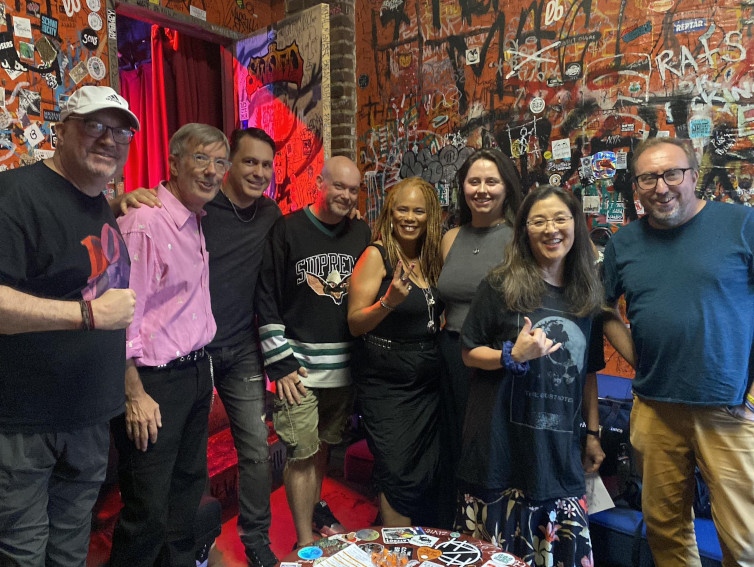
After a summer of weekly rehearsals, and a few ad hoc Sunday afternoon sessions in our keyboard player’s living room, we played our late August show at the Grog Shop, a beloved Cleveland Heights concert bar, complete with graffitied green room.
We did ... pretty good, I guess, for a bunch of novices. A common mistake for newbies, especially when performing to an audience, is to play too fast. That happened on a few of the tunes, in particular Blondie’s “One Way or Another,” which was the show’s kicker. As the drummer on eight of the 11 songs, I take the heat. That said, I’m told that keeping a slow tempo over the course of a song is often harder, and West told me that I nailed my part in “Tennessee Whiskey,” the Chris Stapleton weeper. I gratefully took that to the confidence bank.
By the way, Blondie drummer Clem Burke, who died earlier this year at 70, was an amazing and inventive musician. Listen to the song “Dreaming,” and you’ll hear what I mean—one guy creating a rolling rhythm wall that practically defines the punk rock sound. I mention it because this is the kind of thing I’ve been observing and possibly boring people in my life with a lot these days. But it’s another big positive of learning an instrument—listening to older music with new ears, and new music with a clearer focus.
‘Servicing society by rocking’
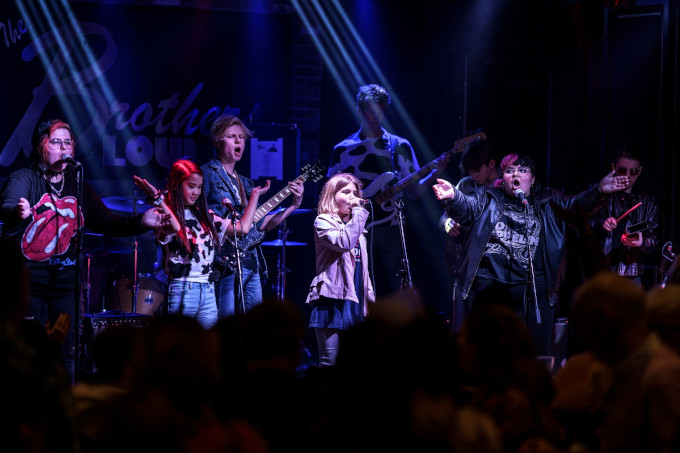
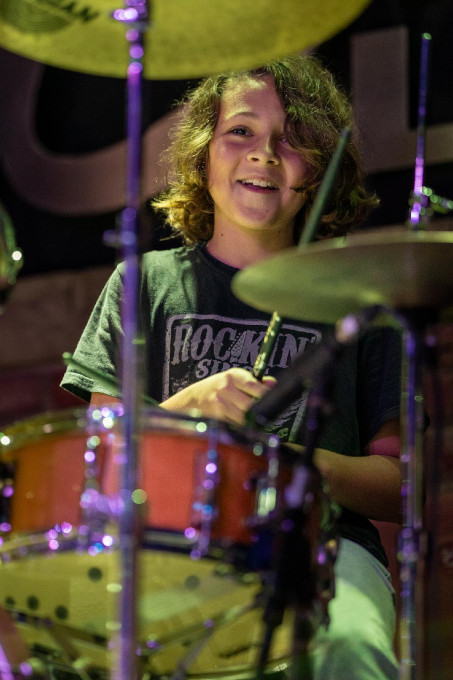
The SOR is, of course, centered mostly on the inspiring kids, and they pretty much drive everyone. I’ve seen 10-year-olds at about a quarter of my weight play in the pocket with well-practiced shuffle grooves and pound out beats with bravado using double-bass pedals. Half my current bandmates (a new semester began after Labor Day) have a child or two in the program, consistent with the rest of the adult groups. I don’t have kids, but jamming with your offspring in the basement seems to be a few steps removed from playing catch in the backyard.
There is a delight that’s hard to describe in watching three half-pints stand at the edge of a stage in front of microphones belting out a guttural “Oi! Oi! Oi!” at the commencement of the AC/DC classic “T.N.T.” But when the guitars, bass, drums, and keys kick in, you are not surprised for long at the size of the musicians. The kids bring it.
After a life of working with musicians of every stripe (including Burke and bandmate Debbie Harry), from household name rockers to jazz legends to career session folks, working with kids is “very rewarding,” West said. “I never dreamt of teaching because I got it in my head a long time ago that we’re all students, forever,” he said. “I’m a support musician. But the joy of watching each student grow is just amazing.”
West is a swift, technically brilliant, richly experienced, seemingly effortless drummer. He’s part of the SOR tradition of instructors who are actively gigging, moonlighting for an ABBA tribute band called Super Troupers.
Gigs and generally rehearsing together in a band of peers is the common Venn sector of SOR students and instructors. It’s the whole point, the fun, the raison d'être, creating even more and varied neural pathways. It recalls the teamwork of my high school soccer team from eons ago, but more so, it has brought back the intimacy of being a cast member for musicals like “My Fair Lady” from those same years—a warm camaraderie, an in-this-togetherness, a strong desire to keep up your end of the collaboration.
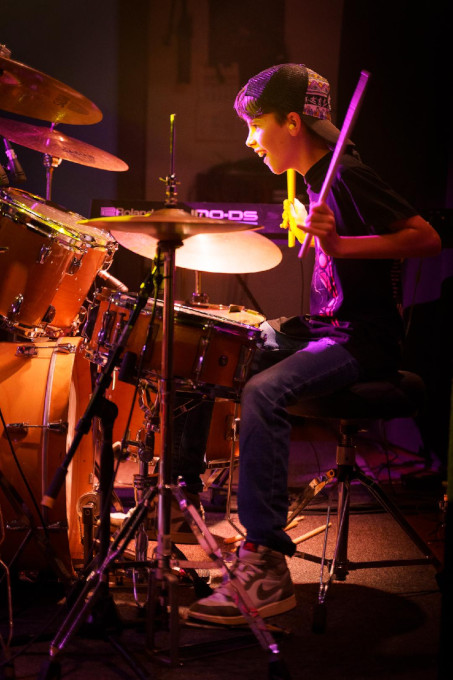
‘The radio’s playin’ some forgotten song’
Like anyone with an AARP card and a new pastime like this one, these days I peruse music equipment porn with perilous ease. The used stuff on Facebook Marketplace alone is enough to create a serious time-suck and blow out even the loosest discretionary budget.
Drum accoutrements pile up: a digital metronome was only the first purchase. There have been new drumheads, drum keys, drum-related tee shirts (Tama, Slingerland, etc.), music books, ear protection, music stands, a small used tambourine that fits on cymbal hardware, a new “splash” cymbal, a wood block. I even got a small electronic kit to use with headphones. Don’t get me started on sticks. And how I managed to avoid buying a cowbell is beyond me, but no worry—I was gifted one recently by a person who very clearly loves me.

After my second lesson back in March, I acquired my kit used, from a dad selling his away-at-college daughter’s Pearl “Road Show” set. I parted with $400 after an embarrassing minute or so of cluelessly smacking and banging the things around. The five drums came with three decent-enough Zildjian cymbals and a too-small stool. An ergonomic throne with lumbar support was the first pricey acquisition after the kit, and far from the last.
With the drums and other equipment, the lessons, and the cost of being in the grad group, I figure I’m down maybe three or four grand so far. I haven’t tried to total it up, because, frankly, I simply don’t want to. Not to put too fine a point on it, but the experience has been an investment in nothing less than my aging soul.
Besides, I’m learning Golden Earring’s “Radar Love” right now. Pull it up on your phone and crank it up loud in your car. Then try to put a price on playing that tasty drum part with a half dozen of your neighbors.

(Photo Credit: Depositphotos.com)
Author Bio:
Thomas J. Walsh is a Cleveland-area writer and editor.
For Highbrow Magazine