


(Photo Credit: Depositphotos.com)
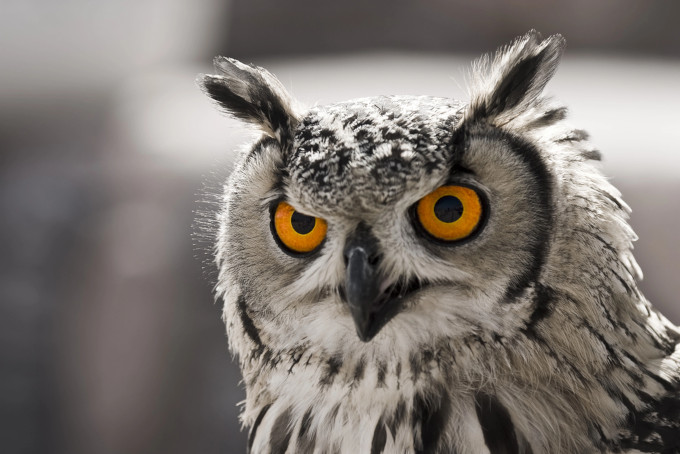
An owl allowed itself to be seen by me. I was running on the other side of the nearly dry creek, on the trail that requires me to hide my sensitive skin under layers of protective fabric. I emerged from the poison oak–choked arroyo into the foggy fields of wild oat, fescue, and brome grass, then turned up the faint two-track, relieved to be out in the open. Just after veering onto the ledge with the ocean view, I swiveled my head toward the most prominent of the oaks and detected the kind of movement that can only come from a creature with a giant wingspan. I stopped and scanned the copse of gray and green tones, hoping to spot something out of the ordinary. I did—an oblong form, seemingly frozen onto a low-hanging branch. It was a great horned owl, I think, based on its size and coloring. It looked at me—and I looked at it—for five dense and drawn-out seconds. We saw each other. And we were seen.
(Photo Credit: Depositphotos.com)
Last year, I attended a presentation at a local raptor center where the docent on duty introduced the crowd to a couple of truly majestic resident owls. “Let me be clear,” she had said. “If you see an owl, it’s allowing itself to be seen by you. I guarantee you that by the time you’ve spotted it, it’s already been aware of your presence for several minutes.” Owls can see in three dimensions and judge distances, much the way we can. They can also hear the heartbeat of their prey from 300 feet away. “You will never sneak up on this creature,” the woman said, nodding to the owl at rest on her gloved forearm, “although it may allow you to think you are doing just that.” Since then, I have made a point of recognizing my passive role in the act of seeing. If I am lucky enough to spot one of these elusive birds, I thank it for allowing me the privilege of its gaze.
My myopia is so severe that I am considered legally blind without my contact lenses. We nearsighted people—those of us who cannot see objects from a distance—have what is called a “focal point.” This is the dividing line between the part of the world we can delineate clearly and the part of the world that remains a total blur. Every year, my focal point moved closer and closer to me. By the time I was an adult and living on my own, it was only a few inches in from my face. Luckily, contact lens technology improved during the course of my childhood, and I have been sticking little plastic discs into my eyeballs for something like 35 years now.

(Photo Credit: Depositphotos.com)
When I have been partnered, I have deliberately gone to bed with my contact lenses still in my eyes. I take them out sometime later, when I get up to go to the bathroom. I tell my bedmate that I can’t stand the awkwardness of groping for the glass of water on the nightstand. Really, though, I’m afraid I might miss some key facial expression.
The eyes of owls can constitute up to 5 percent of their body weight. National Geographic says that if we had eyes of the same proportion, they would be the size of oranges. Their enormous eyes make owls farsighted—like me, now. The limitations of their farsightedness are overcome by their impressive depth perception and ability to see in low light. While they don’t see in color—they lack sufficient cone cells to do so—their low-light vision is exceptional. Owls have five times as many rods in their eyes as we do, allowing for incredibly keen night vision. They see things we cannot. In conditions where we struggle to make out even basic shapes, much less fine detail, owls can both identify objects and locate them in time and space. It seems fair to assume that they can assess their significance too—in the black of night, from far away.
There are about 200 species of owls. Owls come together only for the couple of months of nesting season; the rest of the year, they live and hunt on their own. Great horned owls mate for life, however. Somehow, they manage to find and get back together with the same partner, year after year. I wonder if they recognize each other by their feather patterns or the rhythms of their hearts? Or perhaps it’s something else: a distinct odor, a flight cadence, or even an aura that scientists can’t yet detect. I wonder, too, how they found each other in the first place, how they established that they were a they.
(Photo Credit: Depositphotos.com)
On the day I saw the owl, I kept my distance; just a twitch of my leg could prompt it to fly from the twisted limb into the darkness of the creek bed below. At the same time, those penetrating eyes appeared quite content to check me out from up above. For the owl, getting closer wouldn’t reveal any new information. Its acutely refined senses had already taken in and processed everything important about me. This bird was poised, wise, and in command of itself and its world. Everything about the owl’s presence suggested that it could never be caught off guard.
The fog was lifting, and the fields of strawberries and brussels sprouts along the coastline were coming into focus. The faded map on the kiosk back at the parking lot had indicated that another path— one I had never been on—led down that way. I pulled my shirt off, tied it around my waist, and began running toward the ocean. Then I suddenly stopped and rotated my head to look back at the oak grove. I must have sensed its gaze, still unwavering, as it followed me along this new trail.
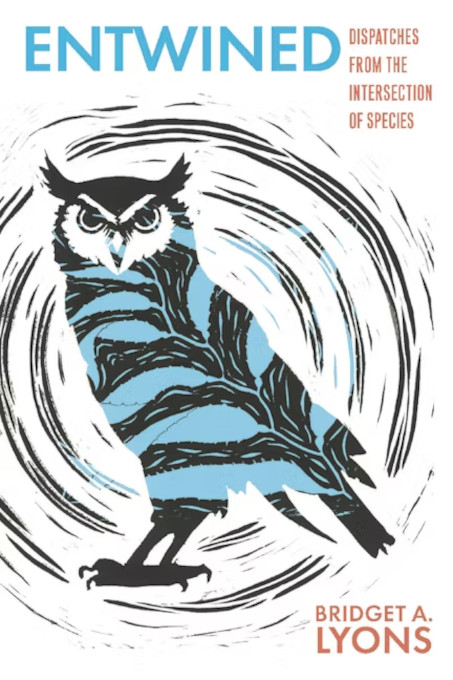
Adapted with permission from Entwined: Dispatches from the Intersection of Species by Bridget A. Lyons. The piece originally appeared in its original form in Catamaran.
Author Bio:
Bridget A. Lyons is a writer, editor, artist, and explorer whose work focuses on appreciating the creativity and diversity of the natural world and increasing our species' awareness of the creatures and landscapes with whom we share our planet.
Highbrow Magazine