


In this article and accompanying video, writer Mark Orwoll recounts his adventures in Dominica and discovering the delights of bush rum.
Read, and watch the video below.
I have a high tolerance for culinary weirdness, but in Dominica, I nearly fell to my knees and said, “No más.”
While there on a pleasant but otherwise bog-standard travel assignment, I discovered something more intriguing than recreation, restaurants, and resorts: bush rum. Here’s how it works: Take a bottle of cheap-ass silver rum, pour it into a jug, and marinate it with whatever you’ve got on the herb shelf. Step Two: Make it a national obsession. Next, serve it at out-of-the-way bush bars, often involving muddy footpaths, jungle boat rides, and, for the sake of atmosphere, a couple of Rastas sharing a spliff. Finally, pour the devil’s brew into plastic shot glasses that look like they were stolen from the cap division of the NyQuil factory.
I loved it. I loved it all—the rickety bars, the people, the nonstop reggae, the horrible but strangely wonderful rum itself.
By my last day in Dominica, I’d become a complete convert. Nick, my taxi driver, and I were bouncing down the dicey cross-island roads from the capital city of Roseau to Douglas-Charles Airport. I saw a roadside bush-rum boîte, little more than a tumbledown shack leaning about 10 degrees to starboard, where a baby and a 9-year-old boy manned the bar. As a farewell gesture to Dominica, I asked Nick to pull over. That’s where I had the unique opportunity to sample the bush rum to end all bush rums. The flavor?
One I hope never to try again in this lifetime.
Obligatory (But Mildly Interesting) History Lesson
Like so many Caribbean Islands, Dominica (not to be confused with the Dominican Republic) was perfect for growing sugarcane. When the island’s colonial overlords discovered that the molasses byproduct of sugar refining could be fermented into rum, they were off to the races.
While the French and, later, British interlopers were busy with their rum and sugarcane, the enslaved Africans who worked the cane fields and the indigenous Kalinago had learned that nearly every plant on Dominica held medicinal properties. Tabac zombie is brewed into a tea for coughs, bronchitis, and even tuberculosis. Mangosteen allegedly cures cancer. Noni, the fruit of a small evergreen tree, cuts body fat. And so on.
This sort of folk pharmacology is also called bush medicine. When the locals put two and two together—bush medicine plus rum equals bush rum—they knew that they’d hit on something profound. Today, bush rum can be found throughout Dominica, in its cafés, restaurants, roadside stands, and bush bars at the end of narrow trails deep in the mountainous central highlands.
You’d be excused for being suspicious of these concoctions. Poured into clear-glass one-gallon jars of unregulated cleanliness, the various flavors are often labeled with gray duct tape and felt-tip marker. The hygiene is admittedly dubious. One might hope that the 40% ABV of the liquor might stave off any unwanted bacteria. But you can’t be sure.
A visitor to a bush-rum bar points at a bottle, crosses their fingers, says a little prayer (“Well, nothing’s killed me so far!”), and then shoots the two ounces of piss-yellow fluid from a plastic cup in one long and fierce swallow, face scrunched up in a mighty wince, fingernails deeply dug into the wooden bar top.

How I Lost My Bush-Rum Virginity
I traveled to Wotten Waven, a village in the Roseau Valley known for its hot springs. One of the more popular of those springs is called Ti Kwen Glo Cho, which translates to “little corner of hot water” from Creole (the island’s second language, after English).
After an hour bouncing between the 113-degree Fahrenheit bath and icy river-fed shower, I repaired to the rudimentary bush bar near the entrance. The bartender was a 30-something local named Sharon. Behind her were dozens of gallon glass jars with handmade labels: some familiar (rosemary, plantain, turmeric, aloe vera) and others I couldn’t describe if you paid me (chadon beni, carpenter, ti kwen, paracetamol). I doubt they’d been approved by the local health department.
“Sharon,” I said, “I’ve never had bush rum before. Which one should I try first?”
Without a word, she gave me a look that said, “Lightweight,” in no uncertain terms. Then she stepped purposefully to the shelves, pulled a bottle from the top rack, and set it on the bar with a clank. The label said, “All Purpose.”
Despite the rum’s industrial name, I thought maybe I’d hit gold. This was the Irish stew of bush rums: anise, pepper, rosemary, cinnamon, peppermint, and for all I knew, a pair of sweaty gym socks. (Each brewer uses their own recipe.) It was my first bush rum, after all. I wasn’t looking for nuance. I wasn’t there to grade the brew for clarity, mouth-feel, nose, or legs. I simply wanted a snootful so I could say that I’d tried it. My goal wasn’t a tickle in the armpit; I wanted a punch in the nose.
“How do you drink it?” I asked. “Do you sip it? How do the local people drink it?”
Sharon gave me a sideways “Is he for real?” glance. Then she mimed someone downing a shot in a single swallow.
I did as she suggested. The rum filled my nostrils until they burned. The back of my throat nearly constricted from the shock. My god, the bottom of my tongue sizzled.
It was delicious.
Rum in the Garden of Eden
Several days later, I found myself in the northern mountain village of Bornes, inland from Dominica’s second city, Portsmouth. There, Dian Douglas and his wife, Caren LeBlanc-Douglas, built Paradise Valley, a 60-acre garden that may be the most beautiful place on one of the Caribbean’s most beautiful islands.
It’s worth your time to stroll through the garden pathways of pineapple, cacao, and mangoes, coconut palms, hibiscus, and bromeliads, and hundreds of other native and imported flowers, shrubs, and trees. Dian’s family name is on the Douglas-Charles Airport. His cousin is a former prime minister. The Douglas name rings loudly “up north” on Dominica.
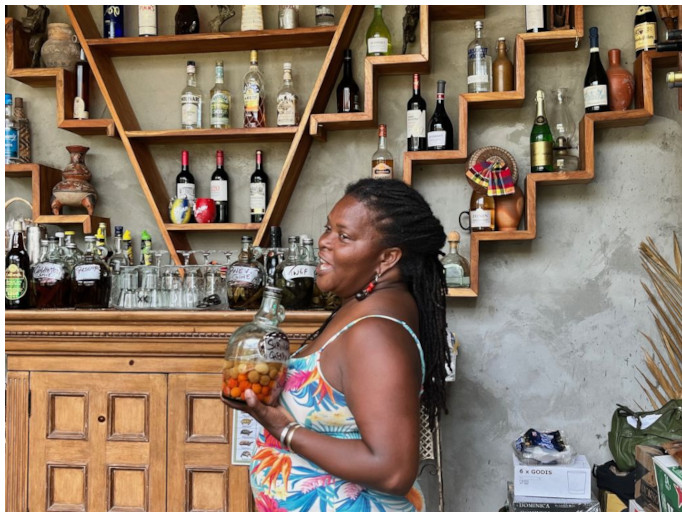
These days the gardens are mainly used for events—weddings, receptions, corporate getaways, birthdays ending in 5 or zero, and such. Dian and Caren have recently built a quasi-outdoor dining and drinking area, including a bar lined with, you guessed it, bush rums.
Caren saw me look longingly at the jars. She didn’t even ask for my preference. She simply pulled down a jug marked “Cinnamon” and poured it into a shot glass. Then she looked at me and doubled it.
Caren could have poured any of several flavors, most of which were, and are, beyond my comprehension: pwev gihe, rosecamp, mere, twefr. The names sounded more like distant civilizations in a Star Wars movie than flavors of rum.
“The cinnamon bush rum warms your spirit,” Caren said, as if sensing that my spirit was somehow not up to par.
The cinnamon bush rum did indeed warm my spirit. I also felt my mouth tingle, my throat come alive, and my knees begin to buckle.
Rum Is Medicine
The Kalinago people used to be called Carib Indians by outsiders. They came to Dominica from the Orinoco River area of South America sometime around 1000 A.D. They are the last aboriginals in the Caribbean, recognized as an indigenous people by the United Nations. After a thousand years in Dominica, they know the plant life like they know their own parents.
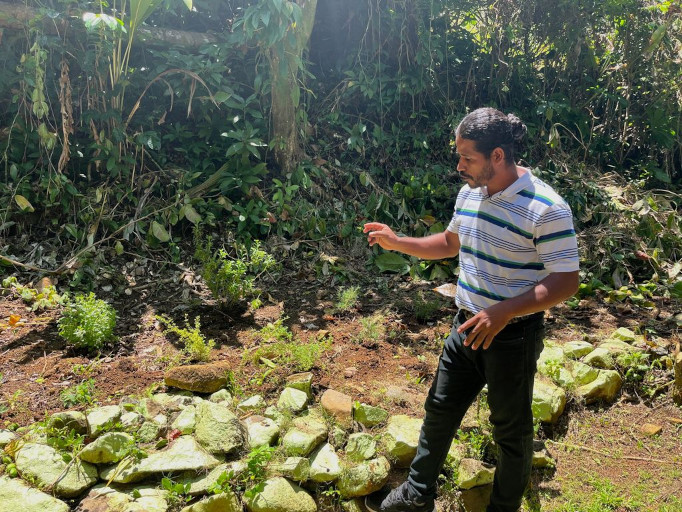
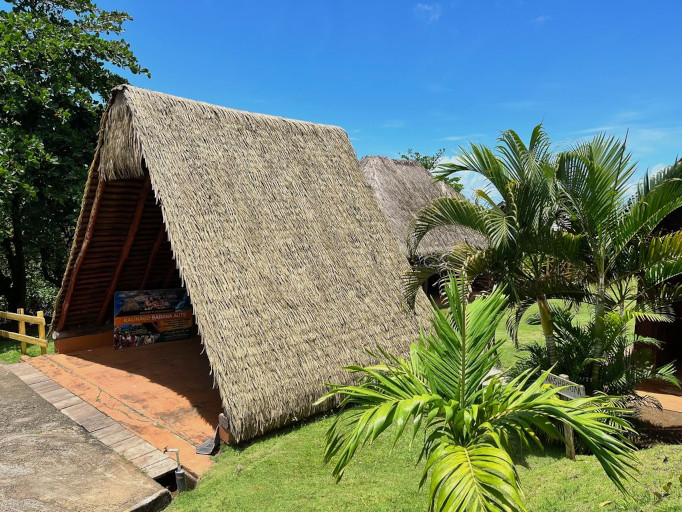
Kendrick Auguiste is a guide at Kalinago Barana Aute, a cultural village that makes and sells Kalinago crafts and food on the rugged Atlantic coast. Auguiste, who wears Western clothes, speaks in educated tones, and ties his hair in a hipster-style man-bun, is anything but a music-hall native catering to tourists.
“When it comes to education and healthcare,” he said, “we blend the modern and the traditional. We use the plants here to stay healthy.”
He pulled a noni fruit from a tree and cracked it open.
“Smell it,” he said, handing it to me. “What does it smell like?”
The odor was overwhelmingly reminiscent of bleu cheese, and I said so.
“Exactly,” he said. “For us, it’s an immune enhancer.”
The juice of the noni fruit can be fermented into alcohol. Other medicinal fruits and herbs are infused into rum.
“We use lavender for the flu,” he explained, “rosemary as a memory enhancer, ginger for antioxidants, and turmeric as a natural antibiotic.”
But do they get drunk on it, I ask?
“No,” he said. “We use only a spoonful.”
The slacker in me said, “Yeah, right.”
Marijuana Bush Rum—Not as Good as It Might Sound
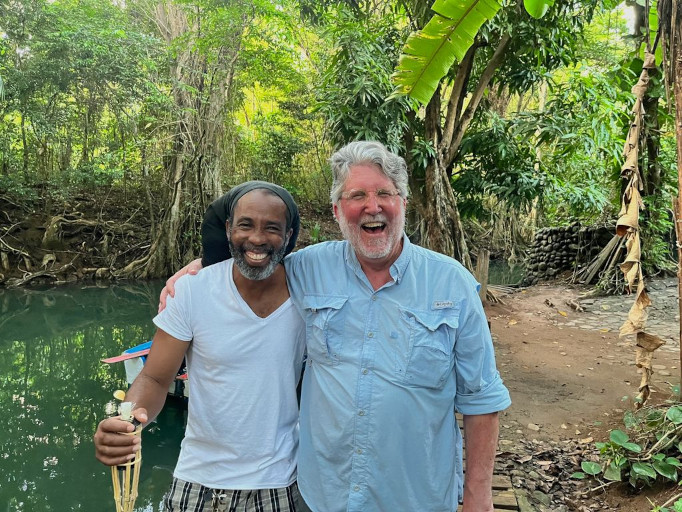
The Indian River—so-named for the indigenous Kalinago who used it as a highway for trade—is the longest and deepest of Dominica’s 365 rivers. Today, it’s a popular spot for visitors to float through the bush and get back to nature. Our boat, a seven-person wooden craft with a small outboard motor, was captained by a middle-aged Rasta, Basil, who guided us deeper and deeper into a jungle that got darker and darker as we proceeded.
Mangroves and palms grew out of the water. The river was quiet, spooky. On either side of us were freshwater ferns and termite-resistant white cedar. We kept an open eye for chirping frogs, crabs, boa constrictors, and black-bodied, yellow-breasted bananaquits.
“Two weeks ago,” Basil said, “I saw a boa on the river. It was about five feet long. I don’t bother him; he don’t bother me. Another time, an iguana fell out of a tree right into my boat. Surprised everyone.”
After 30 minutes or so, we stopped.
“OK,” said Basil, “we gonna be here for 15 or 20 minutes, or whatever you wish.”
A rough-plank walkway lined the bank, and a carved wooden sign said Bush Bar. We tentatively clambered out of the boat onto a dirt path that led to a jungle tavern, an open-walled, arch-roofed structure furnished with little more than a small counter and a half-dozen tables. The menu was handwritten on a whiteboard. Among the choices of bush rum were an herb spelled chok-chok, something called bitterwood, and marijuana.
Weed, in Dominica, has been decriminalized for possession of under one ounce, so I was unlikely to go to jail even in the less likely event that the cops raided a jungle bush bar 20 miles from next-to-no-place. I ordered the marijuana rum. I drank. I swallowed, albeit reluctantly. The rum tasted like the ash end of a half-smoked Winston. No high. No warmth. No nothing.

Do You Smell Garlic?
Nearing the end of my stay in Dominica, I took a public bus south to the diving center of Soufriere. The tourist season was over, there were no cruise ships in port, and all the restaurants were closed. So I walked 2 miles south to the village of Scotts Head, at the southernmost tip of Dominica, where the Atlantic and the Caribbean clash.
Chez Wen Cuisine, right on the water, was the only restaurant open. Chickens and roosters stepped tentatively past the feet of the diners, pecking for crumbs. A Dominican family made a fuss over the baby at their table, cooing at it and laughing. Five beachy young French guys ordered round after round of local Kubuli beers, growing louder with each new serving. On the shoreline, inches from where we sat, the nearly nonexistent waves flapped onto the shingle beach. In the distance, to the north, I could see Soufriere, from where I had walked, its Catholic church standing out from the green backdrop of hills, thanks to its yellow façade and distinctive belltower.
I ordered a garlic bush rum and a bottle of Jamaican Red Stripe. My waitress splashed the hooch into a rocks glass, a healthy pour that was at least double the usual shots I’d had up to now. I drank. The garlic rum didn’t burn my mouth as much as my esophagus. Thank God I’d ordered the Red Stripe to clear away the sting. The rum was the strongest I’d had so far, its flavor overwhelmed by the infusion, tasting as if a garlic clove had somehow alchemized into a pale-yellow liquid.
It occurred to me, sitting at the outdoor table above the Caribbean Sea, with the dramatic leafy cliffs of Dominica on the horizon, that bush rum, at least for me, was as much about the setting as the infused liquor itself.
I thought back on the bush bar in the jungles of the Indian River, the “All Purpose” concoction at the Ti Kwen Glo Cho hot pools, and the cinnamon rum among the lush gardens of Paradise Valley. Each had its physical charms that contributed to the experience.
And now, here I was, where two great seas collide, on the deck of a tiny fish restaurant that hardly anyone’s heard of, a million miles from anywhere, sipping (sipping, mind you, not shooting) an extra-large shot of garlic bush rum, with another on the way.

Do Well, Grasshopper, and Remember to Shoot, Not Sip
After only one week, I had completely dived into the vibe. When my driver Nick and I saw the near-hidden bush bar en route to the airport, I had to pull over and have one for the road.
Nick, being a professional driver, declined my offer of a shot. But nothing was stopping me.
I asked the mother behind the bar (the kids were just watching TV) which of her potions took the longest to infuse. She tentatively shifted her gaze from the lemongrass, rosemary, and pineapple rums to the other side of her bar. She almost looked guilty.
“What are those?” I asked. “The ones on that side?”
She looked askance as if she didn’t want to answer me.
“Those?” she replied, hesitantly. “Those are the animals and insects.”
The wha?
Bottles of rum shuddered under the weight of snakes and lizards, spiders, and whatnots. I tamped down my nausea as best I could.
“What’s your favorite?” I asked.
She pulled a clear-glass jar off the shelf and set it down before me. Inside were a jumble of shapes, with legs and wings and big-eyed heads. What was left of the bodies was burned white, as if they had been bleached in the laundry basin.
Grasshoppers.
She raised her eyebrows to double-check that I was serious. I nodded. She poured. I drank.
The grasshopper rum was better than I’d expected. I detected some floral notes and a smooth finish. I didn’t wince or moan. I was beginning to like bush rum. Honestly, I was grossed out, but putting on a manly face.
“That was excellent,” I told the bar lady. “That might be the best bush rum I’ve had.”
She smiled, almost bashfully, happy to accept the compliment.
“In that case,” she said, still smiling, “have another. On the house.”
Grasshoppers have many moving parts. They have oddly hinged legs. They have big buggy eyes. They can devastate vast swaths of the American heartland, ruining the crops. Maybe grasshopper bush rum was one step farther than I wanted to go. Or maybe not.
I had a plane to catch. But next time, I’ll focus on the animal and insect side of the shelves. Who knows what sort of disease I just might find a cure for?

Author Bio:
Mark Orwoll is the author of four books, including the recent travel memoir Just One Little Hitch. He was on the staff of Travel + Leisure for 30 years and is now a freelance travel and food writer for numerous print and online publications.
For Highbrow Magazine
Photo Credits: Mark Orwoll