

(Photo Credit: Depositphotos.com)
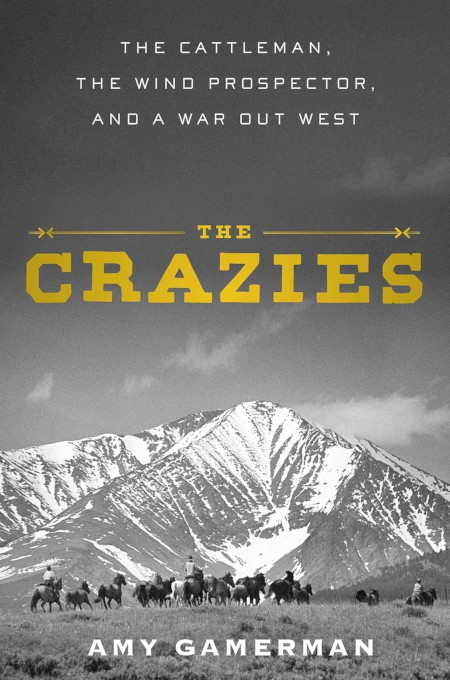
The Crazies: The Cattleman, the Wind Prospector and a War Out West
by Amy Gamerman
Simon & Schuster
464 pages
If there’s one thing the state of Montana has plenty of—aside from mountains, sheep, and big sky—it’s wind.
Here’s how Amy Gamerman, longtime contributor to the Wall Street Journal and author of a new book of reportage, The Crazies, describes it:
“The wind touches every aspect of life in Big Timber. It rattles plate-glass windows in their frames on McLeod Street, where tourists shop for T-shirts and tractor caps at Gusts department store and the old-timers gossip over coffee at Cole Drug. Golden eagles and red-tailed hawks use it to hunt, catching a gust as it bounces off a ridge and surfing it like a wave as they scope the prairie dog towns below. Townies joke about the wind, the way it will pluck the dollars from your hand and steal the lawn chairs from your yard. The uninitiated have been locked out of their vehicles when the wind slammed shut car doors left carelessly open.”
(Photo Credit: Depositphotos.com)
The Crazies chronicles a 20-year saga involving a fifth-generation cattleman and owner of 2,000 acres of prime Montana territory, and his ill-fated campaign to introduce wind turbines on his land. In opposition to this effort, a motley array of billionaires and cattle ranchers battle against this project. Legal fireworks ensue.
Gamerman does an impressive job of laying out the story. Rick Jarrett, struggling to survive financial woes nearly synonymous with farming and raising cattle, learns of the benefits of building massive wind turbines on his land. In his view, this project is both environmentally-friendly and potentially lucrative:
“If he got one Vestas wind turbine with a nameplate capacity of 1.8 megawatts, he’d earn at least $3,600 a year. If twenty such Vestas wind turbines went up on his ranch, he’d earn at least $72,000—on top of one-time installation fees, annual land rental payments, and other incidentals … Over the life of this theoretical project, Rick could collect $1.8 million.”
But opposition quickly arises, based on complaints from neighboring farm owners (“neighbors,” in this context, often live miles apart from each other) as well as issues around wildlife preservation, the rights of Native Americans, tourism, and—as always in such cases—blatant examples of NIMBY.

(Photo Credit: Depositphotos.com)
These opponents employ every tactic possible, from property-rights lawsuits and acrimonious public hearings to spreading unflattering or misleading information about Jarrett and his associates.
Gamerman delves into these issues, and the often-colorful characters driving the story. There’s Jarrett and his dutiful daughter Jami; Marty Wilde, a volatile and eccentric wind prospector; Russell Gordy, an oil and gas billionaire “with the power to make trouble”; and David Chesnoff, a wealthy criminal defense lawyer and prominent figure in Big Sky country.
Then there’s a neighboring farmer, Jan Engwis, who is bitterly opposed to wind farms in his area:
“Engwis would eventually shift the focus of his anti-wind farm rhetoric from the tourists to the locals—specifically, the golden eagles and bald eagles that inhabited his ranch and built nests the size of treehouses in its cottonwoods and sandstone ledges … The Engwises’ didn’t just see the mule deer, pronghorns, bears, and eagles, they lived with them, experienced them.”

(Photo Credit: Depositphotos.com)
Many players populate this statewide drama, and it’s challenging at times to keep track of them all. The author’s strategy of including long bios of some of these players may or may not help readers muddle through.
Also, more than a few digressions fill the pages of The Crazies—the history of wind power, forays into regional zoning laws and Montana statutes, prior land-use conflicts, the ancestral rights of the Crow Nation, and so on. These only serve to delay what readers are presumably after here—the dramatic courtroom drama scenes where, in fact, the book springs into life.
The crux of the issue, according to lawyers defending Jarrett in the court trial, was that the plaintiffs “had brought a nuisance case riddled with baseless claims against a state-of-the-art renewable-energy project that would provide electricity to twenty-six thousand Montana homes and benefit the local economy. The case … boiled down to one question: whether the project’s opponents should be allowed to effectively shut down a lawful, economically beneficial development just because they didn’t like it.”
Depending on your viewpoint, the outcome of the trial may be reasonable, saddening, or infuriating. In any case, The Crazies—cleanly written and thoroughly researched—succeeds in evoking Montana’s majestic terrain and its strong-willed inhabitants.
(Simon & Schuster)
Author Bio:
Lee Polevoi is Highbrow Magazine’s chief book critic and author of The Confessions of Gabriel Ash.
For Highbrow Magazine