


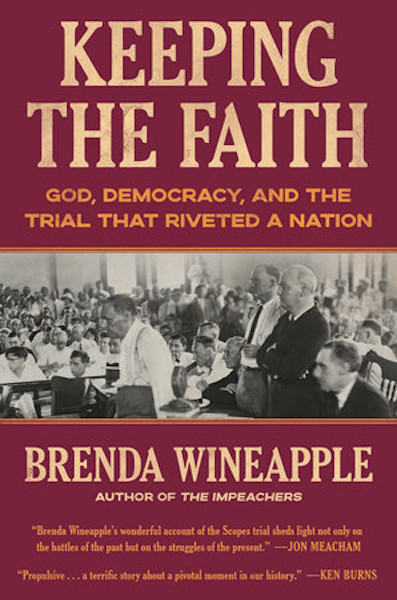
Keeping the Faith: God, Democracy, and the Trial that Riveted a Nation
By Brenda Wineapple
Random House
544 pages
Keeping the Faith by Brenda Wineapple tells the story of the infamous “Scopes Monkey Trial” unfolding in Dayton, Tennessee, in the summer of 1925. A high school teacher, John T. Scopes, was hauled into court for defying the Butler Act, which prohibited the teaching of evolution in state-funded schools.
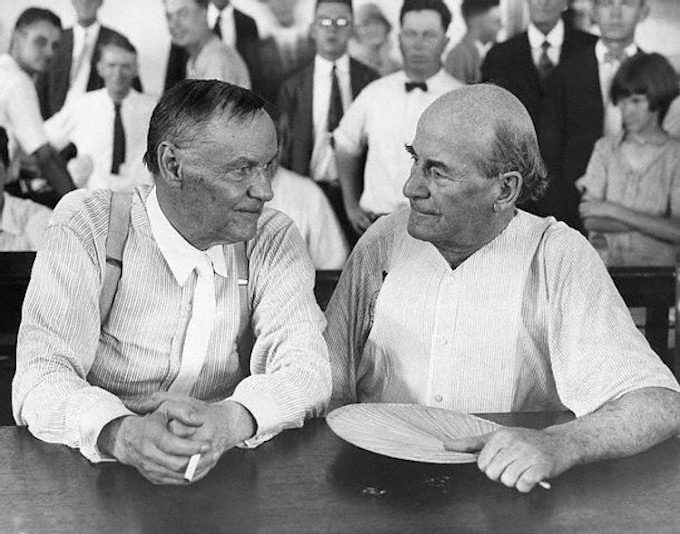
The trial generated international attention when a pair of heavyweights from opposing sides descended on the small Southern town: William Jennings Bryan, a staunch Fundamentalist and serial candidate for the U.S. presidency, and Clarence Darrow, a legendary attorney known for his fervent defense of free speech and other progressive causes.
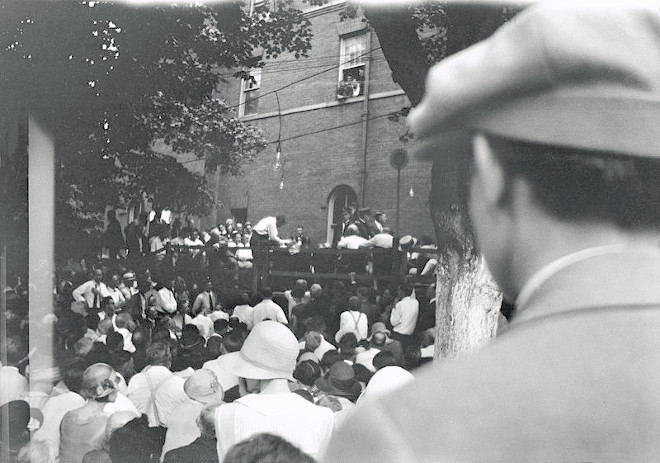
While a contentious mood reigned inside the courthouse, outside a circus atmosphere prevailed:
“There were lemonade and hot dog stands set up around the courthouse, and evangelical preachers sermonized day and night on the courthouse lawn … Two chimpanzees had been brought to town; their trainers offered them as exhibits for the defense, and when Scopes’s lawyers politely turned them down, the trainers displayed the chimps in an empty store. At the railroad junction, the brakemen on passing trains would holler, ‘All out for Monkeyville.’”
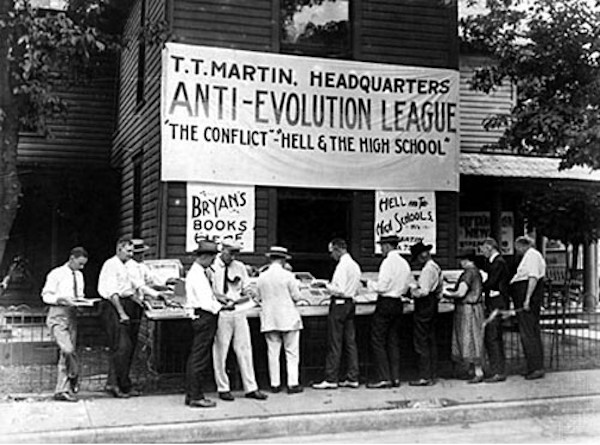
The first half of Keeping the Faith focuses on the backgrounds of the two protagonists, but particularly on Bryan’s long public history as an advocate for Christian religion. At the same time, Wineapple writes about more tangential subjects arising at this turbulent moment in American history:
“The Scopes trial reached back to the era just after the Civil War, when industrialization, immigration, and urbanization threatened institutions like the church, that had once seemed—whether or not they were—coherent, comforting, and foundational. And the Scopes case stretched forward to the next century, the twenty-first century, our century, when once again schools would try to outlaw certain modes of teaching or remove books from library shelves or even rewrite them in part or whole.”
An accomplished historian and author of The Impeachers, Wineapple takes her time setting up the story. In a leisurely manner—perhaps too leisurely—her narrative encompasses Prohibition, the Ku Klux Klan, and the pseudo-science of eugenics. The trial itself doesn’t come to the forefront until some 200 pages into Keeping the Faith.
Not only does this threaten to dampen interest in the “main event,” but the long section on Bryan effectively skewers him for his outdated, borderline-racist views. This only lessens the great public figure’s stature well in advance of the courtroom confrontation with Clarence Darrow.
When the main event finally gets going, Wineapple proves to be an energetic courtroom reporter.
For Darrow, the issue was that “a Fundamentalist reading of the Bible mandated by a state legislature would easily lead to a devastating loss of civil liberties.” Bryan, for his part, regarded Darrow as “an infidel of the most contemptible kind.”
A few stylistic eccentricities distract from this otherwise compelling story. For example, the city of St. Louis is named “Saint Louis,” while H.L. Mencken, the famous correspondent of that time, is referred to throughout as “Henry Mencken.” But overall, Wineapple impressively recounts the epic drama taking place in the sweltering heat of a Tennessee courtroom.
Early in the trial, a prosecutor rails against the influence of “heathens” and “atheists” and their attack on religious values. In an aside to a fellow defense attorney, Darrow asks: “Isn’t it difficult to realize that a trial of this kind is possible in the twentieth century in the United States of America?”
Yes, it is difficult to realize—even as similarly anti-democratic sentiments run rampant well into our own century.
Author Bio:
Highbrow Magazine chief book critic Lee Polevoi is the author of two novels, The Moon in Deep Winter, and The Confessions of Gabriel Ash.
For Highbrow Magazine
Photo Credits: Brown Brothers (Wikimedia Commons); Wikipedia Commons; Mike Licht (Flickr, Creative Commons); Wikimedia Commons; Random House.


