

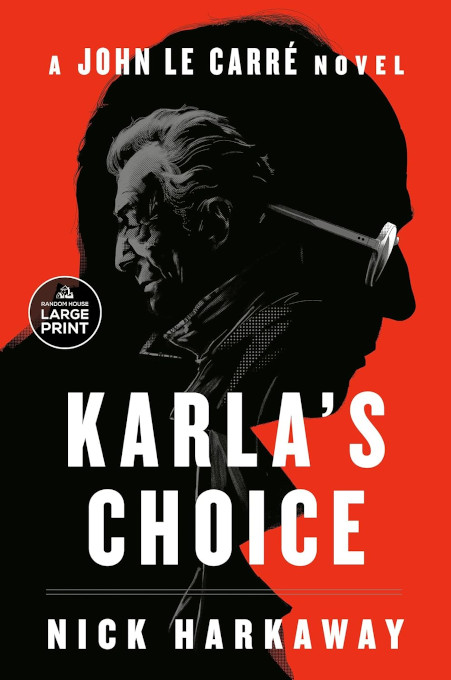
Karla’s Choice: A John Le Carré Novel
By Nick Harkaway
Viking
300 pages
Nick Harkaway, the pseudonymous author of the new novel Karla’s Choice (dubbed by the publisher “A John Le Carré novel”), is the son of John Le Carré, also a pseudonym.
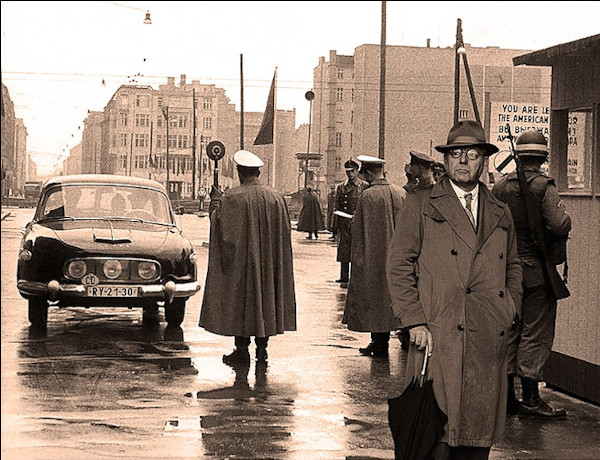
Karla’s Choice takes place in the early 1960s, during the years between Le Carré’s literary triumphs, The Spy Who Came in from the Cold and Tinker Tailor Soldier Spy. The latter novel, together with The Honorable Schoolboy and Smiley’s People, comprise the famous “Karla trilogy.”
In a brief foreword, Harkaway describes how, following his father’s death in 2020, he came to write about the legendary spymaster George Smiley. Harkaway divides his prospective readership between two camps: those who will “love the book whatever it is, because their attachment to George Smiley and the Circus [British intelligence] is so deep that any slight touch of his hand is enough to bring them joy” and those in the opposing camp “who for the exact same reason, cannot conceive of reading it, and whose hackles rise at the mention of my absurd hubris.”
Although I find myself in the first camp, it’s worth asking: How can anyone—even Le Carré’s enormously talented offspring—add to the George Smiley legacy?
Early on, Harkaway demonstrates a clear familiarity with Le Carré’s prose rhythms and insightful throw-away lines. For example, a female character reflecting on her employer “recognized him with a young but not inexperienced woman’s unfailing instinct for difficult older men.” Later, at a high-level meeting inside the Circus, Smiley is seated at one end of a conference table and his boss Control (the aging mastermind of British intelligence) is seated at the other end: “Toby Esterhase was sitting in the middle, turning his head like a dog watching a tennis match.”
The appearance of a potentially high-value Russian defector triggers Smiley’s reluctant return to the Circus. Try as he might to resist it, the paranoia bred into him after years of clandestine life swiftly kicks in:
“The notion of constant danger was a madness that men in his profession must both inhabit and put aside, and the truth was more complex: that the world could change in an instant from clear and kind to desperate and cold, and the trick to survival lay in knowing the instant before it happened, and not when. This was a skill he had once possessed, but could not guarantee until he tested it again. By the time he reached the Circus he was, as he had been for the three preceding decades of his life, afraid.”
In the new novel, Smiley learns about his mysterious Soviet counterpart, codenamed Karla, planning acts of treachery from deep within Moscow Center. Later, in Tinker Tailor Soldier Spy (surely one of the great works of fiction in mid-20th century literature) the discovery of a “mole” Karla has placed near the very top of the Circus leaves the agency blighted with despair.
Harkaway is a skilled mimic of his father’s colorful dialogue, thumbnail character descriptions, and attention to setting. The dialogue rarely strikes a false note, though at times, Smiley seems far more talkative than elsewhere in the Karla trilogy.
If anything, judging by the remarkably dense and complex world-building in Harkaway’s previous novels (such as Angelmaker and Tigerman), he displays considerable restraint in the service of this far more tightly written story.
But what’s missing here is a deeper texture of the milieu of those times, and the Cold War malaise afflicting Smiley and his compatriots. A few too many pages in Karla’s Choice are clogged with unnecessary exposition and conjecture about possible outcomes. The storyline is challenging enough without awkward dialogue devoted to summary, while some plot mechanics—including a breakneck car chase across the East European landscape—feel very much out of character.
One hopes the John Le Carré estate isn’t focused on monetizing every possible cent from the great man’s legacy. Since 2020, there has been the posthumous (and, some say, unfortunate) publication of his novel Silverview, the collected letters, more biographical disclosures about his personal life, and now Karla’s Choice—a well-executed, but borderline-gimmicky “John Le Carré novel.”
Maybe I’m in the second “hackles rising” camp, after all.
Author Bio:
Lee Polevoi, author of the novel The Confessions of Gabriel Ash, is Highbrow Magazine’s chief book critic.
For Highbrow Magazine
Photo Credits: J. Saudek (Wikimedia Commons); Depositphotos.com
