

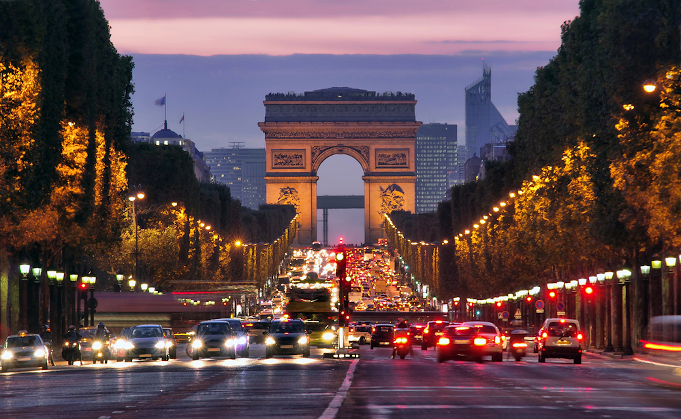
My borrowed Paris apartment takes up the entire fourth floor of a Haussmann-era building. It’s elegantly furnished and filled with art. The owners—he, Parisien, she, Américaine—have installed a well-equipped guest space for friends and their adult children. I use it as my office and for coffee breaks, perfect for a live/work Paris séjour (stay).
This time it’s mostly work. I’m in Paris to write an article on the best croque monsieurs in the city for an online food magazine. I consider it “my” apartment because, after several stays, it feels, indeed, like mine. The location is in the 7th arrondissement, nicely situated near the border of the 5th and 6th arrondissements, which include the neighborhoods of Saint-Germain-des-Prés and the Latin Quarter. It’s just a few blocks from the Musée d’Orsay, the Bon Marché fancy food market, and countless art galleries, antique shops, bistros and cafés, like my regulars, the Deux Magots, Café de Flore, and La Palette. On the Right Bank, just across the Seine’s Pont Royal and only minutes by foot from the apartment, are the Louvre and the Tuileries. My Paris hood.
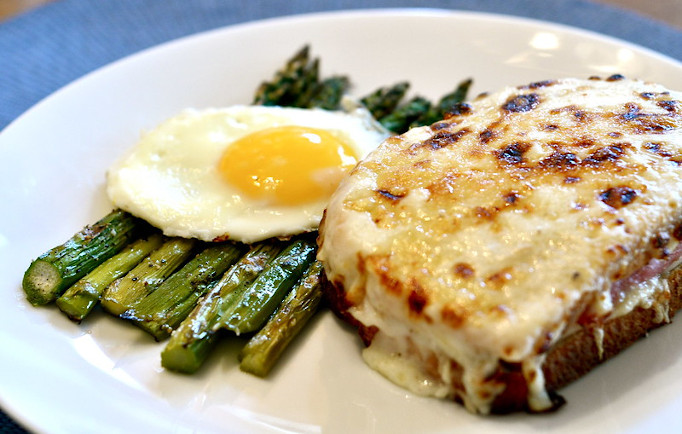
I fall asleep this first night chez moi to the vague rumblings of the Metro trains that pass deep beneath me. My jet lag symptoms are minimal in the morning, thanks to the brief stopover in New York, so I’m ready to go to work. After a café crème at a small café near the apartment, I head to La Palette on rue de Seine for my first croque monsieur. It’s a delightful, leisurely, 20-minute stroll to the café through the 6th.
The café has strong ties to the Left Bank art scene, but these days, it’s mostly a hangout for Parisian millennials, well-to-do older residents, and the global tourist bobos who frequent the area’s high-end art galleries, shops, cafés, and restaurants. La Palette is just one long block from the École des Beaux-Arts, the famed art and architecture school associated with France’s centuries-old chain of conservative art institutions (The Academy) that artists of the late 19th and early 20th centuries rebelled against to create a “modern” art. Passing by the school en route to La Palette, I notice that the gates are open to its large entry courtyard on rue Bonaparte. This, after several years of closure for renovations funded by Ralph Lauren. I make a mental note to come back and explore the campus.
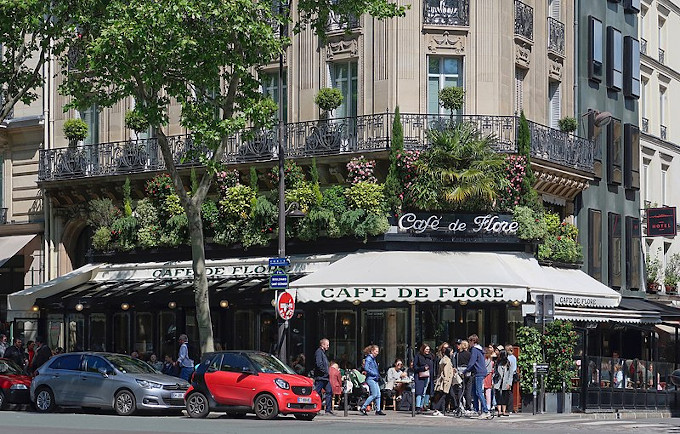
Arriving at the café, I note that the table I’d like to sit at is empty and sports a Reserved sign. This is always the case with this sidewalk power table next to the entrance to La Palette, reserved for regulars. I settle for a small table on the terrace and peruse a menu. My assumption is that the croque will be first class (I’ve been to the café many times but have never had its croque monsieur), but there are no guarantees, given the now well-documented decline in the quality and quantity of traditional Parisian cafés.
Paris’s shrinking reputation today among the world’s culinary capitals (Hong Kong, Copenhagen, New York, San Francisco, and the Costa Brava in Spain) has been noted by food critics for decades, and they may be right, though I have my reservations. Paris will always be Paris, and for the most part, Paris couldn’t care less what the rest of the world thinks about its food or anything else for that matter. There is also a croque madame on La Palette’s menu, the same sandwich as the monsieur, but served with a fried egg on top. Legend has it that the egg represents a woman’s broad-brimmed hat, and hence the madame. Croquer is a French verb meaning “to crunch” or “to munch” and nothing says “café” more than the “crunchy mister.”

Marcel Proust, a café society fixture before he withdrew to his sickbed to write his masterpiece, In Search of Lost Time, mentions the croque in the novel. The working title of my Zester article is a somewhat snarky homage to Proust—“In Search of Lost Croques”—based on an assumption that my croque critique will reveal a decline in this signature café treat.
I place my croque order and prepare to take pictures discreetly and document in my journal what I find. The lunch crowd is buzzing around me, and as at the Deux Magots yesterday, I’m happy as a clam in chowder. The croque arrives in due course accompanied by a rather sparsely dressed green salad. The leaves look dry, no vinegary sheen. I request from the garçon some lemon wedges to add sparkle (acid/moisture) to the greens (one returns a dish in Paris at one’s peril) and then dig into the croque. It’s served on Paris’s ubiquitous high-end rustic loaf from the legendary Poilâne bakery, and the construction of the sandwich is unusual—open faced. Sufficiently cheesy and crusty, it lacks the creamy béchamel sauce one expects. I also prefer a less heavy, less sour pain de mie (French white bread) for croques. Nonetheless, a well-prepared and tasty déjeuner confection.
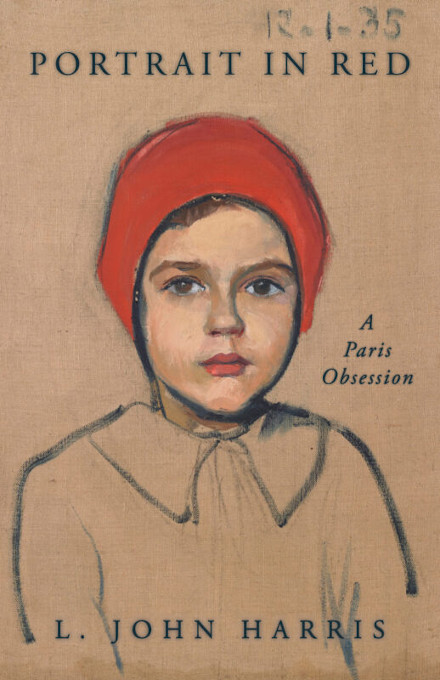
Having noted in my journal the ingredients, cooking method, flavor and appearance of the croque, I pay the bill and head toward the Seine for a leisurely stroll home. So far, so good. Day one, croque one. I am delighted to be back in my food journalist groove, totally unprepared for what will stop me short just a few steps from the café in a junk pile on rue Guénégaud—a portrait of a young girl. I pick it up, examine it carefully, and after a long ruminative pause, take it home.
Arriving back at the apartment with my found object, my guilty treasure, I measure the canvas—15 × 22—and name it, rather literally and after careful consideration, “The Girl in Red.” Red because it’s the only dominant color in the portrait besides black—the so-called absence of color. There is a bit of brown in her eyes and eyebrows and in the few strands of hair that peek out from her head cover, and hints of a pale gray-blue in areas of the image’s bold black outline.
Placing the painting on the mantel over the fireplace in the apartment’s grand salon, I can’t take my eyes away from it. The girl seems to be looking through me to something off in the distance. I see her, but she doesn’t see me. What is she looking at through those dark sad eyes? The unsigned painting is dated January 12, 1935. Does she see the war that will consume Paris, Europe, and the entire world in a few short years?
I can’t know it, but this is the beginning of a years-long obsession, a labyrinthian quest to find the story behind “The Girl in Red.”
Adapted from Portrait in Red: A Paris Obsession by L. John Harris (Heyday Books). Published with permission.
Highbrow Magazine
Photo Credits: Depositphotos.com; KimberlyKV (Flickr, Creative Commons); Rawpixels (Creative Commons); Pixabay (Creative Commons); Pixabay (Creative Commons)