


We’ve all heard the expression “the power of print”. There’s no place better to that maxim than in the rich and turbulent birthing of Mexico. Culminating in the revolution of 1910, mural and printmaking came to express the very soul of a nation.
The Metropolitan Museum of Art’s current exhibition, Mexican Prints at the Vanguard, shines a light on examples of almost 2,000 Mexican prints spanning the mid-18th to mid-20th centuries in their holdings. What is even more surprising is that such a remarkable collection was almost single-handedly assembled through the effort of a French-born artist, Jean Charlot.
Living and working both in Mexico and New York, he came in direct contact with the most relevant publishers and artisans of the day. He was also a prolific artist in his own right. Having studied under the great Diego Rivera, he produced over 70 murals in his lifetime as well as innumerable prints and paintings. As a child, he was exposed to a collection of woodcuts in his great uncle’s house, becoming a master of that art, teaching countless working-class children, and encouraging a unified national culture.
Born in 1852, Jose Guadalupe Posada’s animated skeletons have become for many an instantly recognizable symbol for Mexican art. The Day of the Dead, celebrated in early November each year, continues to have enormous appeal. But the first press was established in 1539 near the Zocalo, the heart of Mexico City. Woodcuts and engravings of religious subjects were plentiful but by the time of the revolution, prints as organs of political persuasion were an indispensable tool for educating the masses. The principal medium for newspaper illustration became the art of the woodcut. El Machete was embraced by the Union of Technical Workers, Painters, and Sculptors and in 1924 was the official paper of the Communist Party.
Cultural and commercial relations between the U.S. and Mexico fueled interest in Mexican art and from the mid-1920s, the Weyhe Gallery in Manhattan published and arranged exhibitions for muralists Orozco, Rivera, and Siqueiros, among others. Perhaps the best-known print in the exhibition sold by Weyhe to the Met is Rivera’s lithograph of the revolutionary hero Emiliano Zapata.

The Met’s aim to embellish the public’s perception of Mexican art in 1930 produced an abundant exhibition, with the prime intention of presenting a positive image of Mexico after the revolution. The Met’s then curator Rene d’Harnoncourt (later director of MoMa) noted it as “an attempt to show the artistic aspects of the origin and development of Mexican civilization from the Conquest to the present. It includes only works of art that express Mexican ideology, characterized by the fusion of Indian and foreign elements.” The colonization by the Spanish with their obvious cultural influences was excluded.

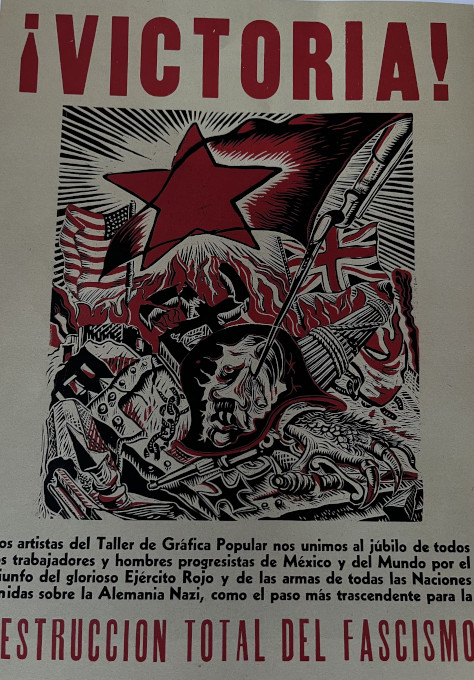
The role and evolution of revolutionary texts cannot be stressed enough. Printmaking rather than murals became a dominant force. The League of Revolutionary Writers and Artists (LEAR) organized exhibitions and established schools for workers. In its wake, the Taller Editorial de Grafic Popular (TEGP) was formed in 1937 and became the most influential of presses and the longest lasting. Led by Leopoldo Mendez, one of his most riveting prints shows a teacher murdered in the presence of his students. Accused of promoting secular education, an estimated 300 rural teachers were killed between 1935 and 1929. Another bloody poster on display by Angel Bracho celebrates the Allied victory over the Nazis at the end of World War II. Hitler’s eroded face is the brutalized centerpiece.
Mexico became a magnet for international artists during this period. American Elizabeth Catlett produced the Negro Woman series when she moved to Mexico in 1946 to work with the TGP, where she remained for 20 years. Her activism, which she described as “important to the struggle to organize the unorganized,” led to her classification in the U.S. as an “an undesirable alien.” Catlett became a Mexican citizen in 1962.
Conversely, the great illustrator and cartoonist Miguel Covarrubias, whose work was heralded in the New Yorker and Vanity Fair, moved from Mexico to New York in 1923. His lithograph of the Lindy Hop is a stylistic and joyful interpretation of Harlem dancers.
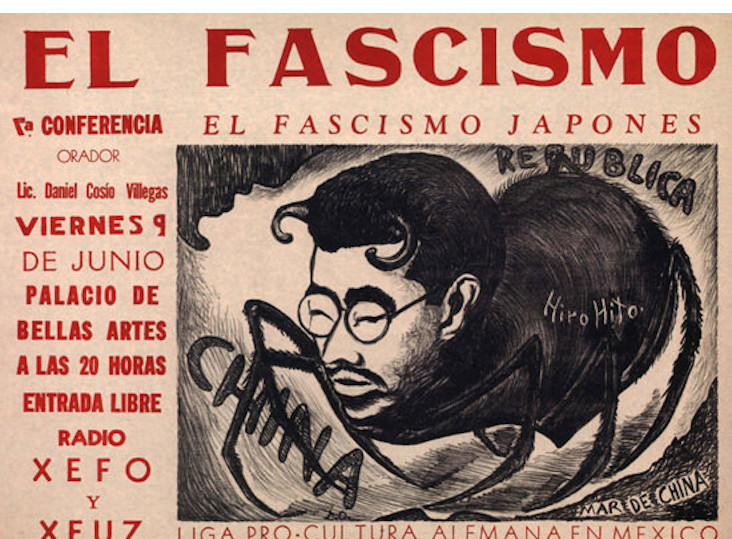
One group of exiles, Los Contemporaneos, opposed the dogmatism of the muralists. They viewed surrealism as a “way to astound itself in a different way.” One of Charlot’s gifts to the museum on display is Carlos Merida’s abstract surreal woodcut composition from 1936. Though surrealism was one way to protest an overreaching regime and there existed healthy interactions among the groups, the bold new styles of Mexican artists held sway. Posters protesting the rise of fascism were best exemplified by this burgeoning illustrative expressionism. The Poster advertising a meeting in Mexico City to discuss Japanese Fascism (1939) transforms its subject into an ominous spidery villain.
Gabriel Fernandez Ledesma, an artist-advocate for public art, said “The poster is the theater, the mural decoration and the book that cannot wait to be visited. It goes out into the street, and from the wall shouts its message to the passersby. The voice of a good poster is always heard.”

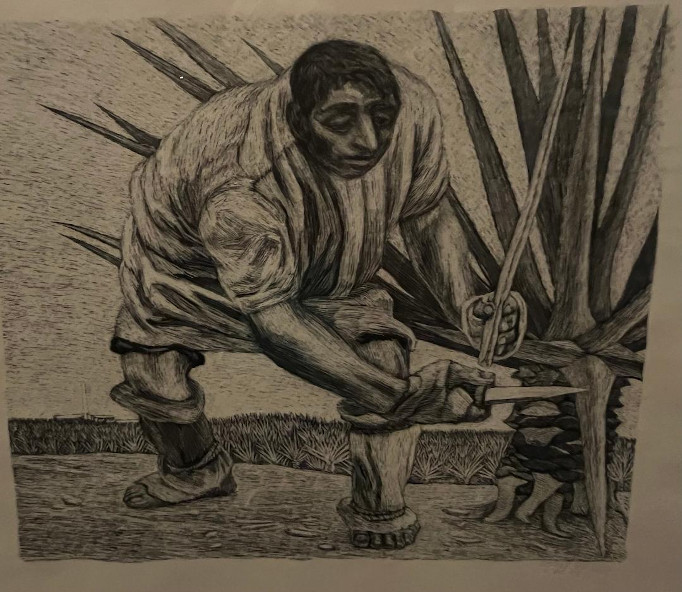
A delightful respite from the brilliant grotesqueries of the period can be seen in Carlos Merida’s A man from Saltillo in the state of Coahuila (1945). This is one silkscreen from his portfolio of regional Mexican dress and provides a collection of patterns, which provides equal weight to its floral effusions on one half and on the other its subject proudly exhibiting a formal caballero costume. Another postwar example of lithographic art that depicts the simple labors of Yucatecans can be found in Alfredo Zalce’s prints. The artist would scrape ink off a blackened lithographic stone to reveal the light areas of his subject.
An important takeaway from this exhibit is the undeniable power of the print to communicate to its populace. Whether its intent was commercial or propagandistic, Mexico’s artistic heritage in printmaking can still stand as an inspiration for artists who feel the mandate for change in the challenges and uncertainties of their times.
Author Bio:
Sandra Bertrand is Highbrow Magazine’s chief art critic.
For Highbrow Magazine