

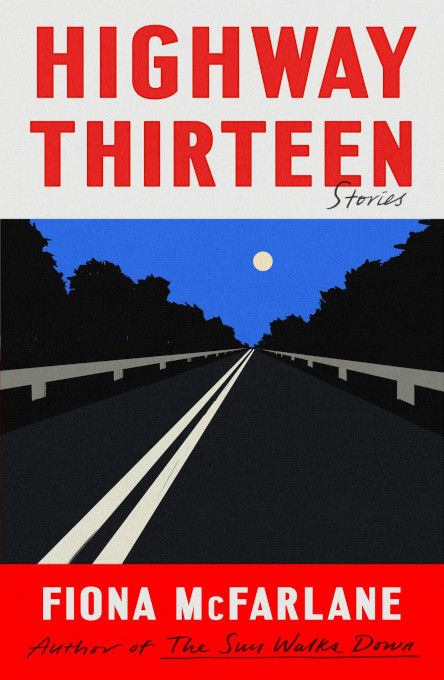
Highway Thirteen
By Fiona McFarlane
Farrar Straus Giroux
258 pages
In Highway Thirteen, Fiona McFarlane’s new collection of linked stories, the crimes of a serial killer, widely known throughout Australia, haunt the populace many years after the fact.
The fictional killer, an itinerant taxi driver named Paul Biga, is arrested and convicted of committing 12 murders in and around the Barrow State Forest region between 1990 and 1997. The stories in Highway Thirteen flit in and out of that timeframe (some occurring earlier, some as far into the future as 2028), and focus not on the murderer himself, but on men and women at some distance removed, who are nonetheless affected by his monstrous crimes.
The small town of Barrow is the setting for the first story, “Tourists.” Joe and his co-worker Lena enter the nearby forest, 10 years after the discovery of the victims’ bodies. Only Lena is interested in going into the forest and seeing where the bodies were found, and Joe reluctantly follows:
“It occurred to him, walking behind her, that when the killer was here with the woman Lena had been looking for, he would have made her walk ahead of him. The killer behind and the woman ahead. To keep her in his sight. And he’d have been saying something like Just walk, do what I say, go left now, hurry up, just walk. Maybe kicking at her if she stumbled or fell.”
It’s an effective way to instill a sense of dread, building at times to outright terror, that lingers throughout Highway Thirteen.
McFarlane’s novel, The Sun Walks Down, centered around a missing child in the Australian outback, c. 1883, and was among the best works of fiction in 2023. Her new book amply displays her deep skills at setting and pacing, plot and character development, and other building-blocks of fiction.
The story “Hunter on the Highway” takes place during the time of the actual murders. A young woman named May comes to believe that her live-in boyfriend Darcy might be the killer—and does a good job of persuading the reader as well. Watching the evening news, she hears a description of the suspect based on evidence supplied by a young woman who got away:
“… and the man was white and tall and thin, tanned skin, brown shoulder-length hair, blue eyes, in his late twenties to mid-thirties, wearing jeans and a dark blue work shirt, driving a white ute [van], with dirt under his fingernails …”
Darcy is tall, thin, with brown hair tied in a ponytail and dirt under his fingernails. May tails him as he goes about the day in his white ute, and enough red flags pop up to prolong her suspicions almost to the breaking point.
In “Demolition,” a woman named Eva who lives next door to the convicted murderer’s house, is visited five years later by a true-crime author, Kate. The author has come back for the demolition of the house and to not-so-gently prod Eva into reliving the terrible past. Eva, confined to a wheelchair and refusing to look out the window at the ongoing destruction, engages in a strange pas de deux with Kate, dodging questions about having known Biga while ruminating to herself about her own dark secret:

“At the end of that summer when he’d come to the garden every day, Paul had written Eva a letter on those thin sheets of paper … The things he said he’d planned for the two of them: a farm, and horses, an aviary, of course, and because he knew she loved the maple tree in his front garden, he would dig it up to bring with them …”
It’s the ripple effect of the serial murders that interests the author. And while these linked stories might lack the narrative sweep of The Sun Walks Down, her flair for originality and her beautiful prose make Highway Thirteen a worthy successor. By the end of the book, readers might agree with the narrator of the story “Hostel,” who craves to hear (one more time) about the ordeal of Biga’s victims:
“It felt as though this might be my last chance to get close to the largeness of life, its terror and mystery, while remaining perfectly safe.”
But, as Fiona McFarlane so dramatically demonstrates, how safe are we, really?
Author Bio:
Lee Polevoi, Highbrow Magazine’s chief book critic, is the author of The Confessions of Gabriel Ash, a novel.
For Highbrow Magazine